

Greenland Energy Company has raised approximately $70 million from public investors to pursue an oil project that, as of June 30, 2026, had no proved reserves, no production, and no oil and gas revenue. The company entered 2026 with only $231,058 of cash at its accounting predecessor, then completed its SPAC merger in March, raised $70 million through an April stock and warrant offering, and by June 30 had already consumed approximately $28.0 million through exploration-related investing activities, with nothing yet to show for.
The company’s public narrative rests heavily on an independently prepared estimate of up to approximately 13.0 billion barrels of gross 3U prospective recoverable oil, but its own prospectus explains exactly what that number means: it relates to undiscovered accumulations, assumes every horizon across 58 identified prospects is productive, and is explicitly not proved or probable reserves under SEC rules. As of June 30, the company still had no proved reserves and had not commenced production, which leaves the marketable number measured in billions while the number actually produced remains Zero.
The timetable behind the story has meanwhile moved materially; under the original Farm Out Agreement, GLND’s rights to earn up to a 70% working interest in the Jameson Land license position depend on drilling two wells for its joint-venture partner, 80 Mile plc, a UK company listed on London’s AIM market that led the Greenlandic permitting process on the ground. The agreement required the first well by December 31, 2026, and the second by December 31, 2027. However, on September 24, 2026, Greenland Energy disclosed that it had pushed both deadlines to December 31, 2028.
Greenland Energy also issued 1,250,000 pre-funded warrants, priced to convert into common stock for a nominal rather than a material exercise cost; on April 30, 2026, Citadel Multi-Strategy Equities Master Fund Ltd. exercised all 1,250,000 of them on a cashless basis, receiving 1,249,962 shares of common stock, and the company did not receive material cash proceeds from the exercise. Citadel did not stay long; by the quarter end covered in its most recent Form 13F, Citadel Advisors LLC reported holding just 41,888 GLND common shares, a reduction of more than 96% from the block it had converted five months earlier, and evidence of a position that was built to be exited, not held. What Citadel kept instead were 2,659,781 warrants, so on paper, Citadel still looks like a meaningful 5.8% owner of this company. But a warrant isn’t stock; it doesn’t vote, it doesn’t get a say in how the company is run, it’s just a ticket that lets you buy shares later if you want to, and just as easily, a ticket you can sell to someone else without ever touching the actual company at all.
The reliability of the numbers behind all of this is itself an open question. GLND dismissed Fruci & Associates as its auditor at the close of the SPAC combination, the same firm that had just issued going-concern language for March GL, the pre-merger entity, citing net losses, no revenue, and development-stage status, and appointed MaloneBailey LLP in its place. MaloneBailey’s own record does not resolve that question in the company’s favor, On May 21, 2024, the PCAOB censured the firm and fined it $400,000 for “pervasive quality control violations” built on three separate inspections, in 2018, 2019, and 2021, that repeatedly found significant deficiencies in testing revenue and in auditing accounting estimates, the exact category of work an exploration-stage company with $17.51 million in capitalized, unevaluated oil-and-gas property and zero producing assets depends on most.
Fugazi Research considers GLND stock uninvestable at any price above zero.
Fugazi Research Analysis
Greenland Energy is an exploration-stage company that, as of June 30, 2026, had no proved oil or natural-gas reserves, no production, and no oil-and-gas production revenue. Its principal headline resource figure (approximately 13 billion gross barrels) is a 3U prospective resource estimate relating to undiscovered accumulations, not proved reserves. The high-end geological model includes 13 billion barrels; no producing well has demonstrated this.
On September 24, 2026, GLND moved the contractual deadline for the first well from December 31, 2026 to December 31, 2028, and the second well from December 31, 2027 to December 31, 2028. It also agreed to pay £500,000 and assume, at its own cost, responsibility for drilling permits, environmental and social permits, licenses, access rights, and governmental approvals; the company did not merely announce that drilling might take longer; it paid cash to rewrite the contract so that it legally can.
Greenland Exploration and March GL both received audit reports containing going concern emphasis language before the business combination. Fruci & Associates specifically cited net losses, the absence of revenue, and March GL’s development-stage status as conditions raising substantial doubt about its ability to continue as a going concern. Fruci was then dismissed when the SPAC combination closed, and MaloneBailey LLP was appointed.
MaloneBailey LLP, the new auditor GLND appointed in Fruci’s place, was censured by the PCAOB on May 21, 2024, and fined $400,000 for “pervasive quality control violations” a settled order built on three separate PCAOB inspections in 2018, 2019, and 2021, that repeatedly identified significant deficiencies in the same two areas: testing revenue and auditing accounting estimates, including fair value measurements. The PCAOB found the firm was on notice each time and failed to make effective changes to its quality-control system.
The predecessor entered December 31, 2025 with $231,058 of cash. By June 30, 2026, following the SPAC and approximately $70 million public offering, GLND held $37.4 million of cash but had already used approximately $28.0 million in investing cash flow, consisting principally of $17.5 million added to unevaluated oil and gas properties and $10.5 million of prepaid exploration costs and deposits; of the balance sheet, zero was raised by oil-related business.
The 19 million outstanding warrants, 17.5 million at $5.00 and 1.5 million at $15.00, a weighted-average exercise price of $5.79, carry no call or mandatory redemption right for the company under any circumstance during their five-year term. The company’s only contractual lever is the right to voluntarily lower the exercise price to induce conversion, a tool that transfers value to warrant holders rather than one that lets the company compel them to pay in.
Of the securities issued in the April offering, 1,250,000 were structured as pre-funded warrants, convertible for a nominal rather than material exercise cost. Citadel Multi Strategy Equities Master Fund Ltd. exercised all 1,250,000 on a cashless basis on April 30, 2026, receiving 1,249,962 common shares, with the company receiving no material cash proceeds from the exercise. Five months later, the filing revealed that of the conversion, Citadel had exited 96% of the whole converted position.
Greenland Exploration signed Rubenstein Public Relations to perform public-relations and social media services beginning September 9, 2025. The agreement called for $10,000 per month initially, $50,000 cash and 10,000 GLND shares described as worth $100,000 at closing, plus a discretionary second 10,000-share award based on the “success of the initial campaign.” It subsequently moved to $15,000 per month for PR plus $5,000 per month for social media.
GLND seated Carol Craig on its Board as a Class I director on June 5, 2026, and placed her on the Audit Committee, the committee responsible for the reliability of the very financial reporting that this report questions. Craig is the founder, CEO and Chair of Sidus Space, a company this publication covered on January 26, 2026, more than four months before her appointment. That coverage documented related-party revenue flowing to a private company she owns and an ineffective internal controls certification.
Citadel-related reporting persons reported beneficial ownership of 4,307,948 GLND shares, or 9.3%, in a Schedule 13G filed May 6, 2026. The amended Schedule 13G filed August 14, 2026 reported 2,713,536 shares, or 5.8%, a decline of approximately 1.59 million shares, or 37%, in reported beneficial ownership. The filing itself breaks down as 41,888 common shares and 2,659,781 shares issuable upon conversion of warrants, the same 41,888-share position later reported on Citadel Advisors LLC’s Form 13F for the subsequent quarter.
Source: Greenland Energy Company, Form 10-Q for the quarter ended June 30, 2026,
Source: Fugazi Research, “The Black Hole at $SIDU: Where Massive Amounts of Capital Get Sucked Into the Void,” January 26, 2026.
Source: Greenland Energy Company, Form 8-K, filed September 24, 2026.
Source: Greenland Energy Company, Form 424B4, April 2026.
Source: Pelican Acquisition Corporation, 10-K, 2025
Source: Citadel Advisors et al., Schedule 13G filed May 6, 2026 and Schedule 13G/A filed August 14, 2026.
Financial Summary
Management itself concluded its disclosure controls and internal controls over financial reporting were ineffective as of June 30, 2026, citing the company’s lack of a “fully formalized and documented internal control framework,” including formal documentation of key controls and review evidence. This is not a third party’s assessment; it is the CEO and CFO’s own signed conclusion, filed the same quarter the company raised $70 million and began spending it.
Cash and cash equivalents increased from $231,058 at December 31, 2025 to $37.42 million at June 30, 2026, entirely from approximately $70 million of gross proceeds raised in the April offering. Strip out the financing, and the underlying company is still the same $231,058 cash shell it was at year-end.
Of the $70 million raised, the company disclosed paying approximately $11.3 million in aggregate transaction costs during the six-month period, covering both the SPAC business combination and the April offering. That’s more than 16% of everything the company has ever raised, gone to fees and advisory costs before a dollar reached the ground in Greenland.
Net loss for the six months ended June 30, 2026 was $5.74 million against approximately $445,000 in the comparable predecessor period, nearly a thirteen-fold increase. Net cash used in operating activities was $4.60 million, before a single well has been drilled.
The company issued 85,000 shares to third-party vendors “in consideration for services rendered” during the quarter (10,000 shares valued at $100,000 and 75,000 shares valued at $217,500), both recognized as noncash operating expenses. GLND is paying its vendors in stock it can print at will rather than cash it doesn’t have.
Investing cash use for the six months ended June 30, 2026 totaled $28.02 million, including approximately $17.51 million of additions to oil and natural-gas properties and approximately $10.49 million of prepaid exploration costs and deposits, money already spent, against a project whose first well was, months later, pushed back two full years.
Combining operating and investing cash use, GLND burned through roughly $32.6 million in six months, a pace that would exhaust its entire $37.42 million cash balance in under seven months from the June 30 reporting date, before drilling anything or generating a dollar of revenue.
At June 30, GLND had capitalized $17.51 million of unevaluated oil and gas property costs while carrying zero proved reserves and zero production. Nearly a quarter of everything this company has ever raised now sits on the balance sheet as an asset whose value depends entirely on a well that isn’t scheduled to happen for another two years.
At June 30, 2026, 43,730,194 common shares were outstanding versus 26,155,232 shares as of April 29, 2026, a nearly 70% increase in two months. Anyone holding GLND stock at their initial offering saw their proportional ownership cut almost in half before the company drilled anything.
Another 20.815 million potential common shares existed through 19.0 million warrants, 1.6 million stock options, and 215,000 RSUs, nearly one additional share already reserved for every two currently outstanding, all of it capable of hitting the market before a single well is spudded.
Separately, the April offering also issued 1,250,000 pre-funded warrants carrying a nominal, non-material exercise cost. Citadel Multi-Strategy Equities Master Fund Ltd. converted all 1,250,000 of them on a cashless basis on April 30, 2026, receiving 1,249,962 shares while the company received nothing material in return. A large institutional holder walked away with roughly 2.9% of the company’s share count for essentially free.
Source: Greenland Energy Company, Form 10-Q for the quarter ended June 30, 2026, filed August 13, 2026.
Source: Greenland Energy Company, Form 424B4, April 2026.
13 Billion Barrels, just on paper…
Greenland Energy’s central geological headline is enormous: approximately 13.04 billion barrels of gross 3U prospective recoverable oil across its Jameson Land acreage. It is also one of the easiest numbers in the story to misunderstand. The Sproule ERCE resource estimate behind that figure contains three numbers: approximately 1.09 billion barrels at the 1U level, 4.20 billion at 2U, and 13.04 billion at the 3U high estimate. More importantly, the company’s filing states that the aggregated estimate across 58 identified prospects assumes every horizon on every prospect is productive. The 13.04 billion-barrel figure is therefore the high end of the range, not the central estimate.
None of this makes the resource estimate illegitimate, but it makes the terminology important. These are prospective resources, potential petroleum in accumulations that have not yet been discovered, meaning the estimates have not been reduced for the probability that an individual prospect actually results in a discovery, and even a discovery does not necessarily mean the hydrocarbons can be commercially recovered.
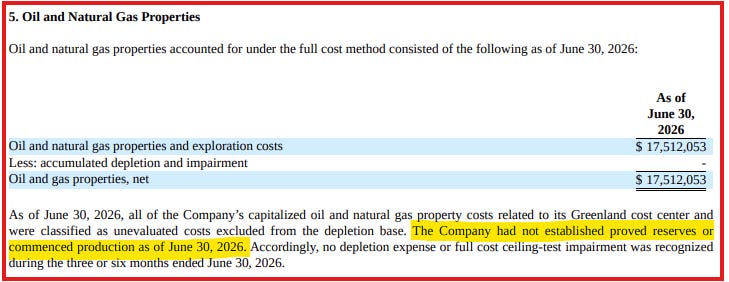
That makes 13.04 billion barrels fundamentally different from a reserve figure; GLND itself states that its prospective resources are not SEC proved reserves, that there is no certainty any portion will be discovered, and that even discovered resources may not prove economically or technically recoverable. As of the June quarter, GLND had no proved reserves and had not commenced production.
Source: Greenland Energy Company, Form 10-Q for the quarter ended June 30, 2026
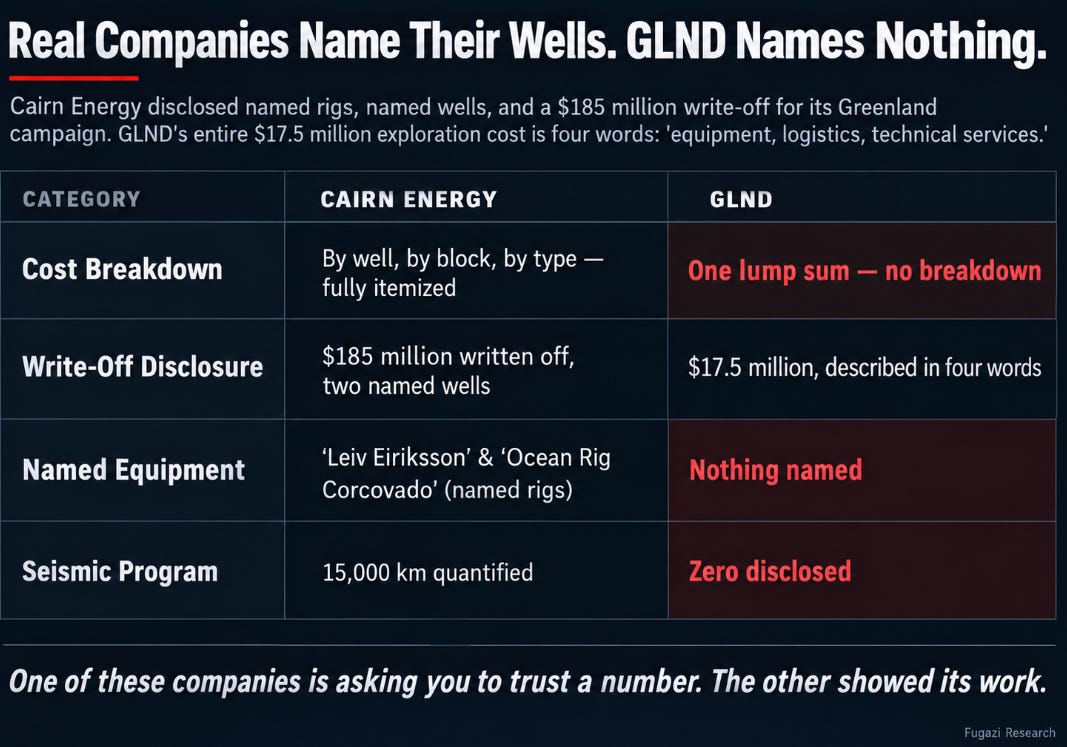
GLND’s own filing gives essentially no line-item transparency into how nearly a quarter of everything it has ever raised was actually spent; the entire $17.5 million capitalized oil and gas property balance is described with a single four-word category list (”equipment, logistics, technical services and other exploration-related expenditures”) and no dollar breakdown of how much sits in each.
There is an even more basic problem: despite decades of evaluation, the company’s filing acknowledges that it has drilled no exploration wells and made no commercial oil discovery in the Jameson Land Basin.
The 2026 Well That Became a 2028 Well
The April prospectus estimated approximately $40 million to drill and test OPW-1, the first required earn-in well, and another $20 million for OPW-6. As recently as May 18, 2026, Greenland Energy described the program as “Fully Funded,” citing roughly $80 million raised over the prior twelve months and targeting OPW-1 for the fourth quarter of 2026 and OPW-6 for the first quarter of 2027.
On August 11, however, Greenland Energy disclosed that its permitting partner said the project’s complexity would require a more extensive review than anticipated. The parties were now working toward a permit timeline of winter 2027, already beyond the drilling schedule presented to investors three months earlier.
Then, on September 24, GLND formally rewrote the timetable:
An amendment with 80 Mile extended the OPW-1 longstop from December 31, 2026 to December 31, 2028. The OPW-6 deadline moved from December 31, 2027 to the same date. GLND also agreed to pay 80 Mile £500,000 and, at its own expense, assume responsibility for obtaining and maintaining the drilling permits, access rights, and environmental and social approvals associated with the Jameson projects.
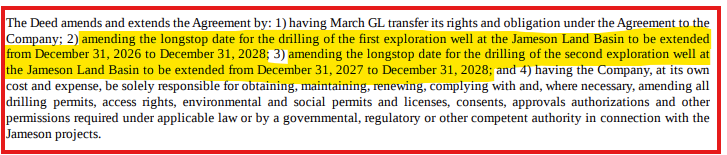
The extension mattered because these were not aspirational drilling targets. Under the farm-out agreement, failure to satisfy the drilling milestones could jeopardize GLND’s right to earn its working interest in the Jameson license position; there was another wrinkle. Sixteen days before the amendment, Greenland Energy and 80 Mile had announced agreed indicative terms for GLND to acquire 80 Mile in an all-share transaction valuing its issued share capital at approximately £61.48 million, a nearly 43% premium to 80 Mile’s pre-announcement share price. That puts the £500,000 extension payment in an unusual context: GLND was paying its farm-out counterparty to extend a critical drilling deadline while simultaneously pursuing an acquisition of that same counterparty.
The sequence is straightforward: GLND raised $70 million in April; in May, it told investors the two-well program was fully funded and targeted the first well for Q4. By August, permitting had slipped, and in September, GLND paid £500,000 to amend the farm-out agreement and move the first well deadline from 2026 to 2028.
The Auditor Behind the Numbers
GLND dismissed Fruci & Associates at the close of the SPAC combination and appointed MaloneBailey LLP as its independent auditor. The company disclosed no disagreements with Fruci on accounting principles, financial-statement disclosure, auditing scope or procedures, and no reportable events. However, there is relevant context. Before its dismissal, Fruci had issued going-concern language for March GL, the pre-merger entity, citing recurring net losses, the absence of revenue, and its development-stage status as conditions raising substantial doubt about its ability to continue as a going concern.
The record of GLND’s successor auditor is also worth examining. On May 21, 2024, the PCAOB censured MaloneBailey and imposed a $400,000 civil penalty for what the regulator called “pervasive quality control violations.” The order followed deficiencies identified during PCAOB inspections in 2018, 2019, and 2021. According to the PCAOB, MaloneBailey repeatedly received notice of significant deficiencies involving testing revenue and auditing accounting estimates, including fair value measurements, but failed to make effective changes to its quality-control system.
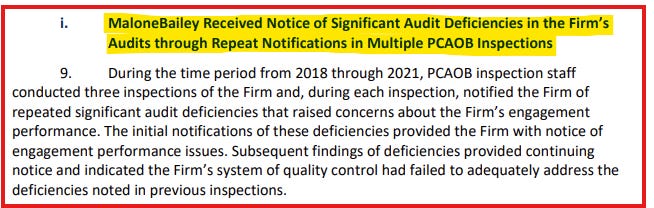
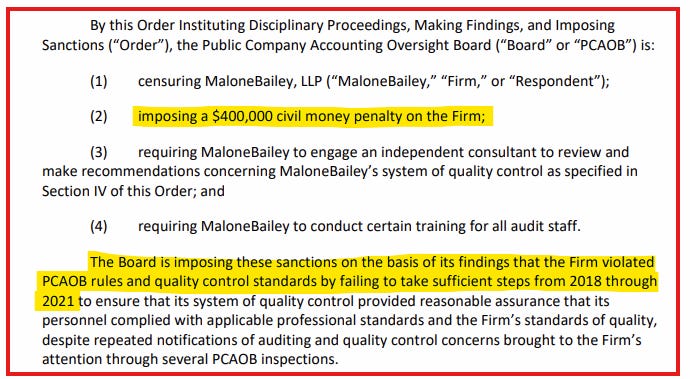
MaloneBailey neither admitted nor denied the findings. As part of the settlement, the firm agreed to retain an independent consultant to review and recommend changes to its quality-control policies and procedures and to provide additional training to its audit personnel. The PCAOB action concerned MaloneBailey’s firmwide quality-control system, not its audit of Greenland Energy, and the regulatory history alone does not establish that MaloneBailey is a “worse” auditor than Fruci.
It does, however, make one part of GLND’s balance sheet particularly relevant. As of June 30, 2026, the company had capitalized approximately $17.51 million in unevaluated oil-and-gas property costs while reporting no proved reserves and no production. Accounting estimates were one of the areas the PCAOB specifically identified in its findings concerning MaloneBailey.
For GLND shareholders, that is the issue worth watching. The company replaced an auditor that had issued going-concern language with a firm carrying a recent PCAOB sanction for deficiencies that included auditing accounting estimates, at a company whose balance sheet now contains millions of dollars in capitalized costs tied to an exploration program that has yet to establish proved reserves.
A Familiar Face on the Audit Committee
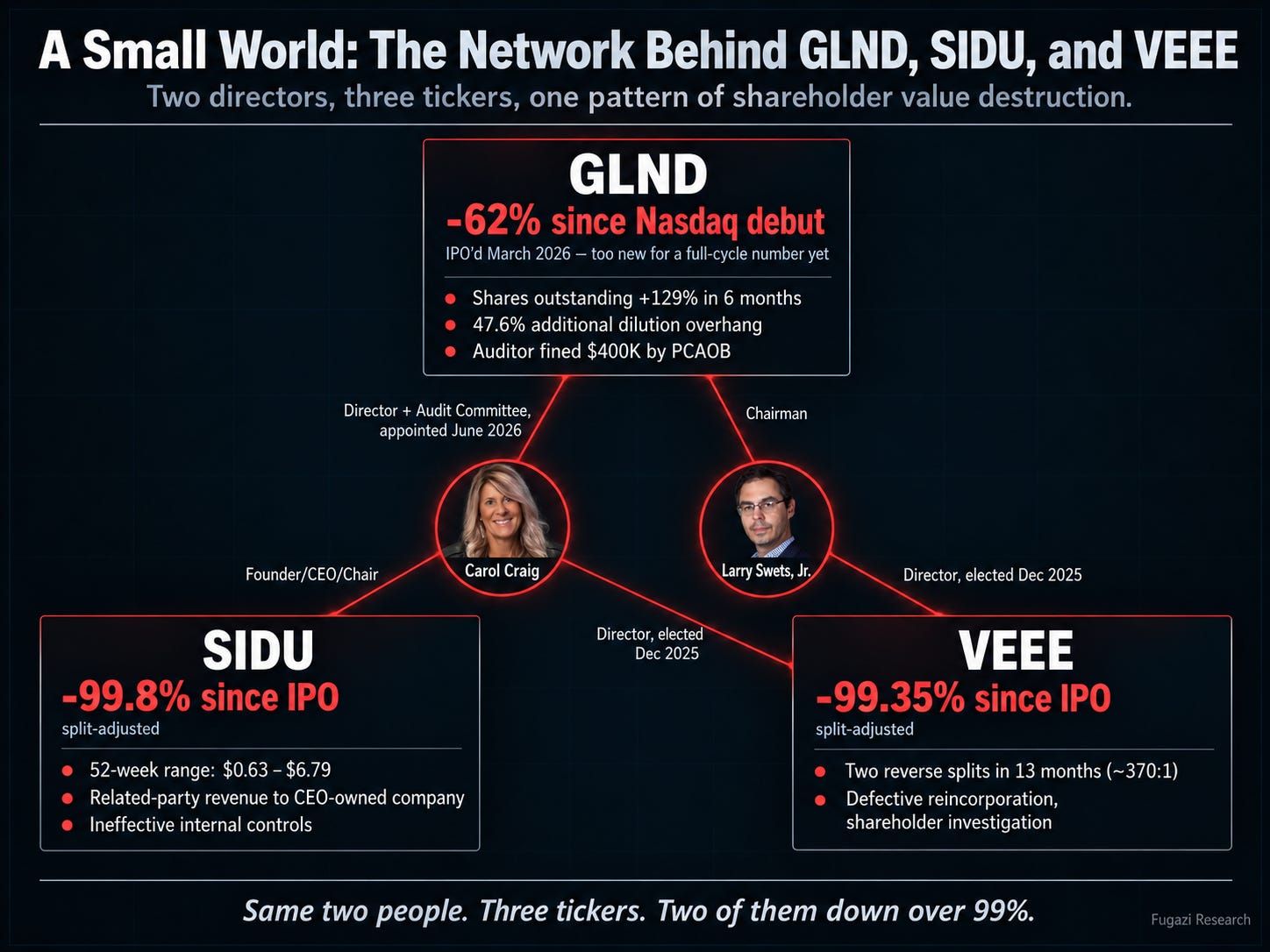
On June 5, 2026, GLND appointed Carol Craig to its Board of Directors as a Class I director and seated her on the Audit Committee (the committee tasked with overseeing the reliability of the company’s financial reporting), the same reporting this report has already found reason to question. Craig is the founder, CEO, and Chair of Sidus Space, Inc.; this publication had already covered her company more than four months earlier, in a January 26, 2026 report documenting related-party revenue concentration flowing to a private company Craig herself owns and controls, alongside an ineffective internal controls certification of Sidus’s own.

Craig’s own governance record includes an ineffective internal controls certification at Sidus Space and a board seat at Twin Vee PowerCats, discussed below, that sits atop a defective Nevada reincorporation and an invalidated reverse stock split. “Building and scaling innovative technology companies, from founding Craig Technologies to taking Sidus Space public on the Nasdaq” cites two real, verifiable events, but “scaling” implies growth, and Sidus Space has traded down approximately 99.8% since that Nasdaq listing on a split-adjusted basis. There is a sharper problem folded into the same clause: Craig Technologies is the same private company, owned and controlled by Craig herself, that this publication’s January 2026 report identified as the recipient of related-party revenue concentration flowing out of the public company she runs, meaning Swets is citing, as a qualification, the existence of the exact related-party relationship that is itself part of the governance concern.
Six months before the GLND appointment, on December 4, 2025, Craig and GLND’s own Chairman, Larry Swets, Jr., were elected together as Class I directors of Twin Vee PowerCats Co. (NASDAQ: VEEE) at the same annual meeting, for three-year terms running to 2028.
The board the two of them share is itself instructive: Twin Vee executed a 10-to-1 reverse stock split in April 2025, reducing its share count from roughly 14.9 million shares to 1.5 million, and then, over the following year, diluted that count back up to approximately 19.6 million through a series of public and ATM offerings, before executing a second reverse split, this one 37-to-1, in May 2026. The two splits compound to a cumulative ratio of roughly 370 to 1 in barely more than a year, with a full dilution cycle sandwiched in between. However, it gets worse: Twin Vee’s own August 2026 proxy statement disclosed that its Nevada reincorporation had been executed defectively, rendering the reverse split itself legally invalid, and required a special shareholder meeting solely to ratify it after the fact, warning shareholders that failure to do so could expose the company to legal claims and “potentially lead to bankruptcy.”
The newest member of GLND’s Audit Committee arrived not through arm’s-length recruitment of the most brilliant and overperforming executives, but from Swets’s own board at a company that was, at the very moment he brought her over, working through a defective reverse stock split, a share count compounding by 370 to 1, and a shareholder fairness investigation of its own, and that comparison doesn’t even reach for Craig’s own company. Sidus Space, the company she founded, runs, and chairs, is down approximately 99.8% since its IPO on a split-adjusted basis. Between the two boards she sits on alongside Swets, the combined track record is not a coincidence, but a pattern of pure shareholder destruction.
Source: Greenland Energy Company, Form 8-K / press release, “Greenland Energy Company Announces Addition of Carol Craig to Board of Directors,” June 11, 2026.
Source: Fugazi Research, “The Black Hole at $SIDU: Where Massive Amounts of Capital Get Sucked Into the Void,” January 26, 2026.
Source: Twin Vee PowerCats Co., Form 8-K, filed in connection with the December 4, 2025 Annual Meeting of Stockholders.
Source: Twin Vee PowerCats Co., press release, “Twin Vee PowerCats Co. Announces Reverse Stock Split to Regain Compliance with Nasdaq’s Bid Price Requirement,” April 30, 2026.
Citadel: In for Cheap, Out Almost Entirely
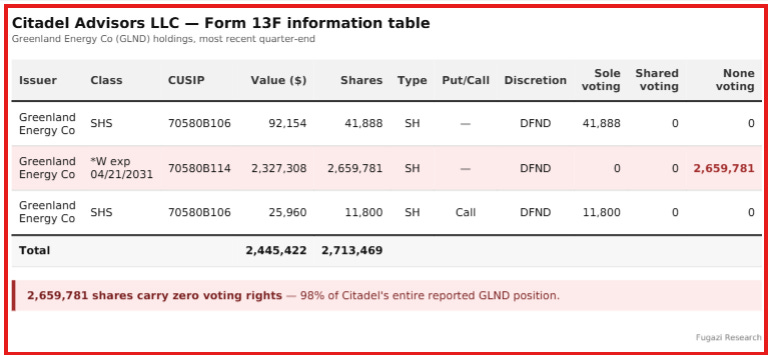
Citadel Multi-Strategy Equities Master Fund Ltd. did not buy into GLND’s April offering the way most participants did. It came in through 1,250,000 pre-funded warrants, an instrument priced at a nominal, non-material exercise cost specifically so a holder can take a position without immediately crossing an ownership-disclosure threshold. On April 30, 2026, one day after the offering closed, Citadel exercised all 1,250,000 of them on a cashless basis and received 1,249,962 shares of common stock. The company received no material cash proceeds from the exercise. Citadel walked away with roughly 2.9% of the company’s entire share count for what amounted to a rounding-error consideration. By the quarter-end covered in Citadel Advisors LLC’s most recent Form 13F, the position had fallen to just 41,888 common shares, down more than 96% from the block it had converted. Whatever Citadel wanted from this stock, it wasn’t a shareholder’s seat at the table for the long haul.
Source: Citadel Advisors LLC, Form 13F Information Table, filed September 2, 2026
What it kept instead is where the story gets interesting, and it’s now fully confirmed against the primary filing rather than inferred across documents. Citadel’s Schedule 13G/A, filed August 14, 2026, reports Citadel Advisors LLC, Citadel Advisors Holdings LP, and Citadel GP LLC each deemed to beneficially own 2,701,669 shares, and the filing’s own footnote does the arithmetic for us: that figure is 41,888 actual common shares plus 2,659,781 shares issuable upon conversion of warrants. Add Citadel Securities LLC’s separate 11,867-share market-making position, and the totals reconcile exactly to the 2,713,536 shares reported as Kenneth Griffin’s aggregate beneficial ownership, down to the last share, with nothing left to reconcile or infer.
The mechanics matter because they shape what a passing reader believes. SEC rules permit a holder to count warrants exercisable within a defined window as “beneficially owned” shares, which is why Citadel’s ownership filing still shows a 5.8% stake, a number that reads, at a glance, like sustained institutional conviction in the company. It is not. Of that 5.8%, less than a tenth of one percentage point is actual common stock. The rest is a warrant position: no vote, no dividend, no claim on the company as a going concern, and a freely tradable instrument Citadel can sell into the market at any liquid moment without ever again appearing as an owner of the underlying stock. Citadel converted a position it received for almost nothing, sold down more than 96% of the resulting shares, and kept the optionality. That is not a fund holding a stake in Greenland Energy’s future; it is a fund that took its profit and kept a free option on the rest.
Promote, Raise, Register, Repeat
Before GLND traded publicly, Greenland Exploration had already hired professional assistance to make sure people heard about it. The September 9, 2025 agreement with Rubenstein Public Relations explicitly covered public relations and social media services. For the initial September-through-December period, Greenland Exploration agreed to pay $10,000 per month. At closing, it agreed to an additional $50,000 cash plus 10,000 GLND shares, described in the contract as valued at $100,000.
The contract provided for an additional 10,000-share discretionary bonus based upon “the success of the initial campaign.” After December 10, compensation stepped up to $15,000 per month for ongoing public relations and another $5,000 per month for social-media services. The 10,000 shares issued to Rubenstein were subsequently included in GLND’s resale registration.
That sequence is more useful than attempting to label individual articles as “stock promotion.” The issuer’s SEC-filed contract already states the relationship, the services purchased, the amount paid, how equity was used as compensation, and how a bonus could be tied to campaign success. A broader media layer also warrants further work. An April 29 company announcement stated that Greenland Energy had been placed in editorial content distributed through EnergyWireNews, part of InvestorBrandNetwork’s network of financial-media brands.
The political/geopolitical layer should also be handled carefully. Recent Financial Times reporting states that Executive Chairman Larry Swets advanced a 36-page “sealskin diplomacy” proposal aimed at changing U.S. treatment of Greenlandic sealskin imports and strengthening U.S.-Greenland relations; the FT characterizes the company as Trump-aligned.
A Series of Dubious Partners to Promote On X
Birds of a feather truly flock together. Mario Nawfal, a baby-faced Lebanese-Australian influencer who has previously been investigated by the New York Times has recently been promoting GLND on X with an undisclosed compensation, which may include shares of stock and or cash. He was accused by both former colleagues and critics of using bots to artificially elevate engagement on his X account, which led to ripping off investors with sketchy sales tactics. He also has been accused of uncomfortably close relationships with Russia and for spreading misinformation throughout the web.
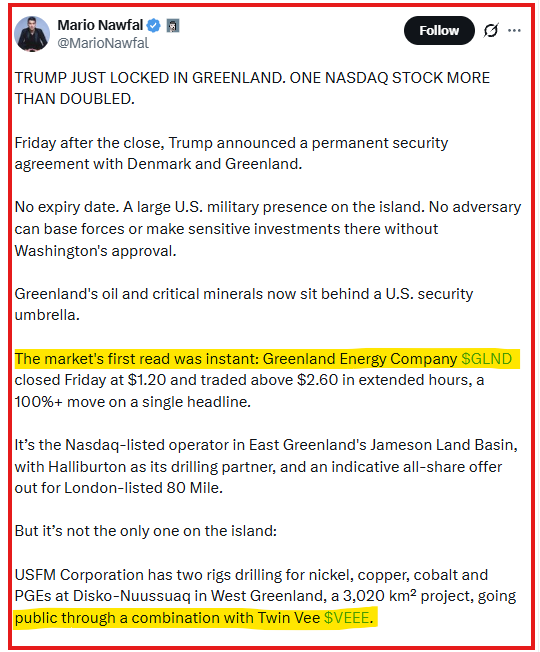
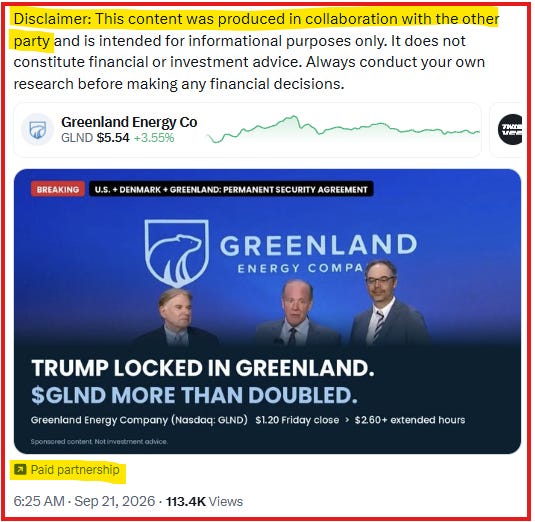
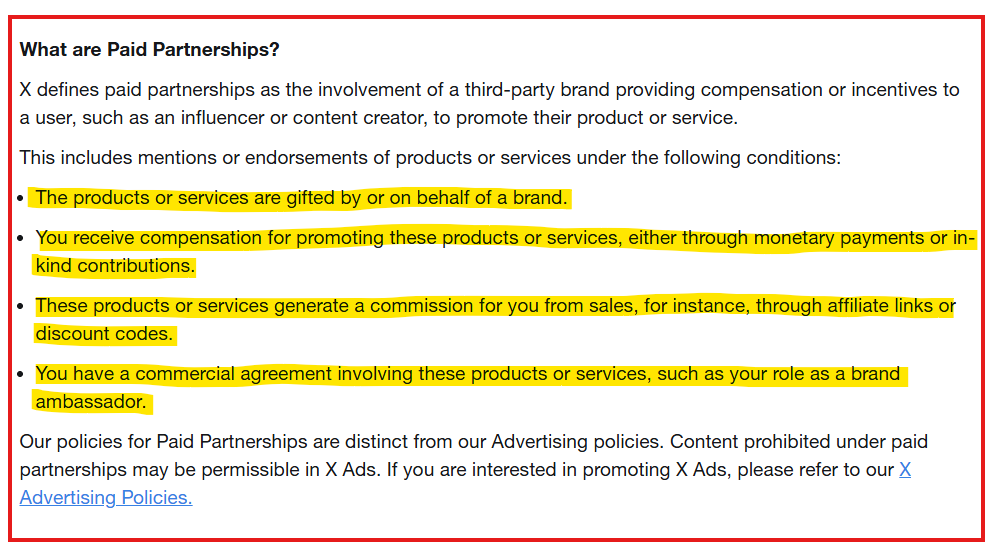
The paid layer also reached social media, at 6:25 a.m. on Monday, September 21, before the market opened, a post from the X account of Mario Nawfal headlined “TRUMP LOCKED IN GREENLAND. $GLND MORE THAN DOUBLED” went out carrying X’s “Paid partnership” label, an image marked “Sponsored content,” a disclaimer stating it was “produced in collaboration with the other party,” and a tag of the account @GL_Energy_Co, closing with “The story is just starting.” Neither the post nor its disclaimer says who paid or how much.
Conclusion
Greenland Energy is asking the public market to value geological possibility years before geological proof. The company references up to 13 billion barrels of gross prospective recoverable resources; its own SEC filing simultaneously tells investors that those resources concern undiscovered accumulations, are not proved reserves, assume every horizon across all 58 prospects is productive in the aggregated high case, and may never be discovered or economically recovered. To find out which version of the geology is real, GLND needs to drill.
The first two wells are estimated to cost approximately $60 million. The company raised $70 million in April, spent about $28 million on exploration-related investing activities in the first six months of 2026, and then amended its agreement in September so the first required well can now be delayed until December 2028. Meanwhile, the capital structure contains another 20.815 million potentially dilutive securities against 43.73 million common shares outstanding. This is the mechanical problem with frontier exploration financed through public equity. The geological question may take years to answer. Payroll, consultants, public-company expenses, equipment, permits and drilling contractors require cash today. When the answer takes longer than the capital lasts, shareholders finance the gap.
GLND began as a SPAC whose sponsor bought millions of founder shares for $25,000, entered Nasdaq with a $215 million transaction valuation, retained a PR firm with cash-and-stock compensation, raised another $70 million while issuing 17.5 million common warrants, spent tens of millions preparing to explore, and has now pushed the contractual first-well deadline two years further into the future; the business currently produces financing events considerably more reliably than it produces oil.
In Fugazi Research’s opinion, GLND common equity represents a speculative residual claim on an undrilled frontier exploration program whose prospective-resource narrative remains unverified by a single producing well. The combination of substantial remaining exploration expenditures, an extended drilling timeline, and an already significant dilution stack leaves public shareholders financing the interval between a 13-billion-barrel headline and geological proof that may never arrive. Fugazi Research considers GLND uninvestable at any price above zero.
Disclaimer
The research, commentary, reports, and other materials published by Fugazi Research LLC (“Fugazi Research,” “we,” “us,” or “our,”) are provided solely for informational and educational purposes. Fugazi Research is an independent research publisher and is not registered as an investment adviser, broker-dealer, or commodity trading advisor with the U.S. Securities and Exchange Commission or any other regulatory authority. All content published by Fugazi Research represents our opinions as of the date of publication and is based on publicly available information, independent research, interviews, and analytical judgment. Our opinions are inherently subjective, may be incomplete, and are subject to change at any time without notice. We do not undertake any obligation to update or revise our content to reflect subsequent events, market developments, or new information.
Nothing published by Fugazi Research constitutes investment advice, financial advice, legal advice, tax advice, or a recommendation to buy, sell, or hold any security or financial instrument. The information should not be construed as tailored to the investment objectives, financial situation, or particular needs of any individual or entity. Readers should conduct their own independent research and consult their own financial, legal, and tax advisors before making any investment decision.
Fugazi Research, its affiliates, principals, members, employees, consultants, or clients may have positions-long, short, or otherwise-in the securities discussed, and such positions may change at any time for any reason, including risk management, market conditions, or liquidity considerations. We may trade in securities covered by our research before, during, or after publication, and we may reduce, close, or reverse positions at any time without notice. Readers should assume that Fugazi Research has a financial interest in the securities discussed.
Our research may include forward-looking statements, estimates, projections, or opinions that involve known and unknown risks, uncertainties, and assumptions. Actual outcomes may differ materially from those expressed or implied. Past performance is not indicative of future results. All investments involve risk, including the potential loss of principal.
While we believe the information we present is accurate and reliable, it is provided “as is” and “as available,” without any representation or warranty, express or implied, as to accuracy, completeness, timeliness, or fitness for any particular purpose. Fugazi Research disclaims any liability for errors, omissions, or losses arising from the use of our content.
By accessing or using Fugazi Research’s materials, you acknowledge and agree that Fugazi Research shall not be liable for any direct, indirect, incidental, consequential, or other losses arising from reliance on our research or opinions. Use of our content is entirely at your own risk.
All content is the intellectual property of Fugazi Research and may not be reproduced, distributed, or shared without prior written consent.