

Executive Summary
Cypherpunk Technologies (NASDAQ: CYPH), the former Leap Therapeutics (NASDAQ: LPTX), is a failed biotech that answered its own failure by changing the ticker and the story. After more than a decade of oncology development with not a single FDA-approved drug to show for it, the company carried a $500.33 million accumulated deficit at June 30, 2026, a half billion dollar monument to a project that never delivered. On June 23, 2025 the board approved a wind-down of research and a workforce cut of about 75%, and four months later the company relaunched itself as a Zcash (ZEC) treasury vehicle, as if a failed cancer program could be rebranded into a crypto strategy.
None of this happened by accident, and none of it is new, Cypherpunk is the second time in just over a year that the Winklevoss twins have taken a vehicle that needed capital, kept either the vote or the cheapest paper in the structure for themselves, sold the public a story and left shareholders to carry what remains when the story stops selling. At Gemini Space Station (NASDAQ: GEMI) the twins took the exchange public at $28 a share in September 2025 while keeping the Class B stock that, by the company’s own proxy, gives them roughly 94.5% of the votes, and the shares have plummeted more than 90% since inception. As shareholders sued the company and both brothers, alleging that the offering documents overstated a business the founders were about to pivot away from. At Cypherpunk, Winklevoss Treasury Investments led a private placement priced near $0.52 a unit and loaded it with pre-funded warrants that cost a tenth of a cent to exercise, while the public buys the same stock today at roughly five and a half times that price.
A third vehicle, a Bitcoin treasury company in Amsterdam backed by the same twins and led by the man who chairs Cypherpunk’s board, has already told the press it plans to grow through future equity issuance and convertible debt, which is the same script. Around all of it, and around the Trump-branded miner the twins also bought into, runs a brand of American patriotism and proximity to power that does the one thing no filing can, which is to make the stock easier to sell. These stocks are designed to capitalize on patriotism by using the MAGA crowd as liquidity to sell heavy dilution into. These are lawful financings and we allege no wrongdoing, but when a structure keeps producing one result for the same people and the opposite result for everyone else, we call it what it is: a pattern.
The SEC investigated Gemini, in January 2023 the commission charged Gemini and Genesis with selling unregistered securities to retail investors through the Earn program, alleging that the two raised billions of dollars in crypto assets from hundreds of thousands of customers before Genesis froze roughly $900 million belonging to 340,000 of them. Genesis settled in March 2024 with a $21 million penalty and a permanent injunction, and even that was largely symbolic because the SEC agreed not to collect a dollar of it until every other allowed claim in the bankruptcy had been paid. In January 2026, the SEC dismissed the case with prejudice, which means it can never bring those claims again, without collecting a single dollar from Gemini. The only regulator that extracted a penalty of any size from the company was the state of New York, at $37 million, and the CFTC’s $5 million is now being unwound in court. A federal enforcement action over a frozen $900 million ended without SEC penalty against the company at the center, a slap on the wrist and essentially a political donation.
CYPH being a former biotech is another red flag. The biotech-to-crypto pivot is not a new theme or scheme. Fugazi Research recently exposed the same playbook with SDEV, formerly the biotech stock NBY. These companies move from being biotechs that accomplished little to nothing into crypto-related cash grabs. The low-level crypto story is the red herring. It gives the people behind the scenes cover to unload an extreme amount of shares onto retail investors. In our October 5, 2026 report, “SDEV: A Dilution Time Bomb Wearing a Stablecoin Costume,” we laid out this scheme. Since then, SDEV’s share price has fallen about 98% in a little over a month.
The red flags keep stacking. The Winklevosses spent heavily on crypto-aligned political access and got nothing for it. In August 2025 they gave $21 million in bitcoin to a pro-crypto PAC. They also backed a Washington club partly owned by Donald Trump Jr. at a reported $500,000 membership fee and put money into American Bitcoin, the miner co-founded by Eric Trump. The result is public and ugly. American Bitcoin (NASDAQ: ABTC) is down more than 90% from its post-IPO high and needed a one-for-fifteen reverse split just to stay listed. Gemini sold its shares at $28. The stock now trades near $2, another drop of more than 90%.
Investors can buy ZEC directly and skip CYPH’s overhead, equity compensation, warrants, and related-party risk. Owning CYPH is not the same as owning Zcash. Shareholders are paying a premium for far less ZEC exposure than the price implies. What Cypherpunk is selling is the same coin stuffed inside a failed biotech, loaded with a 195-million-share warrant and RSU overhang, and held by a custodian tied to a group already under federal investigation. Fugazi Research considers CYPH uninvestable at any price above zero.
Fugazi Research Analysis
A failed biotech with $500.33 million in losses did not shut down, it just changed tickers. R&D collapsed 98%, from $10.54 million to $197,000, and the 75% workforce cut came four months before the company renamed itself Cypherpunk. A 270-patient Phase 3 still sits on paper with no funding behind it, so the cancer program survives only as a story, and the Zcash treasury is what pays for it.
Nearly the entire asset base is a claim, not a coin. At December 31, 2025 the related-party digital-assets receivable was approximately 90% of total assets. Cypherpunk does not directly control the tokens; it holds a contractual right against Gemini consisting of a host receivable plus an embedded derivative, with no FDIC or SIPC protection, and its auditor EisnerAmper identified the accounting as a Critical Audit Matter.
Gemini Earn is the precedent for what such a claim looks like under stress. Earned customers lent their crypto to Genesis, with Gemini acting as agent and deducting a fee that at times reached 4.29% of returns. When Genesis froze withdrawals in November 2022 it held about $900 million from 340,000 investors, and it filed for Chapter 11 on January 19, 2023. The structure was a claim on an intermediary’s counterparty, and investors discovered it only when the counterparty could not pay.
Customers were made whole, but not quickly and not on demand. Earn investors recovered their assets in kind roughly eighteen months after withdrawals stopped, through the Genesis bankruptcy and with support from settlements with New York authorities, including Gemini’s agreement to fund up to $50 million if needed. For a shareholder whose assets sit in a similar arrangement, the lesson is the delay and the dependence on a court process, not the final recovery figure.
Both federal cases against the custodian are now closed or unwound. Genesis consented in March 2024 to a $21 million penalty and a permanent injunction. The SEC dismissed its case against Gemini with prejudice on January 23, 2026, and on May 27, 2026 the CFTC and Gemini jointly asked a court to vacate a $5 million order, with the joint filing stating the agency should never have brought the case. The allegations against Gemini were never adjudicated, the agencies cite customer recovery and a change in enforcement policy, and we draw no inference about motive.
One investor network sits on every side of the table. WTI financed the pivot, holds board-designation rights, is affiliated with the custodian and sold the company its mining fleet for a pre-funded warrant over 43,290,042 shares in place of cash on $33.33 million of equipment. Committee approval is not a valuation, and we have found no fairness opinion or third-party appraisal in the disclosures reviewed. Kevin Zhang, Moria Mining’s contractual contact, became Head of Mining the next day.
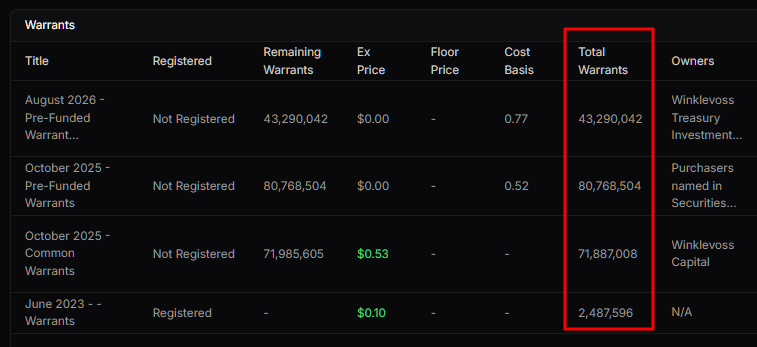
The overhang is larger than the share count, as Warrants covered 158.68 million shares, 147% of the 107.76 million common shares at June 30, before the mining warrant added 43.29 million. On our implied basis the company’s own EPS share count has grown about 6.1x in 13 months, from the roughly 41.4 million weighted shares Leap reported before the pivot.
The share count may already be higher than the filings show. WTI’s 29,793,414 common shares under a 19.99% cap imply at least about 149 million shares outstanding against 129.27 million documented. The August 26 Form 144 still cited the stale 107,764,382 figure, and we believe the gap most likely reflects ATM sales into the September rally.
Reported profit tracks the coin, not the business, as Second-quarter net income of $39.39 million rested on a $45.99 million unrealized gain against a $4.69 million operating loss, while the first half produced a $37.78 million net loss that included a net $31.56 million unrealized derivative loss.
The treasury is funded by equity, not operations. Cash fell 45.7% in six months to $7.62 million, management’s liquidity assessment leans in part on the $200 million Cantor ATM, and the company still put $5.0 million into ZODL, whose CEO advises Cypherpunk and whose round Winklevoss Capital co-invested in.
Source: Cypherpunk Technologies Inc., Form 10-K, filed March 16, 2026.
Source: The New York Times, “How the Winklevoss Twins Won Big in Trump’s Pro-Crypto Washington,” December 15, 2025.
Financial Summary
Cash declined 45.7%, from $14.04 million at December 31, 2025 to $7.62 million at June 30, 2026. Operating activities used $6.12 million, about $1.02 million per month, and management’s 12-month liquidity assessment relies in part on the $200 million Cantor ATM.
Operating and investing activities used $24.67 million in the first half: $6.12 million operating and $18.54 million investing, of which $13.54 million bought digital assets and $5.00 million went into Zcash Open Development Lab (ZODL). ZODL’s CEO advises Cypherpunk, and Winklevoss Capital co-invested in the same round.
First-half operating expenses were $9.51 million, comprising $9.15 million of G&A and $358,000 of R&D, or about $25.55 of G&A per $1 of R&D. In the second quarter R&D fell 98.1% year over year to $197,000 while G&A rose about 147% to $4.49 million.
Second-quarter net income of $39.39 million compares with a $45.99 million unrealized fair-value gain and a $4.69 million operating loss. Excluding the gain, the quarter shows a loss of about $6.60 million.
At June 30, 2026 the company reported 323,394.38 ZEC at an aggregate cost of $110.54 million, carried as a digital-assets receivable of $129.39 million held through the Gemini custody arrangement. At December 31, 2025 that receivable represented approximately 90% of total assets.
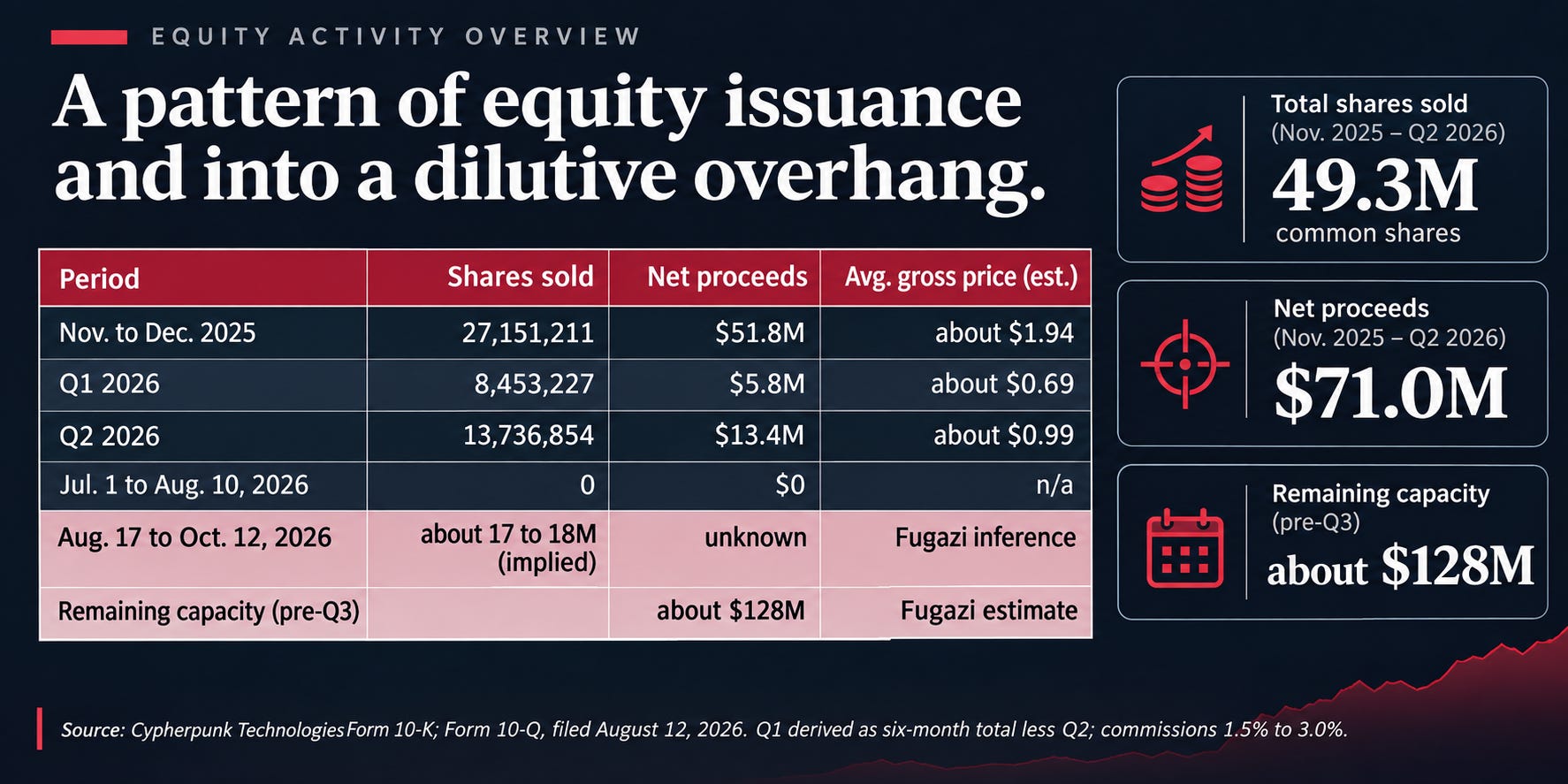
Through the Cantor ATM the company sold 49.34 million shares for about $71.01 million of net proceeds: 27,151,211 in November and December 2025, 8,453,227 in Q1 2026 and 13,736,854 in Q2 2026. We estimate remaining capacity at about $128 million.
Common shares rose from 83,851,051 to 107,764,382 between December 31, 2025 and June 30, 2026, an increase of 23,913,331 shares, or about 28.5%. Outstanding warrants covered 158.68 million shares, 147% of the common count, before the August mining warrant added 43.29 million.
During 2025 the company granted 20,799,921 RSUs at a weighted-average grant-date fair value of $0.98. At June 30, 2026, 16,581,971 RSUs were outstanding, $4.29 million of stock compensation represented about 45% of first-half operating expenses, and $13.86 million of compensation cost remained unrecognized.
From Cancer Research to Cryptocurrency: Half a Billion Dollars Later, a New Business Model
Cypherpunk Technologies did not begin as a cryptocurrency investment company. For years it operated as Leap Therapeutics, a clinical-stage developer of targeted cancer treatments. Its principal candidate, Sirexatamab (formerly DKN-01), is a monoclonal antibody designed to inhibit DKK1, a protein associated with tumor progression and immune regulation. The company also pursued other oncology assets, including FL-501.
These programs consumed substantial capital without producing an approved medicine. As of June 30, 2026, the company reported an accumulated deficit of $500.33 million. The company acknowledges that it has never achieved positive operating cash flow and has never generated product sales. The accumulated deficit is not a measure of cash on hand or a precise accounting of investor proceeds lost, but it records the losses that preceded the latest reinvention.
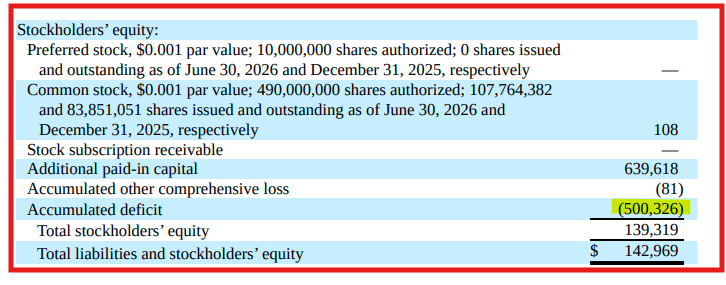
Source: Cypherpunk Technologies Inc., Form 10-K, filed March 16, 2026.
The decisive restructuring began on June 23, 2025. The board approved measures to conserve cash, wind down research, and reduce the workforce by approximately 75%. The restructuring proceeded in two phases and included the departures of the Chief Operating Officer, Chief Scientific Officer, Chief Manufacturing Officer, and even the Chief Medical Officer. Restructuring charges were $4.53 million in the second quarter of 2025.

Source: Cypherpunk Technologies Inc., Form 10-K, filed March 16, 2026.
Four months later, in October 2025, Leap announced a Winklevoss-led financing to establish a digital-asset treasury. On November 12, 2025, it changed its name to Cypherpunk Technologies and its ticker from LPTX to CYPH.

The PIPE was priced at about $0.52 per unit: $0.52064 per common share and $0.51964 per pre-funded warrant, each with roughly three quarters of a warrant at $0.5335. WTI took 8,283,761 common shares, 75,448,618 pre-funded warrants and, after an assignment, 57,182,378 common warrants, Parcrest was the placement agent.
After more than half a billion dollars of losses, no commercialized drug, and a 75% workforce cut, Cypherpunk turned its Nasdaq listing into a vehicle for accumulating Zcash. Its new strategy still relies on equity financing. Public shareholders are now funding another speculative venture built on the financial legacy of a failed biotechnology business.
Pivot from Biotech to Crypto

CYPH is the former biotech stock LPTX. The pivot of biotech to crypto is nothing new and is a notorious red flag for a heavy dilution scheme. Fugazi Research published less than 5 weeks ago on SDEV, formerly NovaBay Pharmaceuticals, Inc. (AMEX: NBY). The title of the report was “SDEV: A Dilution Timebomb Wearing a Stablecoin Costume.” NovaBay was basically a pharma dud which pivoted to the low level crypto scheme and became SDEV.
NBY/SDEV was a dilution time bomb where the float was temporarily small with a massive amount of dilution ready to dump at the expense of unknowing retail investors. CYPH is basically running the same playbook scheme as massive amounts of dilution are being held overhead and being dumped onto the supply in large amounts.
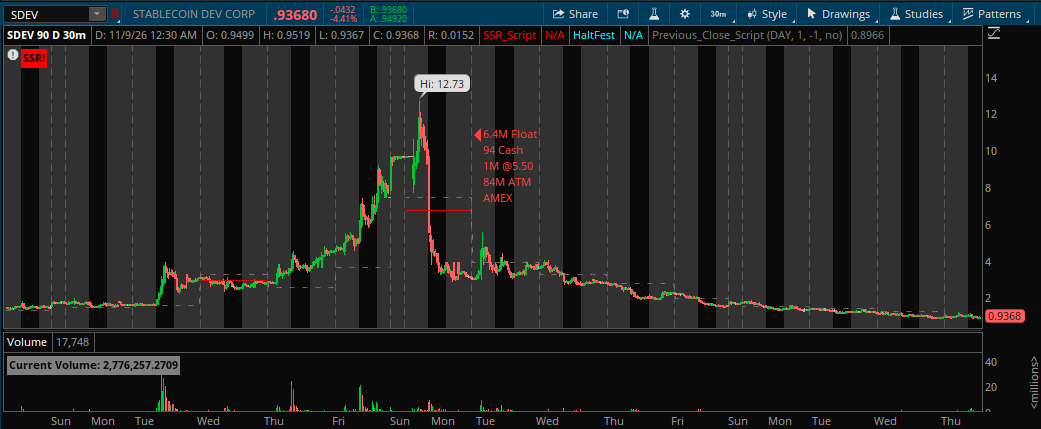
Source: Schwab Thinkorswim Chart showing SDEV capitulation on 10/5/2026 (Fugazi Research publication day)
CYPH is basically another dilution timebomb like SDEV. As we can see in the chart above, this is what a true dilution timebomb looks like. CYPH has a ton of dilution that will eventually end up into the float, driving the price all the way down to pennies on the dollar before they do the eventual reverse split to stay listed on the exchange and rinse/repeat the whole process again just like many historical examples of pump and dump past.
Source: AskEdgar CYPH stock profile.
The Winklevoss Structure: One Network on Every Side of the Table
The October 2025 financing did more than put cryptocurrency on the balance sheet of a failed biotechnology company. It created an ownership and governance structure in which one investor network appears on both sides of nearly every material transaction the company has completed since, and the record of that network’s flagship business is not one shareholders should take on trust.
Winklevoss Treasury Investments (WTI) led the $58.89 million private placement of common shares, pre-funded warrants and common warrants. The accompanying Lead Investor Agreement gave WTI the right to designate two directors, and WTI used it to appoint William McEvoy and Khing Oei. McEvoy, a principal at Winklevoss Capital, is also Cypherpunk’s Chief Investment Officer and signs WTI’s Form 4s as its manager, so the person who runs the company’s treasury strategy also manages the vehicle holding roughly 97 million of its pre-funded warrant shares. Oei, designated by WTI and elected chairman the day he joined, controls CoinXit Ltd., which received about 5.45 million RSUs under a consulting agreement. When he was named chairman he was also founder and CEO of Treasury B.V., a Bitcoin treasury company whose €126 million private round was co-led by Winklevoss Capital in September 2025, a month before the Cypherpunk placement, and whose strategic advisory board includes both Winklevoss brothers.
Cypherpunk’s 10-K states that the company relies on an affiliate of Winklevoss Capital, Gemini Space Sciences LLC, for the trading execution by which it acquires ZEC and for custody of the coins. Customer assets are pooled in omnibus wallets, with an internal ledger tracking ownership, and the company itself warns that in a custodian insolvency it could be treated as a general unsecured creditor.

Source: Cypherpunk Technologies Inc., Form 10-K, filed March 16, 2026.
At December 31, 2025, the related-party digital-assets receivable represented approximately 90% of total assets. For accounting purposes Cypherpunk does not directly control the tokens; it holds a contractual claim consisting of a host receivable and an embedded derivative, without FDIC or SIPC protection, and its auditor, EisnerAmper, identified the accounting as a Critical Audit Matter. Nearly the entire asset base therefore sits with a custodian affiliated with the same investor that designates two of the company’s directors.

Source: Cypherpunk Technologies Inc., Form 10-K, filed March 16, 2026.
The group behind that custodian has a regulatory history that shareholders should weigh, and one that has narrowed considerably in the past two years. Gemini, the Winklevoss controlled exchange whose regulated trust company, Gemini Trust Company, LLC, was the respondent in the matters below, offered the Earn lending program, in which customers lent crypto to Genesis Global Capital, a borrower owned by the Digital Currency Group. In November 2022 Genesis stopped allowing withdrawals, with about $900 million belonging to 340,000 investors affected.
In its October 2023 lawsuit, the New York Attorney General described a 73-year-old retired grandmother who, with her husband, had put more than $199,000 of their life savings into Gemini Earn because they believed Gemini’s marketing that it was a safe and secure choice, money she had hoped would help pay for a grandchild’s education. After Genesis froze withdrawals, she wrote to Gemini in November 2022 that without that money she was doomed, according to the complaint.
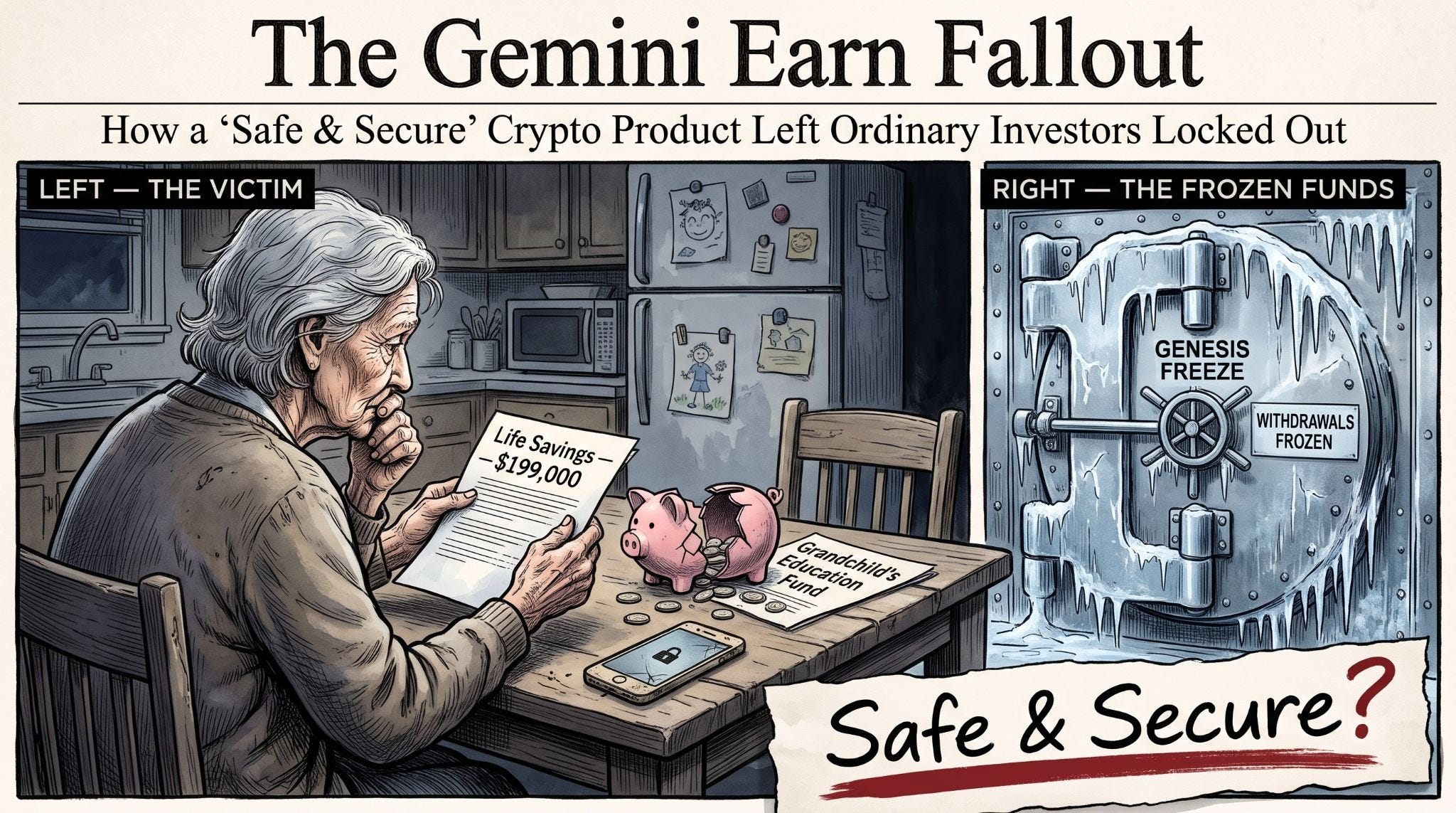

Source: New York Attorney General, press release, “Attorney General James Sues Cryptocurrency Companies Gemini, Genesis, and DCG for Defrauding Investors,” October 19, 2023,
In February 2024 the New York State Department of Financial Services found that, despite Gemini’s public statements to the contrary, it had not fully vetted or sufficiently monitored Genesis and had not maintained adequate reserves, and that an unregulated affiliate, Gemini Liquidity, LLC, had collected hundreds of millions of dollars in fees that would otherwise have gone to the regulated company. Gemini agreed to a $37 million fine and a $40 million contribution to the Genesis bankruptcy and committed to return at least $1.1 billion to Earn customers. In June 2024 the New York Attorney General, which had sued Gemini, Genesis and the Digital Currency Group in October 2023, settled with Gemini for approximately $50 million in additional customer recovery and a bar on operating lending programs in New York.
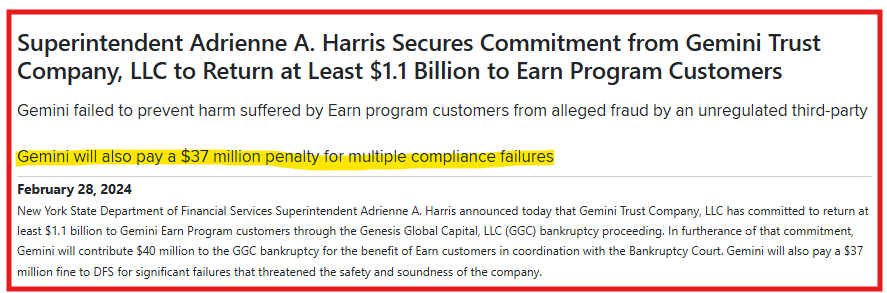
Source: New York State Department of Financial Services, press release and consent order, February 28, 2024.
The SEC charged Genesis and Gemini in January 2023, and Genesis settled in March 2024 with a $21 million penalty and a permanent injunction, payable to the commission only after all other allowed claims in its bankruptcy. Gemini kept litigating until April 2025, when the commission chose to pursue a settlement, announced an agreement in principle in September, and on January 23, 2026 dismissed the case with prejudice, citing the full in-kind return of Earn customers’ assets, without collecting a penalty from Gemini itself.
The twins are prominent supporters of the current administration, each gave $1 million to a fund supporting the president’s 2024 campaign, both appear on the White House’s list of donors to the East Wing ballroom, they reportedly gave $21 million in bitcoin to a pro-crypto political action committee in August 2025, they backed an exclusive Washington club partly owned by Donald Trump Jr., and they invested in American Bitcoin, the miner co-founded by Eric Trump. According to filings reported in July 2026, each also gave $5 million to MAGA Inc. in June 2026. A New York Times investigation found that the SEC had eased up on more than 60 percent of the crypto cases it inherited since January 2025 and has said it decides cases on the merits.
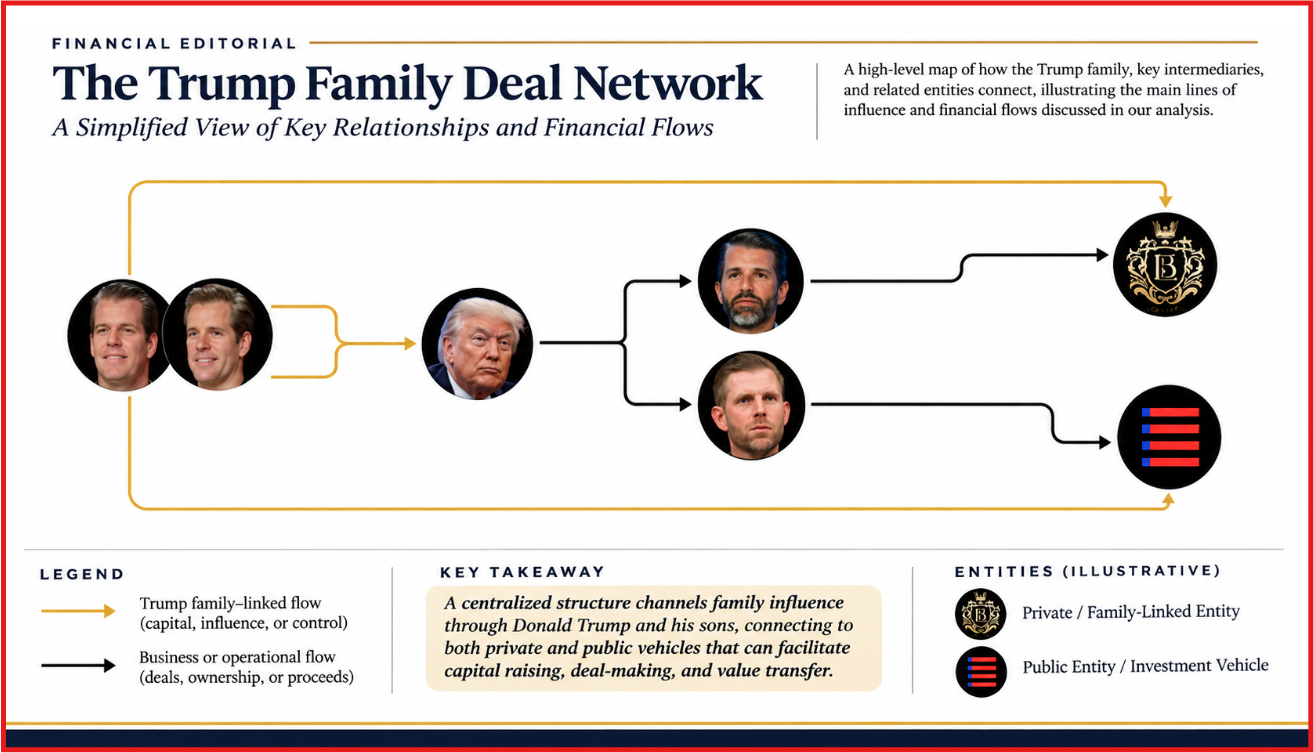

Source: The New York Times, “How the Winklevoss Twins Won Big in Trump’s Pro-Crypto Washington,” December 15, 2025.
We do not allege that any contribution or relationship influenced any enforcement decision, and the agencies cite customer recovery, a changed enforcement policy and doubts about the underlying case. But shareholders do not need to resolve the question of motive to see the risk, because the network’s other public vehicle shows what dependence on it can look like for outside holders. Gemini sold its Class A shares to the public at $28 in September 2025 and they closed at $2.39 on November 5, 2026, while the twins hold the Class B stock that carries roughly 94.5% of the votes, and shareholders have sued the company and both brothers, alleging that its offering documents were misleading. Still, we believe the combination of concentrated relationships, a custodian that holds almost everything, substantial potential dilution and a regulatory record that has narrowed warrants more disclosure than Cypherpunk has given. We ask the company to publish the terms of its custody arrangement, including segregation, insurance, audit rights and the treatment of the receivable if the custodian is stressed, to provide independent proof of reserves, and to disclose the fairness analysis, if any exists, behind the Moria Mining purchase. For Fugazi Research, the question is not simply who controls the cryptocurrency. It is who benefits economically from the transactions used to acquire, custody, mine and finance it.
The Equity Printing Machine: Cheap Warrants, an ATM and Profits That Do Not Exist in Cash
The dilution picture is much larger than the headline common-share count. As of June 30, 2026, Cypherpunk reported 107,764,382 common shares. Its warrant schedule disclosed another 158,681,413 underlying shares, including 80,768,504 under October 2025 pre-funded warrants and 75,985,605 under common warrants, including placement-agent warrants. Shareholders had also approved doubling authorized shares from 250 million to 500 million, of which 490 million are common.
The pre-funded warrants were largely paid for upfront, leaving a $0.001 exercise price. The 75.99 million common warrants carry a $0.5335 strike and may be exercised for cash or on a cashless basis, another large source of potential supply.
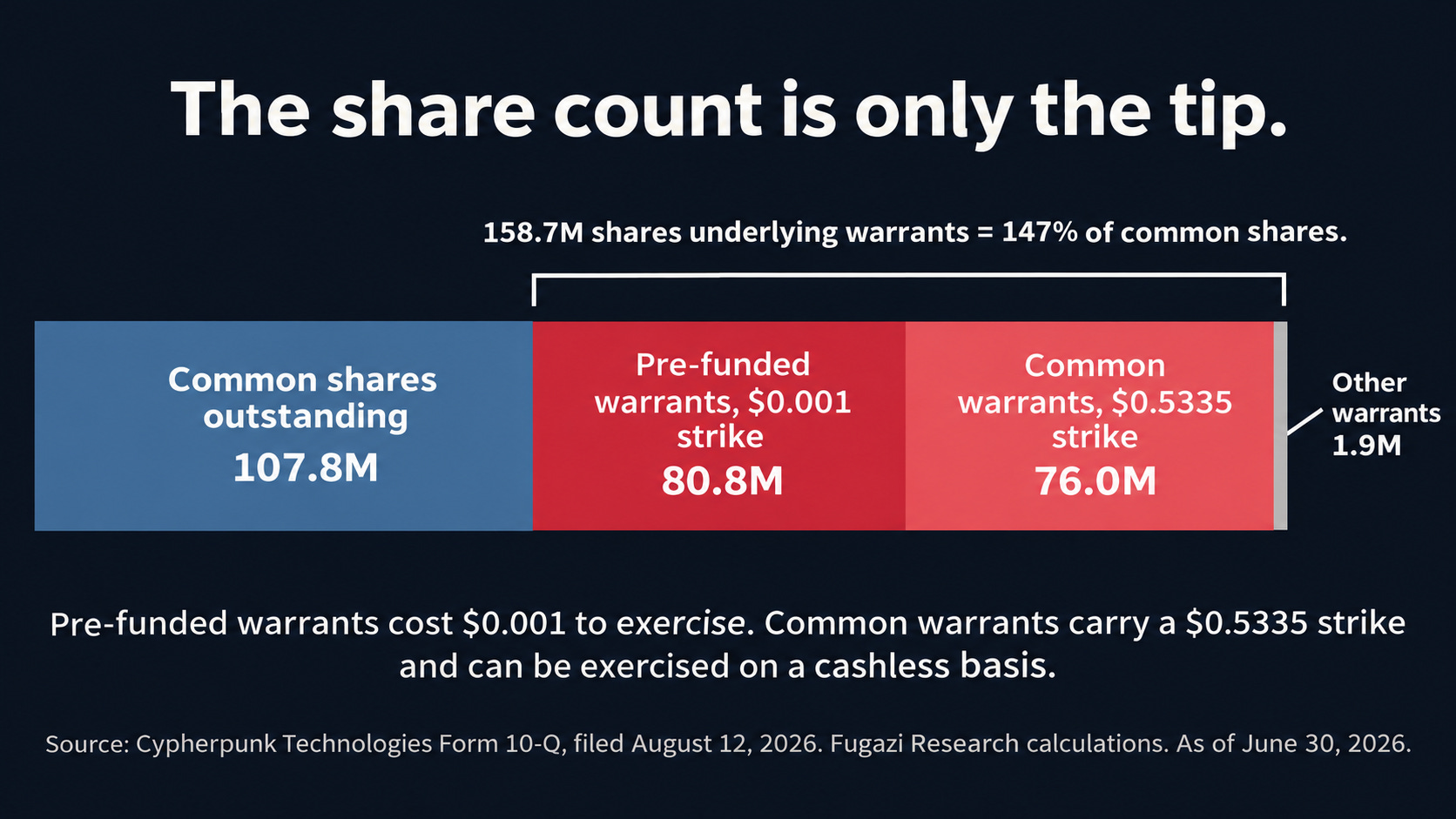
The August mining deal added warrants for 43.29 million more shares. WTI exercised 16.57 million pre-funded warrants in August and 4.94 million in October, bringing the documented minimum common count to about 129.27 million before other issuances. The October 14 Form 4 still showed 97.23 million pre-funded warrant shares with WTI, including the Moria position, these exercises raised almost no new capital because they were paid for at issuance.
What the October Form 4 implies about the share count
On August 17, WTI ended at 24,854,613 shares, which its 13D/A described as 19.9% of 124,335,234 outstanding; the exact ratio is 19.99%, right at the cap. On October 12, it exercised 29,793,414 shares. If it again exercised to the cap, outstanding shares were about 149.0 million (29,793,414 divided by 0.1999), or about 149.7 million at a 19.9% reading. At the documented 129.27 million, Winklevoss Treasury Investments would own 23.0%, above its own blocker.
That implies roughly 19.8 to 20.4 million new shares between August 17 and October 12. Some are RSU settlements (the CoinXit one-third vest of about 1.8 million units and September director settlements). The remaining 17 to 18 million shares are most consistent with ATM sales into the run from $0.71 to $4.19. Notably, the Form 144 filed August 26 still cited 107,764,382 shares, a count that was already stale.
Separately, Cypherpunk has kept issuing through the Cantor ATM. The November 2025 agreement authorized up to $200 million of sales. The company sold 27.15 million shares in late 2025 and 22.19 million in the first half of 2026, for about $71.01 million of combined net proceeds. Those sales also enlarged the share count against which the holdings must be valued.
The balance sheet shows why asset accumulation and shareholder value are not the same thing. Cash fell from $14.04 million to $7.62 million in the first half of 2026 as operations used $6.12 million and investing used $18.54 million. The company raised equity while deploying cash into digital assets and its $5 million ZODL investment. Meanwhile, the income statement introduced a new source of apparent profit. Second-quarter net income was $39.39 million, but $45.99 million came from the unrealized gain on the ZEC derivative. Excluding it leaves a loss of about $6.60 million, before considering the other non-operating items.
Cypherpunk’s own 10-K warns that shareholders could lose all or a substantial portion of their investment even if ZEC does not decline, citing corporate expenses, financing transactions, equity compensation, and dilution as reasons the shares can underperform the coin. Cypherpunk can accumulate more ZEC while diluting what each existing share represents. Unless asset value grows faster than the share count, shareholders absorb dilution without a matching gain in per-share value. The mechanism is equity-funded treasury expansion layered over a large warrant overhang.
Source: Winklevoss Capital Fund, LLC and affiliated reporting persons, Form 4, filed October 14, 2026.
Conclusion
The company began as a failed biotech, it spent more than a decade on oncology without an approved drug, accumulated a $500 million deficit and missed the primary endpoint of the randomized colorectal cancer trial that was supposed to justify all of it. It then cut about 75% of its workforce, collapsed research spending by 98%, (just over $197,000), and kept a 270 patient Phase 3 on the books that depends on financing it does not have, at a company with $7.62 million in cash. What remains of the oncology business is a press release, a plan nobody has funded and a name the company has already taken off the door.
The company did not repair the failure, but just rebranded it. The new Zcash strategy is funded entirely by equity, layered over pre-funded warrants, at the market facility, and private placement deals. Warrants now cover 147% of the common shares in the public’s hands, and the third quarter will likely show the count is higher than the filings document. Roughly 90% of its assets are a contractual claim against a custodian affiliated with the investor that designates two of its directors, without FDIC or SIPC insurance, and the company’s own 10-K warns that if that custodian fails it could be treated as a general unsecured creditor. Count every share already promised, and CYPH is not a discount to its Zcash, it is a bet that Zcash is worth roughly twice what it trades for today, held through a related party.
The Winklevoss network has now run the same structure twice in just over a year: sell the public a story, and leave outside shareholders to carry what is left. Gemini’s shares trade more than 90% below the $28 IPO price while the founders control the vote, and the investors who financed Cypherpunk’s pivot hold paper priced at a fraction of what the public pays. The group’s history with its customers gives shareholders reason to look closely, since New York’s regulator found that Gemini failed to vet or monitor its Earn borrower, while the federal cases against it ended in a dismissal with prejudice and fines of roughly $42 million, less than half of the $100 million the twins’ fund put into Gemini last May.
You can buy Zcash directly. Buying CYPH just means paying a premium to get diluted. Its dilution overhang, related-party entanglements, and dependence on volatile Zcash prices expose shareholders to severe and potentially permanent capital losses. Fugazi Research considers CYPH common stock uninvestable at any price above zero.
Disclaimer
The research, commentary, reports, and other materials published by Fugazi Research LLC (“Fugazi Research,” “we,” “us,” or “our,”) are provided solely for informational and educational purposes. Fugazi Research is an independent research publisher and is not registered as an investment adviser, broker-dealer, or commodity trading advisor with the U.S. Securities and Exchange Commission or any other regulatory authority. All content published by Fugazi Research represents our opinions as of the date of publication and is based on publicly available information, independent research, interviews, and analytical judgment. Our opinions are inherently subjective, may be incomplete, and are subject to change at any time without notice. We do not undertake any obligation to update or revise our content to reflect subsequent events, market developments, or new information.
Nothing published by Fugazi Research constitutes investment advice, financial advice, legal advice, tax advice, or a recommendation to buy, sell, or hold any security or financial instrument. The information should not be construed as tailored to the investment objectives, financial situation, or particular needs of any individual or entity. Readers should conduct their own independent research and consult their own financial, legal, and tax advisors before making any investment decision.
Fugazi Research, its affiliates, principals, members, employees, consultants, or clients may have positions-long, short, or otherwise-in the securities discussed, and such positions may change at any time for any reason, including risk management, market conditions, or liquidity considerations. We may trade in securities covered by our research before, during, or after publication, and we may reduce, close, or reverse positions at any time without notice. Readers should assume that Fugazi Research has a financial interest in the securities discussed.
Our research may include forward-looking statements, estimates, projections, or opinions that involve known and unknown risks, uncertainties, and assumptions. Actual outcomes may differ materially from those expressed or implied. Past performance is not indicative of future results. All investments involve risk, including the potential loss of principal. While we believe the information we present is accurate and reliable, it is provided “as is” and “as available,” without any representation or warranty, express or implied, as to accuracy, completeness, timeliness, or fitness for any particular purpose. Fugazi Research disclaims any liability for errors, omissions, or losses arising from the use of our content.
By accessing or using Fugazi Research’s materials, you acknowledge and agree that Fugazi Research shall not be liable for any direct, indirect, incidental, consequential, or other losses arising from reliance on our research or opinions. Use of our content is entirely at your own risk.
All content is the intellectual property of Fugazi Research and may not be reproduced, distributed, or shared without prior written consent.