

Executive Summary
Stablecoin Development Corporation is not a stablecoin company in the normal operating sense, before, it was NovaBay Pharmaceuticals (AMEX: NBY). The new business is a digital asset treasury built almost entirely on one token: as of June 30, 2026, SDEV held about 2.286 billion SKY, roughly 10% of total supply, carried at $119.2 million, or about 94% of total assets. The danger in valuing a company based purely on digital assets is that the number holding up the whole structure is a quoted token price multiplied by a share count, with no operating business underneath it, and a quoted price says very little about what a holder of roughly 10% of the supply could actually realize if it ever had to sell. SDEV’s own results show how far that number can move: a $28.0 million unrealized loss on digital assets in the first six months of 2026, including $50.6 million in the second quarter alone, with no customers or contracts to absorb the swing and an absurd amount of warrants waiting to dilute whatever common shareholders have left.
The transformation was financed by a January 2026 private placement with $134 million of stated gross proceeds, but only $25 million arrived as cash. The rest was $51 million in stablecoins and $58.0 million in SKY, which the purchase agreement valued at a fixed $0.0615 per token regardless of the market price. In exchange, SDEV issued pre-funded warrants covering 167.5 million shares, against 50.6 million common shares outstanding at June 30. That is more than 3x the visible share count.
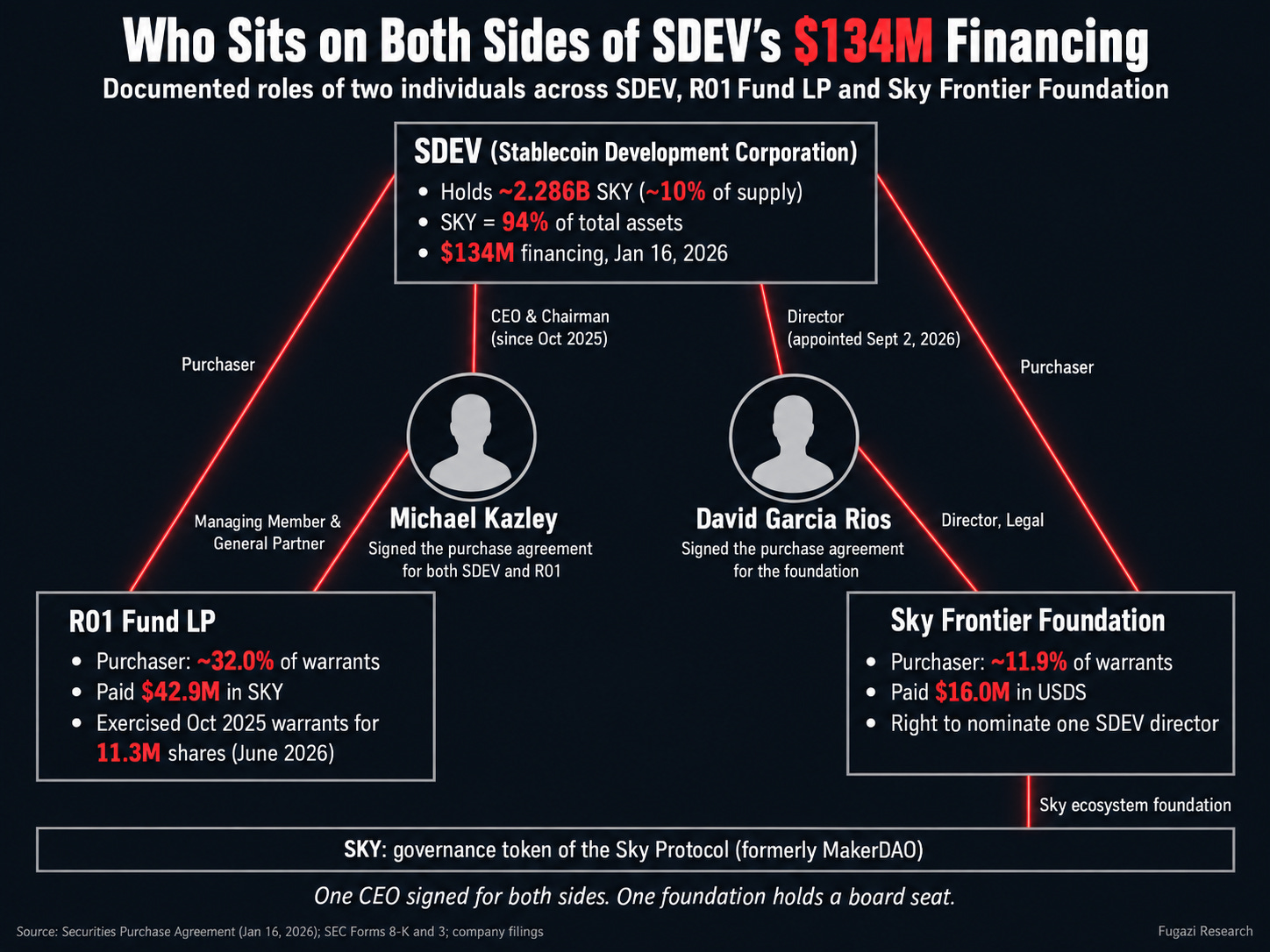
The four buyers were all crypto related, R01 Fund LP, Framework Ventures, Tether Investments and Sky Frontier Foundation. SDEV’s CEO and Chairman, Michael Kazley, is the Managing Member and General Partner of R01, the largest purchaser, and he signed the purchase agreement for both the company and R01. Sky Frontier foundation, which paid $16.0 million in USDS, placed its Director, David Garcia Rios, on SDEV’s board on September 2, 2026. In our opinion this is a blatant conflict of interest, because the same parties who bought the warrants and supplied the tokens also run the company, sit on its board, and hold a contractual right to approve or reject any change to the one asset it is allowed to hold, with the CEO himself signing for both the company and the largest buyer. Basically, the company is listed on the market to get the warrant holders rich. In this case, it is SDEV’s own CEO and director.
What the market is valuing is not an operating stablecoin network, a payments business or a software platform. It is a former pharmaceutical shell holding one concentrated token position, funded through warrants and ATM issuance, and governed with the consent of the investors who supplied that position. Fugazi Research considers SDEV stock uninvestable at any price above zero.
Fugazi Research Analysis
Stablecoin Development Corporation is a renamed pharmaceutical issuer whose asset base is almost entirely one crypto token. As of June 30, 2026, SDEV held about 2.286 billion SKY, roughly 10% of total supply, at $119.2 million, or about 94% of total assets. This is not diversification, but a single-token balance sheet with a listing fee.
The $134 million financing was not a clean cash raise. Only $25 million was cash, all of it from Framework Ventures. Another $51 million came in stablecoins, (35.0 million USDT from Tether and $16.0 million USDS from Sky Frontier Foundation), and $58.0 million came in SKY from R01 (about $42.9 million) and Framework (about $15.1 million), valued at a fixed $0.0615 per token.
The purchasers received pre-funded warrants for 837.7 million shares, or 167.5 million after the 5 to 1 reverse split, at $0.16 per pre-split warrant plus a $0.01 exercise price. That is $0.80 plus $0.05 post-split, an effective $0.85 per share.
The warrant stack equals more than 331% of the 50.6 million common shares outstanding at June 30, 2026.
SDEV’s CEO and Chairman, Michael Kazley, has been the Managing Member and General Partner of R01 Fund LP since 2023, according to the company’s own 8-K. He was appointed CEO and Chairman on October 16, 2025, and signed the January 2026 purchase agreement for both SDEV and R01.
Mr. Kazley’s March 2026 equity awards include performance units tied to stock price and digital-asset NAV hurdles, so his pay rises with the SKY mark.
Sky Frontier Foundation bought 100 million pre-funded warrants pre-split (20 million post-split, about 11.9% of the total) with $16.0 million of USDS. The purchase agreement is signed for the foundation by “David Garcia, Director.” On September 2, 2026, SDEV appointed David Garcia Rios to its board as the foundation’s nominee. The foundation’s own website lists him as Director, Legal, and lists Sky Protocol co-founder Rune Christensen as a Director.
R01, Framework and the foundation each hold the right to nominate one SDEV director, and each can remove its nominee and name a replacement at any time.
For 24 months, each purchaser that still holds at least half of its original position has a consent right over any material change to SDEV’s digital asset strategy. SKY is the only asset the company has approved, this concentration is protected by the parties who hold the warrants.
Pre-funded warrants unlock in three tranches: 20% six months after the January 16, 2026 signing, 30% at nine months (October 16, 2026), and 50% at twelve months (January 16, 2027), each subject to stockholder approval. After each unlock, each purchaser may sell up to 10% of 30-day average daily volume per day, a cap that rises with trading volume.
SDEV used $84.5 million of cash to buy additional SKY in the first half of 2026 and ended June 30 with $7.0 million of cash and cash equivalents. A treasury company spending cash on tokens while relying on capital markets to keep cash on hand is a public market refill loop.
On April 27, 2026, SDEV’s audit committee concluded that the audited 2025 financial statements should no longer be relied upon because of an error in accounting for pre-funded warrants issued on October 16, 2025, the date R01 and Framework received their first warrants.
The company completed a 5 to 1 reverse split in February 2026 and asked stockholders to raise authorized common shares from 1.5 billion to 5 billion. The purchase agreement also carves out a future ATM program from its restriction on new equity sales.
SDEV disclosed about $84.5 million of common stock remaining available under its ATM program as of July 27, 2026.
Financial Summary
SDEV ended June 30 with $7.0 million of cash, which covers about five months of operating burn at the first-half rate of $7.8 million, or roughly $1.3 million a month, before any help from selling tokens or issuing stock.
Digital assets were $119.2 million of $127.5 million in total assets, so 94% or 94 cents of every balance sheet dollar rides on one token, and cash was about 5%.
Of the $134.0 million headline, only $25.0 million, less than 19%, arrived as cash, while $51.0 million was stablecoins and $58.0 million was SKY accepted at a fixed $0.0615 per token regardless of the market price.
SDEV spent $84.5 million of cash buying more SKY in the first half, more than three times the cash the financing delivered, and ended the period with $7.0 million.
Staking revenue was $4.7 million against $8.3 million of general and administrative expense, so the company spent about $1.77 on administrative costs for every $1 of revenue, before operating costs.
Common shares outstanding doubled, from about 25.2 million at December 31, 2025 to 50.6 million at June 30, 2026 (101% in six months), and that is before any of the warrants are exercised.
Pre-funded warrants for 167.5 million shares equal 3.3 times the common share count, so most of the company’s eventual equity has not yet been issued.
The reported $511.3 million of net income was an accounting artifact of a $5.3 billion non-cash loss at issuance and a $5.8 billion non-cash gain on warrant revaluation, while operating activities consumed $7.8 million of cash.
SDEV took a $28.0 million unrealized loss on digital assets in the first half, and because that includes $50.6 million in the second quarter alone, the second quarter erased a first quarter gain of about $22.6 million and then some.
At June 30 the carrying value implied a SKY mark of about $0.052, 15% below the $0.0615 rate in the financing and 20% below SDEV’s own average purchase price of about $0.065.
Source: Stablecoin Development Corporation, press release, first quarter 2026 results, May 20, 2026.
Source: NovaBay Pharmaceuticals, Form 8-K, January 16, 2026
The Pivot: NovaBay Becomes a Token Wrapper
Stablecoin Development Corporation began this chapter as NovaBay Pharmaceuticals, an eyecare and skincare products company, which means the listing did not originate from a stablecoin operating business but from a former pharmaceutical issuer that changed hands and then changed its name, its ticker and its story.
The change of control is documented in the company’s own filings: on October 9, 2025, then CEO David Lazar entered a securities purchase agreement with R01 Fund LP and Framework Ventures, and on October 16, 2025, the board appointed Michael Kazley, R01’s General Partner, as CEO and Chairman while the company issued pre-funded warrants to R01 and Framework, which both funds exercised in June 2026 for a combined 22.6 million shares, so that the two investors who took control in October returned three months later as buyers in the $134 million financing.
When David Lazar had the reins of the company when it was NBY pharmaceutical, it was a similar game plan to what SDEV is doing now. Lazar owned the majority of the supply. At one point he owned 77,000,000 shares when the float was only 5.3 million. He effectively owned 94% of the supply. NBY went on to have a big short squeeze which eventually got rug pulled once the supply was able to be dumped. NBY = SDEV. History doesn’t repeat, but it rhymes.
The filing language gives away the economics, because results depend on the SKY price, staking rewards, token market liquidity and access to capital markets, and SDEV’s only revenue line is staking revenue on the token it already holds, which is not the profile of a stablecoin infrastructure company but of a public market wrapper around one volatile digital asset.
Friday Run-Ups, Next-Session Dumps
The stock’s trading since January repeats a sequence that shareholders should weigh, a violent run-up on a Friday, then a sharp decline on the next trading session, often on a day when new shares can reach the market. The first two rows of the informative table are documented, the ATM agreement was signed on January 20 and the stock fell sharply that day, four days after the purchase agreement carved such a program out of its restriction on new equity sales.
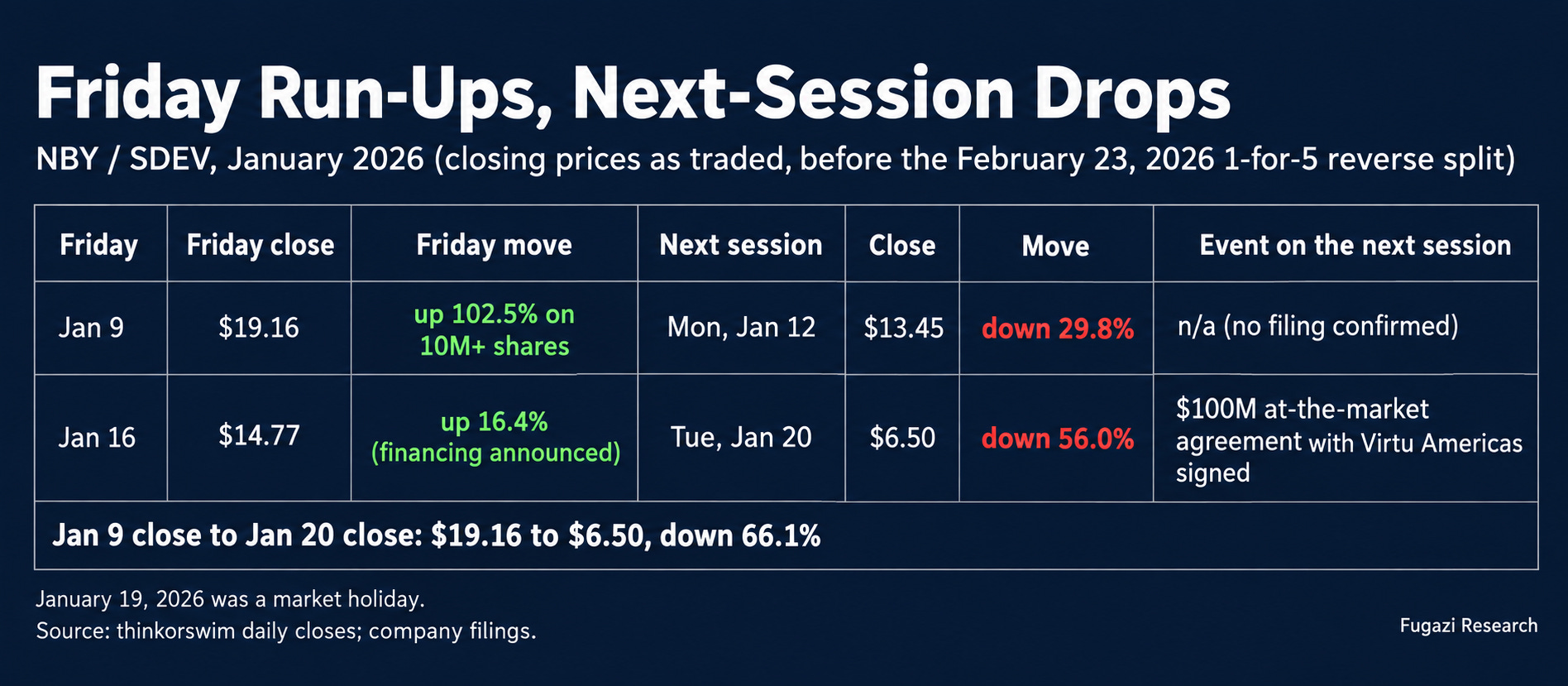
The structure explains why the pattern matters to shareholders. The purchasers paid $0.17 per pre-split share while the stock traded between $6.50 and $19.16 in January, so they hold embedded gains of 96% or more and no price at which selling is unattractive. The first tranche of warrants has been exercisable since July 16, and the second unlocks on October 16. Once a tranche unlocks, each purchaser may sell up to 10% of the 30-day average daily volume each day. A Friday run-up on 150.9 million shares adds about 5 million shares to that average by itself, which lifts each purchaser’s daily limit by about half a million shares for the weeks that follow, a spike in volume therefore also widens the limit on how much the people with the lowest cost basis can sell.
The Warrant Stack: Dilution Wearing a Seatbelt
The January 2026 private placement is the center of the capital structure. SDEV sold pre-funded warrants for 837,696,130 shares, or 167,539,226 after the 5 to 1 reverse split effected on February 23, 2026. The purchasers paid $0.16 per pre-split warrant with a $0.01 exercise price. Post-split, that is an effective $0.85 per share, at $7.48, the paper gain is about 8.8 times. The ownership caps and staged exercisability are just waiting for the schedule to open, and the warrants to unlock in three doors:
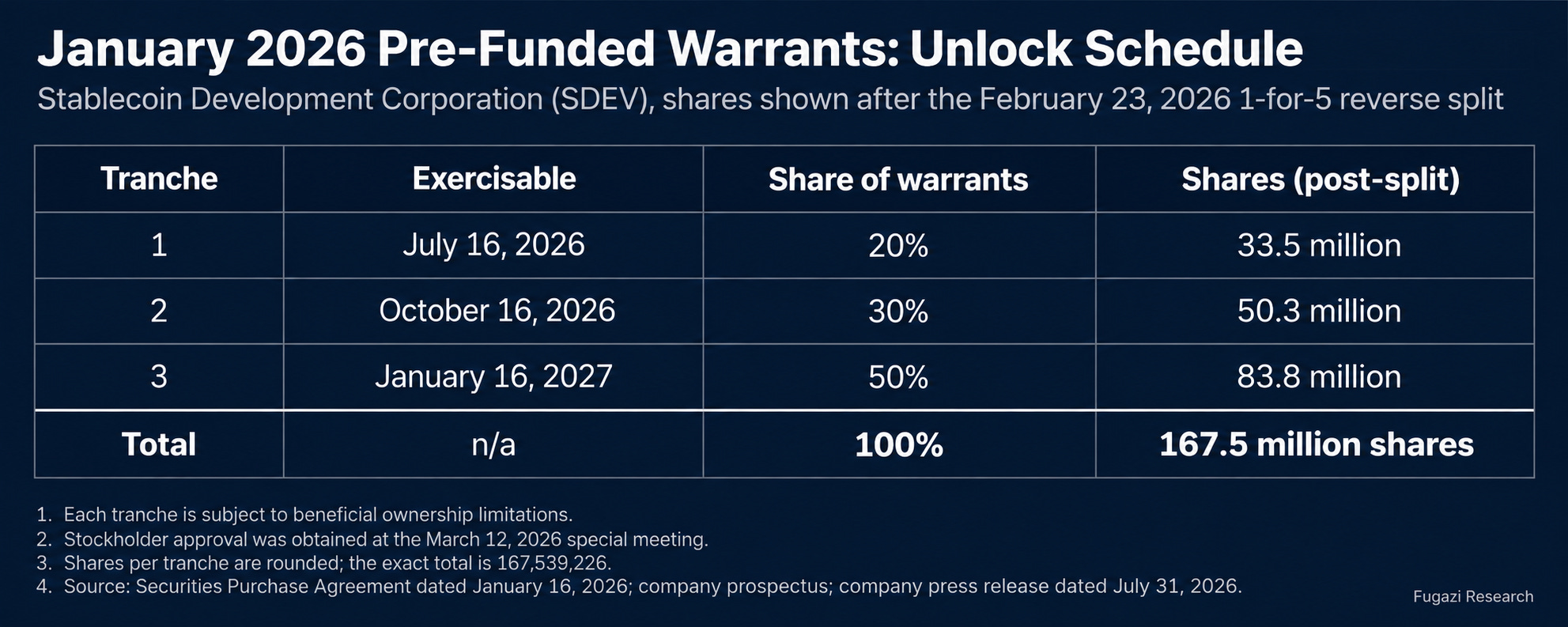
The first two tranches alone total 83.8 million shares, about 166% of the 50.6 million common shares outstanding on October 2, 2026.
The beneficial ownership blockers (4.99% for R01 and Framework, 9.99% for Tether and Sky foundation) cap how much each purchaser can hold at one time, which means the dilution comes in the form of a downward spiral.
After each tranche unlocks, each purchaser may sell up to 10% of 30 day average daily volume per day.
Four purchasers at the cap could sell up to about 40% of average daily volume.
The lock-up is narrower than the headline suggests. It applies only to purchasers that already held SDEV securities before the deal, a group that appears to include R01 and Framework, and it expired six months after closing, around July 16, 2026. The agreement shows no lock-up for Tether or Sky foundation. It also acknowledges that purchasers may hedge or short the stock, and states that no other trading limits apply after closing.
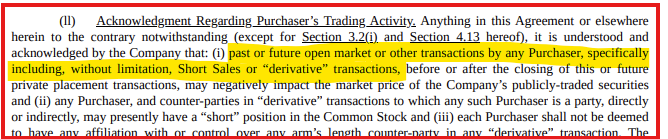
The January warrants are also the reason an otherwise routine filing matters, because the investors' rights agreement obliges the company to keep a resale shelf registration effective for the 167.5 million shares underlying them, and the Form S-3 first filed on August 11 and amended on September 16 goes further by registering 212.9 million shares for resale, more than four times the common stock outstanding on July 27, including the 45.3 million shares already issued to R01 and Framework, which together own 87.6% of the company. The September amendment added a new business and risk section built on data as of September 13, and the fresh October 5 8-K refreshes that same disclosure through October 2 and September 30 and places it under Item 8.01 so that it is filed and incorporated by reference into the registration statement, which in our view reads as the company clearing the last disclosure items so that the shelf can go effective ahead of the October 16 unlock, after which the selling stockholders could resell registered shares, within the 10% daily volume limit, into a market where every other holder together owns only about 6.4 million shares.
Source: Stablecoin Development Corporation, Pre-Effective Amendment No. 1 to Form S-3 (Registration No. 333-298229), filed September 16, 2026.
The purchase agreement made a stockholder vote to raise authorized common shares from 1.5 billion to 5.0 billion part of the approvals it required, with either side free to terminate and unwind if approval was not obtained within 120 days, and it carved a future at-the-market program out of its restriction on new equity sales, a carve-out the company used four days later when it signed a $100 million agreement with Virtu, while SDEV acknowledged in the same agreement that the dilution may be substantial and that its obligation to issue the shares is unconditional, so that the reverse split made the share count look cleaner and the larger authorization made sure the machine still had room to operate.

Insiders on Both Sides
The January 16, 2026 financing was not sold to the market. It was sold to four crypto-native purchasers, two of which sit inside SDEV’s governance.
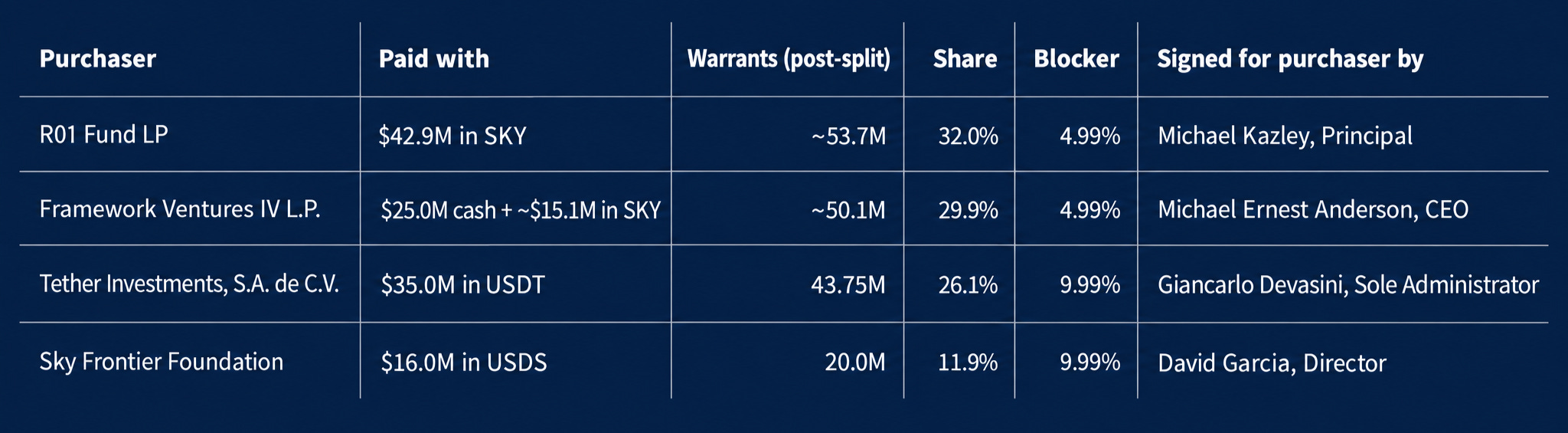
Every purchaser paid the same $0.16 per pre-split warrant. The totals reconcile to $134,031,381.
SDEV’s own 8-K states that Michael Kazley has been Managing Member and General Partner of R01 Fund LP since 2023, and that the board appointed him CEO and Chairman on October 16, 2025. He signed the January purchase agreement for SDEV as CEO and again for R01 as Principal, R01 received about 32% of the warrants and supplied about 74% of the SKY contributed in the financing, roughly 698 million of 943.6 million tokens. While the connection is disclosed, the questions are how the transaction was approved, by whom, and whether the related-person disclosure told shareholders what it means for the CEO’s fund to hold about a third of the warrants.
The foundation’s signature block on the purchase agreement reads “David Garcia, Director,” for a $16.0 million purchase paid in USDS, the stablecoin the Sky Protocol is built around. On September 2, 2026, SDEV appointed David Garcia Rios to its board as a Class II director, as the foundation’s nominee. The Sky foundation’s website lists him as Director, Legal, and lists Rune Christensen, described there as co-founder and long-term architect of the Sky Protocol, as a Director.
The FTT Lesson: When the Balance Sheet Is the Token
The closest structural precedent for SDEV’s balance sheet is not another microcap treasury vehicle but the FTT problem at Alameda Research, where the SEC alleged in December 2022 that Alameda’s then CEO propped up the price of FTT by buying large quantities on the open market, which inflated the value of Alameda’s FTT holdings and overstated the collateral on its balance sheet.
Fugazi Research does not allege that SDEV, its officers or its investors have engaged in any similar conduct, and the differences are real, because FTT was issued by the exchange affiliated with Alameda, SKY is the token of a protocol that SDEV did not create, and we are aware of no pledging of, or borrowing against, SDEV’s SKY, so the comparison is limited to two structural features.
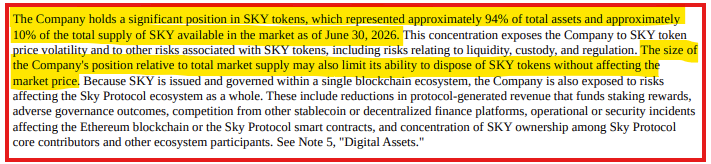
Concentration. At June 30, 2026, SDEV held about 2.286 billion SKY, roughly 10% of total supply, carried at $119.2 million, or about 94% of total assets, with substantially all of the tokens staked in the protocol and held in self custody through a single key management provider, so that one asset, one protocol and one infrastructure vendor stand behind nearly the entire balance sheet. The company’s own filing warns that a position of this size relative to total supply may limit its ability to sell without moving the price, and it lists among its risks the concentration of SKY ownership among the protocol’s core contributors and other ecosystem participants.
A holder that is also the buyer. SDEV is not a passive holder, because after the January placement it bought about 1.28 billion SKY on exchanges for $84.5 million, an average of roughly $0.066 per token and about 5.5% of the entire supply in six months, on top of the 943.6 million tokens it received from the purchasers at a contractual $0.0615 and the 67 million it earned in staking rewards, and it now carries the whole position at a quoted value 19% below the $147.2 million it cost. SDEV’s SKY position is not cash but a token inventory carried at quoted prices that may not survive the act of selling it.
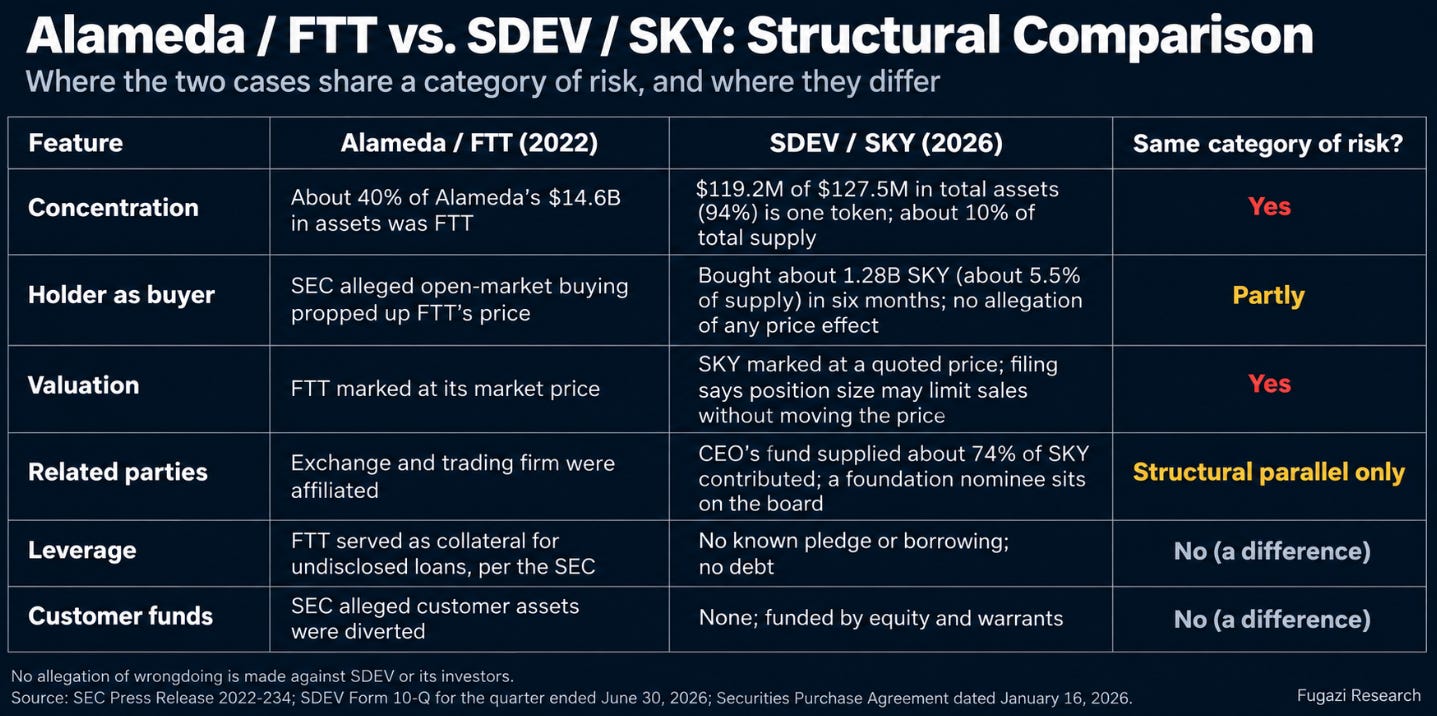
SDEV bought roughly 5.5% of the entire SKY supply in six months and now holds about a tenth of it, nearly all staked with a single key management provider, while a foundation tied to the ecosystem that created the token sits on its board, the CEO’s own fund supplied about three quarters of the tokens SDEV received in the financing, and the purchasers hold a contractual consent right over any material change to a strategy whose only approved asset is SKY, so that the funding, the board seats and the exit approval all sit with a handful of crypto native investors, two of whom paid in SKY itself and one of whom is a foundation of the ecosystem that issues it.
Conclusion
SDEV is a former pharmaceutical shell that changed hands in October 2025, was renamed in April 2026 and has since been presented to the market as a stablecoin company, when what it actually owns is one token, SKY, of which it holds a tenth of the entire supply, $119.2 million of it against $7.0 million of cash, with revenue that arrives in the same token and, because not one token has been sold, has paid none of its bills.
The financing that built the position was priced at $0.17 per pre-split share when the stock closed at $14.77 on the day it was signed and had closed at $19.16 a week earlier, and its $134 million of stated proceeds was only $25 million of cash, the rest paid in stablecoins and in SKY that the agreement accepted at a fixed price, in exchange for warrants over 167.5 million shares, more than three times the common stock outstanding, which the company’s own books valued at $5.4 billion on the first trading day after the announcement, so that a business that burned $7.8 million of cash could report $511.3 million of net income.
The people on the other side of that agreement are the people who run the company: its CEO and Chairman is the General Partner of R01, the fund that supplied three-quarters of the tokens, holds a third of the warrants and signed the agreement alongside the company he runs, a foundation of the ecosystem that issues the token holds a board seat, and every purchaser that keeps half of its position holds, for 24 months, a consent right over any change to a strategy whose only approved asset is SKY.
The exit is on a calendar, with the first tranche of warrants exercisable since July, the second unlocking on October 16 and the third in January, and once a tranche unlocks each purchaser may sell up to 10% of average daily volume, a limit that rises whenever a volume spike inflates the average. The stock’s own history shows how that has gone, with Friday run-ups followed by declines on the next session and a 66% fall from January 9 to January 20 as the financing and an ATM program reached the market, and on September 29 the company itself told the NYSE American that it was aware of unusual trading activity and knew of no development to explain it, days before the next unlock.
In Fugazi Research’s opinion, this is a conflict of interest on its face, because the buyers of the warrants, the suppliers of the tokens, the holders of the board seats and the approvers of any change in strategy are the same small group, and the common shareholder owns a thin claim on whatever one token turns out to be worth after that group has sold. A company whose assets, insiders and exit all depend on one token has given shareholders nothing to stand on if that token stumbles. Fugazi Research considers SDEV stock uninvestable at any price above zero.
Disclaimer
The research, commentary, reports, and other materials published by Fugazi Research LLC (”Fugazi Research,” “we,” “us,” or “our,”) are provided solely for informational and educational purposes. Fugazi Research is an independent research publisher and is not registered as an investment adviser, broker-dealer, or commodity trading advisor with the U.S. Securities and Exchange Commission or any other regulatory authority. All content published by Fugazi Research represents our opinions as of the date of publication and is based on publicly available information, independent research, interviews, and analytical judgment. Our opinions are inherently subjective, may be incomplete, and are subject to change at any time without notice. We do not undertake any obligation to update or revise our content to reflect subsequent events, market developments, or new information.
Nothing published by Fugazi Research constitutes investment advice, financial advice, legal advice, tax advice, or a recommendation to buy, sell, or hold any security or financial instrument. The information should not be construed as tailored to the investment objectives, financial situation, or particular needs of any individual or entity. Readers should conduct their own independent research and consult their own financial, legal, and tax advisors before making any investment decision.
Fugazi Research, its affiliates, principals, members, employees, consultants, or clients may have positions-long, short, or otherwise-in the securities discussed, and such positions may change at any time for any reason, including risk management, market conditions, or liquidity considerations. We may trade in securities covered by our research before, during, or after publication, and we may reduce, close, or reverse positions at any time without notice. Readers should assume that Fugazi Research has a financial interest in the securities discussed.
Our research may include forward-looking statements, estimates, projections, or opinions that involve known and unknown risks, uncertainties, and assumptions. Actual outcomes may differ materially from those expressed or implied. Past performance is not indicative of future results. All investments involve risk, including the potential loss of principal.
While we believe the information we present is accurate and reliable, it is provided “as is” and “as available,” without any representation or warranty, express or implied, as to accuracy, completeness, timeliness, or fitness for any particular purpose. Fugazi Research disclaims any liability for errors, omissions, or losses arising from the use of our content.
By accessing or using Fugazi Research’s materials, you acknowledge and agree that Fugazi Research shall not be liable for any direct, indirect, incidental, consequential, or other losses arising from reliance on our research or opinions. Use of our content is entirely at your own risk.
All content is the intellectual property of Fugazi Research and may not be reproduced, distributed, or shared without prior written consent.