

Executive Summary
This is not the first time this entity has been examined this closely, and the earlier record dates to August 2021, when White Diamond Research published a short report on this same public company (then Flora Growth Corp.) after sending a seasoned trader and investigator, David Capablanca, to physically inspect the flagship asset the company’s entire public narrative rested on in person: a cannabis cultivation facility outside of Bucaramanga, Colombia. Upon arrival, Capablanca found a site reachable only by motorcycle over unpaved mountain terrain plagued with Colombian cartels. He was twice denied a promised tour of the public company’s physical site and discovered that the company’s SEC filed Colombian office address did not correspond to an actual office. The company’s on site manager on the investigator’s second visit, spotted his recording equipment and attempted to seize his phone before the investigator escaped the property on his motorcycle.
Five years and one crypto rebrand later, the pattern Capablanca documented on the ground, has simply changed asset class, as his own account adds texture the White Diamond report’s summary points don’t fully capture: the cultivation site was nearly impossible to locate on the map beforehand and a separate stop at the address the company listed for its outside auditor turned up to be a storefront with no connection to the company at all. Where the 2021 story was a cultivation facility that could not be toured, inspected, or located at its stated address, the 2026 story is a meme token treasury whose valuation depends on the fair-value marks of thinly-traded digital assets and a self-published, non-GAAP “discount to NAV” framing the company has no independent obligation to substantiate. The 2021 report also documented a paid promotion apparatus timed to a specific insider liquidity event: the company engaged multiple stock promotion services in the weeks ahead of its first share lockup expiration, and separately paid for a third party research report whose own bullish framing conceded the company’s core export claims were unworkable.
ZeroStack Corp, wants investors to believe they are looking at a newly positioned decentralized artificial intelligence treasury company built around ownership of the 0G token and exposure to the emerging AI infrastructure economy as ZeroStack is not a newly formed AI company, but Flora Growth Corp., (the former Nasdaq cannabis company traded as FLGC), now operating under a new name, a new ticker, a new corporate domicile, and a radically different investment narrative. It is important to note that ZeroStack’s 0G is an actual meme token. Meme tokens derive from memes, which are meant to be jokes or fun gambling vehicles. They are not meant for any serious investing whatsoever. Both Flora Growth and ZeroStack have spent years cycling through businesses, acquisitions, capital raises, operating losses, asset impairments, reverse stock splits, and strategic resets. The company has recorded a series of reverse splits, in order to regain compliance with Nasdaq’s $1 minimum bid requirement, resulting in massive shareholder equity destruction.
Flora Growth recorded enormous impairments, persistent operating losses and an accumulated deficit that reached $158.1 million by the end of 2024, its 2024 annual report disclosed only $6 million in cash, and substantial doubt about its ability to continue as a going concern, and by September 2025, Flora had sold its legacy hemp and cannabis businesses transforming now into ZeroStack. Today, the company describes itself as a decentralized AI treasury and AI focused asset management company whose primary strategy centers on ownership of the native token, Zero Gravity (0G) blockchain.
For the six months ended June 30, 2026, ZeroStack reported $20.9 million of total revenue and a $61.3 million net loss. Meanwhile, the company’s digital asset segment recorded $82.5 million of losses from changes in the fair value of digital assets. Now the company had just $2.6 million of cash, and an accumulated deficit of $339.1 million. Management explicitly stated that substantial doubt exists regarding the company’s ability to continue as a going concern. ZeroStack says it expects to fund itself primarily by monetizing digital assets earned from staking and potentially by selling the underlying treasury assets. Proving that changing the business name, and pivoting industry did not help whatsoever in making the balance sheet or cash flow stronger, but merely worked as a PR pivot in order to keep riding the tailwind of the hottest sector. Fugazi Research considers Zero Stack shares uninvestable at any price above zero.
Fugazi Research Analysis
In 2021, White Diamond Research’s investigator, trader David Capablanca, physically inspected the company’s then flagship operating asset and found conditions inconsistent with the commercial-scale story the company was telling the market, an inaccessible site, a denied tour, and a field office address that did not exist. That episode establishes a documented precedent, from this exact company, of a public narrative outrunning what direct inspection could support.
David Capablanca’s chapter in Short Selling Master describes searching unsuccessfully for the site on standard mapping tools and only locating it after cross-referencing a company Instagram photo showing a hand-lettered farm sign against satellite imagery, a company whose flagship operating asset could not be found through ordinary due diligence tools without an in person trip.
Capablanca’s account describes the stock’s behavior ahead of the 2021 report, a rapid price run-up accompanied by paid promotional outreach, including text-message campaigns whose fine print disclosed compensation for the promotion, as consistent with a pattern he associates with underwriters that have a documented history of share dumps roughly 180 days after an offering, timed to prior price run-ups just before lockup expiration.
The 2021 report documented a web of loans between the company’s then-Executive Chairman’s affiliated entities and the company itself, with the same individual serving as CFO across several of those entities simultaneously. The present-day structure differs in mechanics but rhymes in form: a token contributor installed as President concurrent with the asset contribution, and a CEO, Executive Chairman, and CFO who are themselves named sellers in the registration statement built around the same transaction.
The substantial majority of total assets consists of digital assets and restricted digital assets, non-yielding, fair-value-marked cryptocurrency positions, not cash, receivables, or productive assets tied to the legacy pharmaceutical distribution business.
ZeroStack is Flora Growth Corp. with a new name and no meaningful change to the underlying pharmaceutical distribution business it still carries on its books. The company redomiciled jurisdictions, abandoned a cannabis/CBD identity for an “AI-focused asset management” identity, and adopted a crypto treasury strategy. (The second strategic reinvention in the company’s public life inside a single year).
The token position that was the entire premise of the company’s rebrand was carried at a fair value representing a small fraction of its original cost by the following quarter. This is the company’s own fair value mark in its own filing.
Management’s liquidity assessment moved from “sufficient for the next twelve months” to “substantial doubt” in the space of a single quarter, with the reversal attributed directly to the collapse in fair value of the company’s treasury holding rather than to any change in the underlying operating business.
Weeks after warning it might not survive the year, the company entered into an even larger token acquisition, priced at a steep premium to its own trading price, for a token whose independent liquidity and market depth have not been established in any filing reviewed to date.
The individual described in the company’s own 8-K as “a significant source of the Digital Assets contributed to the Company” was appointed President effective at the closing of that same transaction, with an employment agreement negotiated concurrently with the asset contribution itself.
The bulk of the shares issuable in the transaction cannot be exercised without a future shareholder vote, and the token contributing investors whose shares are subject to that same vote are bound by concurrent voting agreements to vote as directed by a company-designated proxyholder, with an irrevocable proxy running for a decade.
The resale registration that covers the new warrant shares also covers shares held by the CEO, the Executive Chairman, and the CFO, issued via earlier private placements and warrant exercises tied to the same string of 2026 crypto transactions.
Days after the second token deal closed, the company issued a press release valuing its combined treasury on a per-share basis and framing its trading price as a steep “discount” to that figure, a non-GAAP metric that the release itself concedes is subject to significant volatility and liquidity limits.
Fugazi Research considers $ZSTK uninvestable at any price above zero.
Source: David Capablanca, Short Selling Master, Chapter 4, “Adventures in Bucaramanga, Unmasking a Blatant Pump and Dump”
Source: ZeroStack Corp. Form 10-K, fiscal year ended Dec. 31, 2025, filed Feb. 27, 2026.
Source: ZeroStack Corp. Form 10-Q, quarterly period ended June 30, 2026, filed July 31, 2026.
Source: ZeroStack Corp. Form 8-K , filed Aug. 19, 2026.
Source: ZeroStack Corp. Form S-3 , filed Aug. 21, 2026.
Financial Summary
The accumulated deficit jumped from $277.8 million as of Dec 31, 2025 to $339.1 million as of June 30, 2026, up $61.3 million in six months.
Two reverse splits (20 to 1) in June 2023 and (39 to 1) in August 2025, for a cumulative 780 to 1 ratio.
Per Yahoo Finance, ZSTK’s 5-year total return as of Feb 23, 2026 was -99.81%, against the S&P 500’s +76.17% over the same window.
FY2025 net loss was $119.7 million (comprehensive loss attributable to ZeroStack of $119.331M), versus $15.988 million in FY2024, the loss widened by roughly $103 million year over year.
Total assets of $130.2 million as of December 31, 2025 were dominated by digital assets ($71.95 million) and restricted digital assets ($49.0 million), against total liabilities of $59.7 million, including $50.7 million of long-term debt consisting primarily of the Zero Gravity Convertible Note.
As of June 30, 2026, the company held 75,101,767 0G tokens at a cost basis of $163.4 million and a fair value of $15.2 million, a decline of approximately 91% plus a nominal Bitcoin position, for total digital assets of $15.2 million against a combined cost of $163.4 million.
The company recorded an $82.5 million fair value loss on digital assets and a net loss of $61.3 million for the six months ended June 30, 2026, against $3.8 million of staking revenue earned on the 0G position over the same period.
Cash stood at $2.6 million with negative working capital of $600,000 and an accumulated deficit of $339.1 million as of June 30, 2026, the balance-sheet basis for management’s going concern disclosure.
The President appointed concurrent with the MemeCore closing receives a $500,000 annual base salary, a contractual entitlement to 125,000 restricted shares (subject to shareholder approval), and severance of up to 30 months of base salary in a qualifying change in control termination.
The August 21, 2026 resale registration covers 54,609,992 shares, comprising 10,028,935 private-placement shares issued across the March 31, July 20, and August 19, 2026 transactions, 5,954,743 shares issued to CEO Daniel Reis-Faria upon exercise of earlier pre-funded warrants, 2,428,020 shares underlying executive stock options, and the 36,198,294 MemeCore warrant shares.
An August 24, 2026 press release valued the combined 0G and MemeCore treasury at approximately $1.06 billion, or $18.19 per partially diluted share ($17.33 fully diluted), against a $4.71 reference trading price, implied discounts of 74.1% partially diluted and 72.8% fully diluted.
Source: ZeroStack Corp. Form 10-K, fiscal year ended Dec. 31, 2025, filed Feb. 27, 2026.
Source: ZeroStack Corp. Form 10-Q, quarterly period ended June 30, 2026, filed July 31, 2026.
FloraGrowth before ZeroStack
The most important fact in understanding ZeroStack may be the one receiving the least attention from traders discovering the ticker today. Before it was ZeroStack, this entity’s public story was a 246-acre cannabis cultivation operation in the mountains outside Bucaramanga, Colombia, a story nobody at the company could actually produce access to when someone showed up and asked to see it.
The company was incorporated in 2019 as Flora Growth Corp. and went public in May 2021 at $5 per share. At the time, Flora presented itself as an international cannabis cultivation and consumer products company positioned to capitalize on global cannabis legalization and commercialization, during its initial public offering it sold 3.33 million shares before subsequent reverse splits, with an additional overallotment option available to underwriters.
The public story expanded quickly as the company released a series of PR’s showcasing acquisitions in the cannabis related business. The language surrounding these transactions was ambitious as management said the JustCBD acquisition was expected to accelerate top and bottom line growth and generate major distribution synergies. Flora spent aggressively to assemble those stories, however those investments did not produce the durable economics investors might have expected from the language surrounding them. And by 2023, Flora reported more than $23 million of goodwill impairment and more than $16 million of additional asset impairments, while net loss from continuing operations accelerated to $46.7 million.
By the end of 2024, Flora’s accumulated deficit had reached $158.1 million. The cannabis empire that had once been presented as a platform for international expansion was ultimately dismantled, and the company’s current filings state that it finalized the sale of its legacy hemp and cannabis businesses on September 26, 2025, by this time FloraGrowth had no other option but to pivot to the hottest theme available, in order to keep surviving, enter ZeroStack.
“The Mountain That Wasn’t on the Map” (White Diamond Research’s 2021 Field Investigation)
By White Diamond Research’s account, Flora Growth Corp. was, structurally, a roll-up: a shell built up through a series of small acquisitions, anchored by a Colombian cultivation asset, purchased for roughly $80,000 in October 2019, a nominal sum for what the company would go on to market as the foundation of a global, low-cost cannabis export business. The company’s own IPO prospectus, months later, disclosed that it had not yet grown or harvested a commercial crop and lacked the infrastructure to extract cannabis oil in any material amount. In the weeks before its first share-lockup expiration in August 2021, the company published a run of press releases, and engaged in multiple paid stock promotion services.
White Diamond’s report rested on more than filings analysis, as the firm sent an investigator, David Capablanca (author of Short Selling Master), to the company’s stated cultivation site in person. Capablanca’s recently published 2026 book recalls that the site was difficult to even locate on standard maps, as he found it only after matching a company Instagram photo of a hand lettered farm sign against satellite imagery. The location itself, in a remote mountain community outside Bucaramanga was reachable only by motorcycle over unpaved, muddy terrain in which no local driver he approached was willing to make the trip. Capablanca resorted to going up the mountain to the Flora Growth site on a motorbike. The bike used on this first attempt sustained mechanical damage from the conditions and had to be repaired before a second visit was possible. The company’s on site manager in Colombia declined to grant the promised tour and, on noticing Capablanca’s recording equipment, attempted to physically take his phone before Capablanca and his guide left the property. Both White Diamond’s published report and Capablanca’s recently published book describe the same sequence of events independently.
A separate check of the company’s SEC-filed Colombian office address, and of the address listed for its outside auditor, found no functioning company presence at either location, in the auditor’s case, a storefront with no apparent connection to the company. White Diamond’s report separately documented a web of related-party loans between the company, its then-Executive Chairman’s other ventures, and a shared CFO who held the same role across several of those entities simultaneously. Capablanca’s recently published book, Short Selling Master recounts that the stock declined substantially following the report and that the company was subsequently forced into repeated reverse stock splits to maintain its Nasdaq listing. This is confirmed in this report’s own SEC sourced research: a 20 to 1 split in June 2023 and a 39 to 1 split in August 2025, for a cumulative 780 to 1 ratio.
Source: FLGC- TOS 5-year chart showing a decline massive decline & reverse split history over time
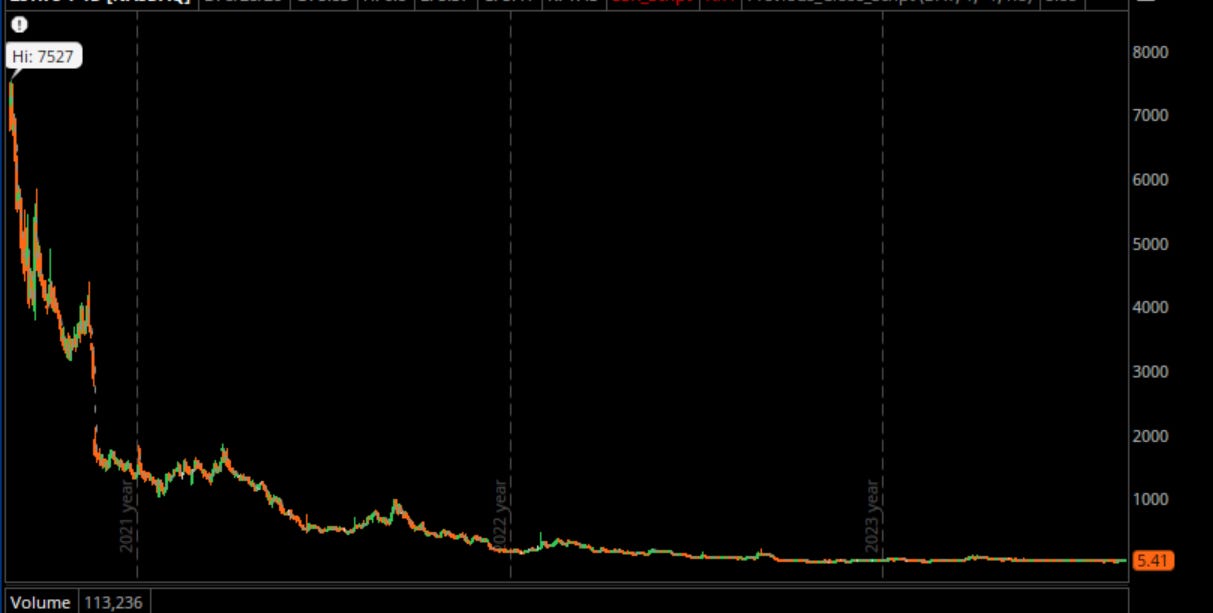
This is the same public company Fugazi Research is examining today, five years and one identity change later, the specific facts are new, a token treasury instead of a cultivation facility, a self published NAV metric instead of paid stock promotion, a President appointment instead of an Executive Chairman’s loan network, but the pattern White Diamond and Capablanca documented on the ground in 2021 is the same pattern this report documents in the current filings: a public narrative that outgrows what can actually be verified about it, and the one time someone checked closely, it didn’t hold up.
The Reverse Split History
Public investors evaluating ZeroStack should understand how much compression has already occurred in the historical share structure. In June 2023, Flora Growth completed a 20 to 1 reverse stock split, subsequently in August 2025, Flora completed another reverse split, this time at a ratio of 39 to 1, those two actions alone represent a cumulative 780 to 1 consolidation of the historical share count. An investor holding 780 shares before the first reverse split would theoretically hold about one share after both splits, ignoring fractional-share treatment and any trading activity in between.
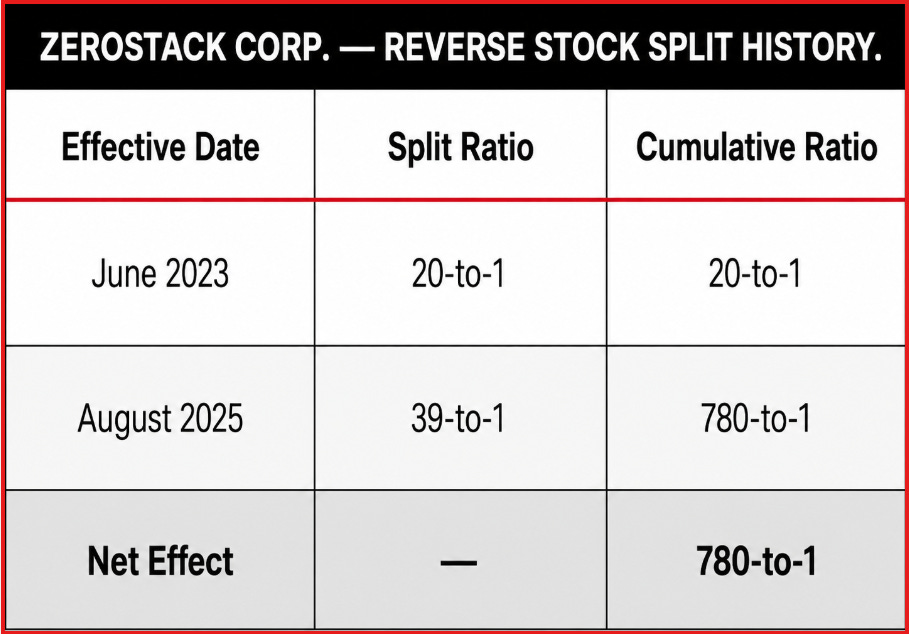
The 2025 split was directly connected to maintaining the company’s Nasdaq listing, FloraGrowth subsequently reported the shares remained above the required $1 bid price for ten consecutive trading days and that Nasdaq notified the company in August 2025 that it had regained compliance. Reverse splits do not, by themselves, destroy shareholder value, but repeated reverse splits matter most when they occur alongside recurring operating losses, equity issuance, and continued dependence on external financing. In this case for Flora shareholders, the denominator has been reset more than once.
Cannabis Out, AI Treasury In
On September 19, 2025, Flora Growth (then still a cannabis and CBD operator) announced a $401 million financing built around the Zero Gravity (”0G”) token, comprising $35 million in cash and over $366 million in non-cash digital assets, and rebranded as ZeroStack shortly after. Management framed this as a “cornerstone” of a new decentralized-AI treasury strategy and, on eliminating the associated convertible note in March 2026, stated the company would be “operated debt free.” Then on January 29, 2026, Flora Growth Corp. (FLGC) officially became ZeroStack Corp (ZSTK). ZeroStack now describes itself as a decentralized AI treasury and AI-focused asset management company investing in the future of artificial intelligence, its first major strategy is ownership of 0G, the native token of the Zero Gravity blockchain.
By the second quarter of 2026, the same treasury that was the entire basis of the rebrand had lost roughly 91% of its cost basis, and management’s own going-concern disclosure attributes the reversal directly to “the steep decline in the reported fair value of the 0G holdings.” Staking revenue of $3.8 million over six months did not come close to offsetting an $82.5 million fair-value loss over the same period.
Source: 0G 1-year chart showing a decline of +97% decline from its peak, less than a year ago.
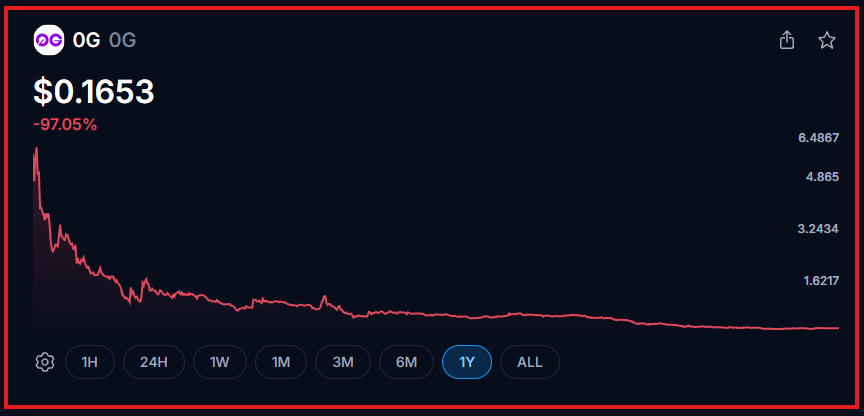
0G is currently trading at $0.1653, down 97.05% over the trailing year, a chart that reads less like a volatile crypto asset and more like a token in terminal decline. This is the same token ZeroStack restructured its entire corporate identity around in September 2025, the asset a $401 million financing was built on, the “cornerstone” management said would anchor a debt-free, decentralized-AI treasury strategy.
A treasury built on a single collapsing token would, in most companies, be a five-alarm signal to diversify, or at minimum de-risk. ZeroStack’s response was to do it again, larger, as one month after disclosing going concern doubt tied directly to the 0G collapse, the company entered a second token acquisition roughly an order of magnitude bigger, paid for in stock and warrants priced at a steep premium to the market. There is no visible mechanism in any filing reviewed to date that would prevent the MemeCore position from tracing the same curve now showing on the 0G chart and management has not demonstrated it learned anything from the first chart before building the second bet.
Source: Wojack meme character emotionally destroyed from bagholding worthless meme coins.

Quarter Over Quarter Value Destruction
Three consecutive balance sheets tell the same story from three different angles. Total assets fell from $130.235 million at December 31, 2025 to $45.2 million at March 31, 2026 to $25.187 million at June 30, 2026, an 80.7% collapse in two quarters. Cash followed the same direction, falling from $5.596 million to $2.640 million over the same window, a 52.8% decline that leaves the company with barely two and a half months of its own starting cash balance left on hand. The main culprit behind the broader collapse is the digital assets line itself: non-current digital assets fell from $71.950 million at December 31, 2025 to $14.148 million at June 30, 2026, an 80.3% decline that, combined with the near-total elimination of the company’s restricted digital assets over the same period, accounts for the overwhelming majority of the drop in total assets.
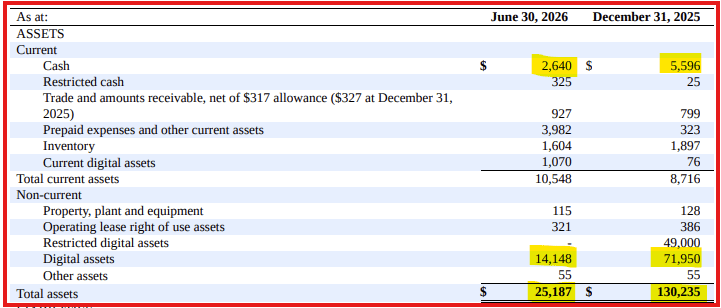
Source: ZeroStack Corp. Form 10-Q, quarterly period ended June 30, 2026, filed July 31, 2026.
Shareholders’ equity followed the identical trajectory: $70.552 million, then $36.797 million, then $13.818 million, a decline of 47.8% in the first quarter alone and a further 62.5% in the second, for a cumulative destruction of 80.4% of equity in six months.

Source: ZeroStack Corp. Form 10-Q, quarterly period ended June 30, 2026, filed July 31, 2026.
The one balance-sheet item that improved looks better than it is. Long-term debt fell from $50.767 million to essentially zero between year-end 2025 and June 30, 2026, which reads on its face like deleveraging. It isn’t. The company settled its only material debt obligation, the Zero Gravity Convertible Note, by transferring 50 million 0G tokens directly to the noteholder on March 31, 2026, paying down debt with treasury assets rather than operating cash flow or refinancing. The balance sheet looks cleaner because the company handed over the thing that was supposed to be the whole investment thesis.

Source: ZeroStack Corp. Form 10-Q, quarterly period ended June 30, 2026, filed July 31, 2026.
The share count adds a final layer most of the destruction above doesn’t even capture. Shares outstanding roughly doubled in the first quarter, from 1.046 million to 2.430 million, then held flat through June 30. The dilution came after, by August 23, 2026, following the Texas Blocker exchange, the MemeCore private placement, and related warrant exercises, shares outstanding reached approximately 21.8 million (nearly nine times the June 30 count), in under two months. A shareholder holding the stock at the June 30 balance sheet date has since watched their proportional claim on whatever assets remain shrink by roughly 89% on top of the equity losses already sustained.

A History of Equity Financing
Flora Growth’s capital markets history did not begin with the 0G treasury transaction. In November 2021, only months after its IPO, Flora Growth priced a $30 million follow-on public offering of 10,000,000 units, each consisting of one common share and one-half warrant — and closed it larger, after the underwriters exercised their over-allotment option in full, at $34.5 million and 11,500,000 units, introducing 11.5 million common shares and 5.75 million warrant shares exercisable at $3.75.
Additional financings followed. A September 2023 unit offering raised approximately $2.7 million and issued 1,369,000 investor warrants at a $2.50 exercise price, plus 54,760 placement-agent warrants at $2.39; as part of the same transaction, the company repriced 66,245 warrants from the November 2021 offering and 624,995 warrants from a December 2022 offering downward, from $8.00 to $2.50 per share.
The company later established a standing mechanism for issuing stock in smaller, more flexible increments. In 2024, it filed a Regulation A offering circular authorizing the sale of up to 44,910,179 common shares at a fixed price of $1.67 per share. The company drew only a small fraction of that capacity (425,000 shares, for gross proceeds of $0.7 million) before the year’s reported financing activity shifted to a separate $3.6 million registered direct offering at $1.25 per share. The gap between what was authorized and what was actually sold is itself notable: a Regulation A filing of that size gives the company standing authority to sell tens of millions of additional shares on short notice, largely outside the scrutiny a fully underwritten offering would draw, whether or not it is ever fully used.
Source: Flora Growth Corp. Form 253G3, “Offering Circular,” 2024.
These historical figures must be adjusted for the two subsequent reverse splits 20 to 1 in June 2023 and 39 to 1 in August 2025, and therefore cannot simply be added to today’s share count. Across a roughly $30 million underwritten offering, a warrant-repricing transaction, and a Regulation A shelf authorizing tens of millions more shares, this is a company that has repeatedly turned to equity issuance for capital, well before crypto treasury accounting entered the picture.
Going Concern, Again
This is not the company’s first going-concern warning either. Flora’s FY2024 annual report already disclosed substantial doubt about the company’s ability to continue as a going concern: management reported $6.1 million of cash and cash equivalents at December 31, 2024, a $15.9 million net loss for the year, and an accumulated deficit of $158.1 million, and stated plainly that its cash position was not sufficient to continue investing in growth while meeting its obligations as they came due.
ZeroStack’s most recent financial statements contain another going-concern warning, the second in three fiscal years, now under a different corporate identity and a different business model entirely. As of June 30, 2026, the company had $2.6 million in cash and Management states that it expects to fund operations primarily by monetizing digital assets generated through staking and, if that proves insufficient, by monetizing the underlying digital asset portfolio itself. The company nevertheless states it cannot conclude that these plans are probable of alleviating the conditions raising substantial doubt about its ability to continue operating over the following twelve months.

Source: ZeroStack Corp. Form 10-Q, quarterly period ended June 30, 2026, filed July 31, 2026.
Insider and Related-Party Relationships
The 0G transaction becomes more interesting once you examine who was on both sides of it. ZeroStack Executive Chairman Michael Heinrich is also the Chief Executive Officer of Zero Gravity Labs Inc., which was among the largest participants in the 0G token contribution. Before the share exchange that brought those tokens onto ZeroStack’s balance sheet, Zero Gravity Labs held 4,608,684 shares (50.6%) of Texas Blocker, the private vehicle formed to receive the contribution. At closing, Zero Gravity Labs received 4,608,864 ZeroStack common shares in exchange.
The related-party structure runs deeper than one director’s outside role. Texas Blocker, the entity that actually received the 0G tokens and was later exchanged into ZeroStack was formed by CEO Daniel Reis-Faria and CFO Dany Vaiman, and its board of directors consisted of exactly those two people. The company’s own CEO and CFO, in other words, created and controlled the private company on the other side of a transaction that their own employer would later acquire. Separately, of the 71.77 million 0G tokens contributed through the company’s original Token Private Placement in September 2025, 50 million (valued at $150 million), more than a third of the entire $401 million financing the company has publicly credited as its founding transaction, came from Daniel Reis-Faria personally.
The question for public shareholders was never whether the relationships were disclosed, but the real question is what economic interests those relationships created, and how those interests interact with ZSTK’s public market valuation. On May 5, 2026, the company’s independent directors granted Reis-Faria, Vaiman, and Heinrich a massive amount of stock options respectively, vesting in tranches tied to the stock hitting VWAP price thresholds between $7.65 and $17.85, compensation that pays out specifically when the share price rises, awarded to the same three executives who control the timing and structure of the token transactions that move that price.
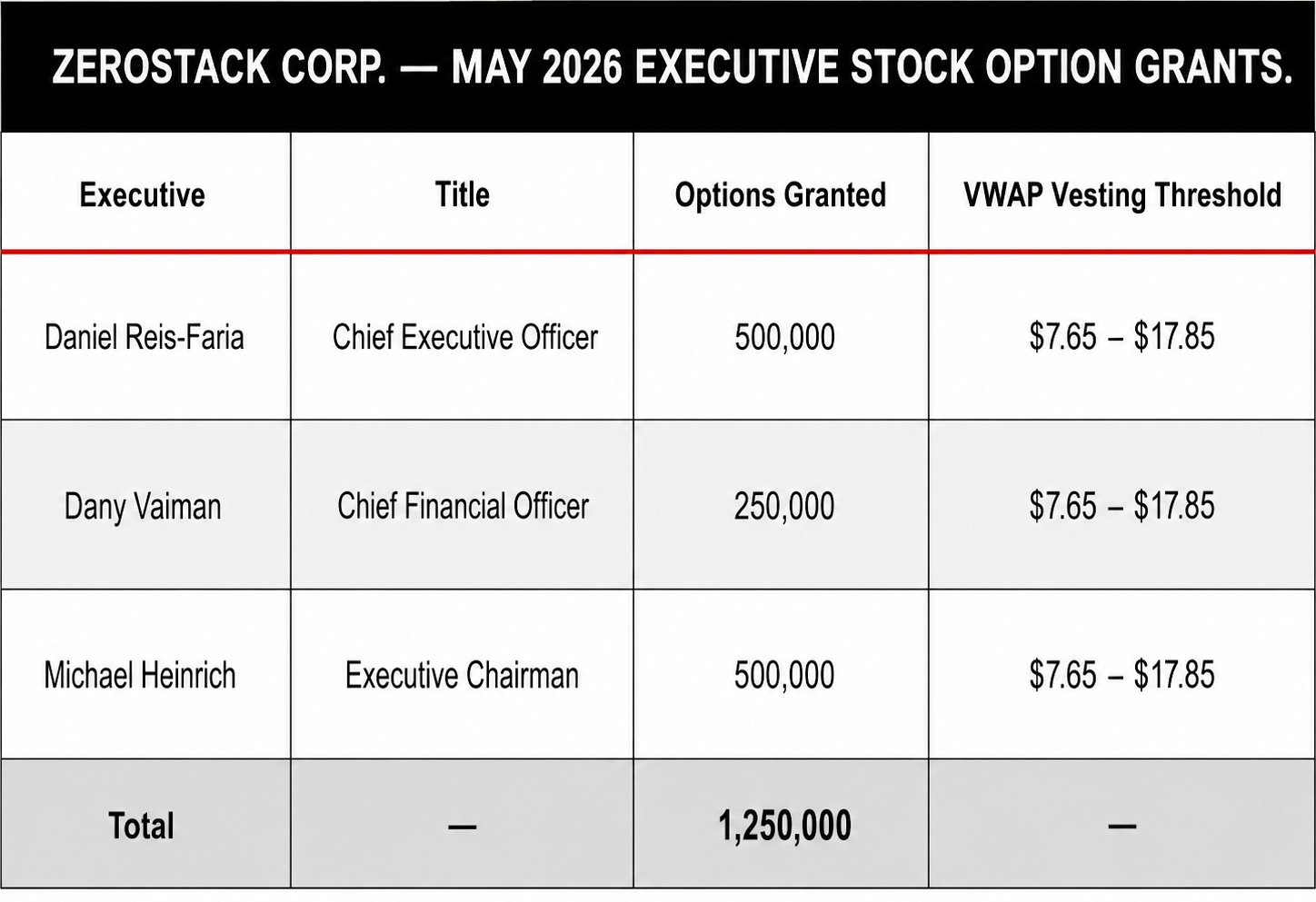
Source: ZeroStack Corp. Form 8-K, filed May 6, 2026.
Source: ZeroStack Corp. Form S-4.; ZeroStack Corp., “Transparency First: An Update on ZeroStack’s Financials and Progress,” Oct. 9, 2025.
What Happened to the Original Businesses?
One of the more revealing exercises with this company is simply following the businesses it once told investors would drive its future. Flora Growth’s founding story was Colombian cannabis cultivation, the company IPO’d on a claim of producing cannabis at $0.06 a gram from a 246-acre outdoor facility. Those Colombian operations were sold to an unnamed private buyer for CAD $800,000 in 2023. Flora Growth had separately spent tens of millions building out a consumer-facing cannabis portfolio.
The rest of that portfolio was disposed of on September 20, 2025, under an Equity Transfer and Debt Repayment Agreement the company calls the “Cannabis Sale Agreement,” which transferred JustCBD, Vessel, United Beverage Distribution Inc., and High Roller Private Label LLC out of the company.

Source: ZeroStack Corp. Form 10-K, fiscal year ended Dec. 31, 2025, filed Feb. 27, 2026, Note 5.
Phatebo, the company’s German pharmaceutical distribution subsidiary, remains and continues to generate the overwhelming majority of the company’s conventional operating revenue. But Phatebo is not the reason investors are chasing ZSTK, the token treasury is. That distinction matters: the operating business generating most of the company’s actual revenue is not the business generating most of the market’s excitement, and the company’s valuation increasingly depends on the market’s willingness to treat a volatile pool of digital assets as a growth platform, held by a company with a long and now-documented history of turning to whatever asset story is currently available, cannabis cultivation, consumer cannabis brands, and now crypto to fund itself.
Conclusion
ZeroStack is a new name attached to an old public company, and the old company’s record is the most relevant diligence available on the new one. Before decentralized AI, there was cannabis: Colombia, Vessel, JustCBD, a European expansion story, and a run of acquisitions that ended in impairments, losses, two reverse splits, and a going-concern warning. In 2021, an independent investigator physically inspected the company’s flagship operating asset and found a story that collapsed on direct contact, a facility that couldn’t be toured, an office that didn’t exist, paid promotion timed to an insider lockup.
This is the company’s second going-concern warning in three fiscal years. Total assets fell 80.7% and shareholders’ equity fell 80.4% in the two quarters following the 0G treasury’s adoption, driven by an 87.4% collapse in the digital assets that were supposed to be the entire investment thesis. The company generated $20.9 million in revenue over the first six months of 2026 against a $61.3 million net loss, with only $3.8 million of that revenue coming from the digital-asset staking activity the treasury exists to justify, along with a share count that grew from roughly 2.4 million to over 21 million in a matter of months, largely to fund transactions structured by the people who benefit from the resulting share price.
Our work on ZSTK is continuing, particularly around the fully diluted capital structure, historical promotion, insider economics, 0G token liquidity, the economics of staking, and the relationship between ZeroStack and Zero Gravity Labs. Based on what we have reviewed so far, we believe those details are likely to make Flora Growth’s history considerably more relevant, not less. For these reasons, Fugazi Research believes ZSTK shares are uninvestable at any price above zero.
Disclaimer
The research, commentary, reports, and other materials published by Fugazi Research LLC (“Fugazi Research,” “we,” “us,” or “our,”) are provided solely for informational and educational purposes. Fugazi Research is an independent research publisher and is not registered as an investment adviser, broker-dealer, or commodity trading advisor with the U.S. Securities and Exchange Commission or any other regulatory authority.
All content published by Fugazi Research represents our opinions as of the date of publication and is based on publicly available information, independent research, interviews, and analytical judgment. Our opinions are inherently subjective, may be incomplete, and are subject to change at any time without notice. We do not undertake any obligation to update or revise our content to reflect subsequent events, market developments, or new information.
Nothing published by Fugazi Research constitutes investment advice, financial advice, legal advice, tax advice, or a recommendation to buy, sell, or hold any security or financial instrument. The information should not be construed as tailored to the investment objectives, financial situation, or particular needs of any individual or entity. Readers should conduct their own independent research and consult their own financial, legal, and tax advisors before making any investment decision.
Fugazi Research, its affiliates, principals, members, employees, consultants, or clients may have positions—long, short, or otherwise—in the securities discussed, and such positions may change at any time for any reason, including risk management, market conditions, or liquidity considerations. We may trade in securities covered by our research before, during, or after publication, and we may reduce, close, or reverse positions at any time without notice. Readers should assume that Fugazi Research has a financial interest in the securities discussed.
Our research may include forward-looking statements, estimates, projections, or opinions that involve known and unknown risks, uncertainties, and assumptions. Actual outcomes may differ materially from those expressed or implied. Past performance is not indicative of future results. All investments involve risk, including the potential loss of principal.
While we believe the information we present is accurate and reliable, it is provided “as is” and “as available,” without any representation or warranty, express or implied, as to accuracy, completeness, timeliness, or fitness for any particular purpose. Fugazi Research disclaims any liability for errors, omissions, or losses arising from the use of our content.
By accessing or using Fugazi Research’s materials, you acknowledge and agree that Fugazi Research shall not be liable for any direct, indirect, incidental, consequential, or other losses arising from reliance on our research or opinions. Use of our content is entirely at your own risk.
All content is the intellectual property of Fugazi Research and may not be reproduced, distributed, or shared without prior written consent.
This is crazy yo. Seems like every week a story comes out about a zombie company resurrected from an old failed company or a more recent vintage SPAC. Thanks for the ideas 🙏