

Executive Summary
TEN Holdings, Inc. is not a software company hiding inside an events business. It looks much more like a tiny webinar and event production company that discovered software clothing at precisely the moment Wall Street became obsessed with AI. Unfortunately, the income statement never got the wardrobe change. It is not a technology company in any meaningful sense but a services vendor with a proprietary platform wrapped around it. Total revenue for fiscal 2025 was approximately $3.1 million, down from $3.5 million in 2024, an 11.4% decline against a net loss of $19.5 million.
Behind the story sits one of the most visible names in the small-cap pump-and-dump stock frenzy, which regulators have spent years trying to shut down: Bancroft Capital LLC. Bancroft priced TEN Holdings IPO at $6 a share in February 2025, being one of at least fourteen small-cap IPOs Bancroft led and underwrote between 2024 and 2025, roughly one a month, of which twelve completed and raised a combined $100 million, each paying Bancroft the standard 7% underwriting fee regardless of what happened to the stock afterward. XHLD opened at $6, spiked to just over $100 on its first trading day, valuing the company near $200 million, then tanked to roughly $31 the next day, $18 four days later, and traded at around $1.50 for months.
Of the twelve Bancroft IPOs that Bancroft has underwritten and completed, nine traded between 54% and 98% below their IPO price as of May 2026, and two were halted (one delisted) by Nasdaq, outright, for the kind of extreme volatility regulators associate with pump-and-dump activity, as Bloomberg independently named Bancroft among ten underwriters of “apparent pump-and-dump deals”. XHLD shows every visible symptom of a pump-and-dump scheme run by unidentified third parties exploiting a thin float and a low-quality underwriter IPO structure. However, in every case Bancroft cashed in, fees were collected on the way up, while the losses were sucked up entirely by whoever was still holding shares on the way down.
In May, Nasdaq notified TEN Holdings that it had fallen below the exchange’s $2.5 million minimum stockholders’ equity requirement, and roughly a month later, the company sold 7.5 million new shares at $1.00 each and said it believed the financing restored compliance. Revenue could not fix the problem, and the company resorted to an equity purchase arrangement with Lincoln Park Capital, opened the gate to millions of shares being issued through assorted financing and advisory deals, and then authorized a 15-to-1 reverse split, more $1-per-share sales, and then a June 2026 financing on top of all of it. In one of their latest stretches of toxic dilution, XHLD entered 2026 with 3.98 million shares outstanding and closed June 2026 with 11.98 million, a roughly 201% increase in six months, with that single June 30 offering alone responsible for about a 168% increase.
TEN Holdings received subpoenas and information requests from both the DOJ and the SEC concerning the company’s IPO and four contracts it executed after going public (a live disclosed federal inquiry). TEN Holdings’ own Board, acting on an internal investigation, concluded that certain agreements executed by former management in connection with the IPO “lacked economic substance and any direct benefit to the Company” and may have “solely benefited the counterparties to those agreements rather than the Company.” The disclosure landed within weeks of a Nasdaq stockholders’ equity deficiency notice and the resignation of CEO Randolph Wilson Jones III, replaced by CFO Virgilio Torres, who now holds both titles at once, running finance and the company at the same moment federal investigators are asking questions about both. Every officer and director who ran the company at the time of the IPO are now gone.
In August 2026, the pattern came full circle, as XHLD closed at $0.80 on August 5 (an all-time low); one trading session later, it reached $5.42 on nearly 69 million shares of volume. By August 19, it had touched $8.30 (a move of more than 900% in roughly two weeks), except this time the business is still tiny, revenue is lower, and the losses continue. Eighteen months and a reverse split later after the IPO date, XHLD investors got a rerun of the exact same show. Fugazi Research considers XHLD shares uninvestable at any price above ZERO.
Fugazi Research Analysis
A grand jury subpoena in October 2025 became a parallel SEC investigation within 24 hours, which became a second SEC subpoena naming the former CEO five months later; now every officer and director in place at the time of the IPO is gone.
CEO Randolph Wilson Jones III resigned May 8, 2026, weeks before a Nasdaq stockholders’ equity deficiency notice and a disclosed DOJ/SEC inquiry into the company’s IPO and four post-IPO contracts. CFO Virgilio Torres now holds both the CEO and CFO titles simultaneously.
A “market awareness agreement” with MicroCap Advisory, LLC ($100,000 a month plus warrants), for “investor outreach” and “media planning”, was signed in June 2025, inside the time window as the company was under DOJ and SEC scrutiny. TEN Holdings was paying an outside party specifically to shape market perception of its stock at the exact moment its stock was behaving exactly the way regulators associate with manipulation.
An active Lincoln Park Capital equity line, a forced 15-to-1 reverse split, repeated sub-$1 and $1 share sales, and a 168% single-day share-count expansion in June 2026 collectively describe a company financed by continuously issuing itself away, not by operating cash flow.
Bancroft was paid in full before the float ever found a real price, as it collected its standard 7% fee on TEN Holdings’ $10 million IPO regardless of what happened to the stock afterward, and what happened was a collapse from over $100 to roughly $18 within four trading days.
Of the twelve Bancroft-underwritten IPOs completed between 2024 and 2025, nine traded 54–98% below issue price as of May 2026, and two were halted outright for volatility regulators associated with pump-and-dump activity. Bloomberg independently named Bancroft among ten underwriters of “apparent pump-and-dump deals.”
One of Bancroft’s most recent IPOs, Fitness Champs Holdings, spiked past $100 within three weeks of listing before Nasdaq halted trading over the volatility; it settled near $1.10 days later. Fitness Champs is now the named defendant in a shareholder suit citing seven other Bancroft IPOs as “similarly disastrous.” No regulator has charged Bancroft, and the one court to examine the theory declined to let it proceed on the pleadings offered.
Premium Catering (Holdings) Ltd. was suspended by the SEC in October 2025 over suspected social-media-driven manipulation, then halted outright by Nasdaq “for additional information requested from the company” and has not traded since. Magnitude International Ltd. followed an identical sequence in December 2025 and, eight months later, received a Nasdaq delisting determination specifically because the exchange concluded a stock vulnerable to this kind of manipulation cannot support fair and orderly markets. Both are Bancroft-underwritten IPOs, exactly like XHLD.
TEN Holdings increasingly emphasizes artificial intelligence, automation, analytics, personalization, and AI-powered content capabilities. None of that is inherently problematic. What matters is whether those initiatives produce revenue, customer growth, operating leverage, and cash flow. So far, the financial statements do not show an AI business remotely large enough to support the current valuation.
The stock’s 52-week range spans $0.76 to $128.10, a 168x peak-to-trough spread, on a company whose implied market capitalization fell from roughly $200 million at the IPO-day high to under $5 million in the non-affiliate valuation reported (as of the 10-K’s stated record date) for FY2025, shows mostly a pump-and-dump pattern than a value investment.
Fugazi Research considers XHLD uninvestable at any price above zero.
Source: TEN Holdings, Inc. Form 10-K, fiscal year ended Dec. 31, 2025, filed March 18, 2026.
Source: TEN Holdings, Inc. Form 8-K (Nasdaq compliance plan), filed July 20, 2026.
Source: Bloomberg, “How Apparent Pump-and-Dump Scams Thrive on Wall Street,” Jan. 29, 2026.
Source: TEN Holdings, Inc. Form S-1, filed April 6, 2026.
Financial Summary
TEN Holdings lost nearly $20 million in 2025 while generating only $3.1 million of revenue. It lost another $5.9 million during the first six months of 2026 against $1.6 million of revenue.
Total revenue declined 11.4% year over year to approximately $3.1 million in FY2025, from $3.5 million in FY2024, while net loss expanded approximately 550% to $19.5 million, from $3.0 million, a loss more than six times the revenue that produced it.
Q2 2026 revenue fell 34.5% year over year to $0.7 million, from $1.1 million in Q2 2025, with the same single-customer concentration flagged in the FY2025 10-K driving the decline directly.
The accumulated deficit grew in three consecutive steps: $21.4 million (Dec. 31, 2025) to $24.3 million (March 31, 2026) to $27.3 million (June 30, 2026), a 28% expansion in six months, against net cash used in operations of $10.1 million for FY2025 alone.
The company recognized a $4.2 million impairment on capitalized software in FY2025, reducing gross intangible assets of $4.9 million to essentially nil net of impairment and accumulated amortization; management’s own stated trigger was “recurring operating losses and negative cash flows.”
Cash climbed from $0.08 million (March 31, 2026) to $5.8 million (June 30, 2026) entirely on the back of the $6.6 million net proceeds from the June 30 share sale , as the company’s operating business generated none of it.
The company paid $100,000 per month plus warrants to a third-party “market awareness” advisor beginning June 2025, a cash outflow for stock promotion services layered on top of an already negative cash-flow business.
Research and development expenses grew about 900%, from $0.1 million (2024) to $1.0 million (2025), even as revenue moved in the opposite direction.
Total shareholders equity fell 61% in one quarter, from $4.279 million (Dec. 31, 2025) to $1.662 million (March 31, 2026), the direct precursor to Nasdaq’s May 26, 2026 deficiency notice under the $2.5 million minimum equity standard.
A single customer accounted for 66.7% of total FY2025 revenue, up from 64.6% in FY2024, concentration risk that increased in the same year total revenue declined.
Shares outstanding grew from 3,977,443 (Jan, 2026) to 11,977,443 (June, 2026) a 201% increase in six months, with the single June 30 offering of 7,500,000 shares at $1.00 alone responsible for a 168% increase against its immediate pre-offering base of 4,477,443 shares.
Source: TEN Holdings, Inc. Form 10-K, fiscal year ended Dec. 31, 2025, filed March 18, 2026.
Source: TEN Holdings, Inc. Form 8-K (Nasdaq compliance plan), filed July 20, 2026.
Source: TEN Holdings, Inc. Form 10-Q, quarter ended June 30, 2026.
Source: TEN Holdings, Inc. Form S-1, filed April 6, 2026.
Bancroft’s Microcap IPO Record
Our review of SEC filings identifies at least 12 Bancroft-underwritten microcap IPOs completed during 2024 and 2025. The Philadelphia Inquirer’s May 2026 analysis examined 11 of those deals. SEC filings identify another completed Bancroft deal in the same period: Ten-League International, which priced its IPO in July 2025 with Bancroft as underwriter. Across eight of Bancroft’s IPOs tracked through May 1, 2026, the combined paper losses to investors exceed $1 billion. Seven of the 12 issuers operated from Singapore, four from Hong Kong, and TEN Holdings was the only U.S. company in the group.
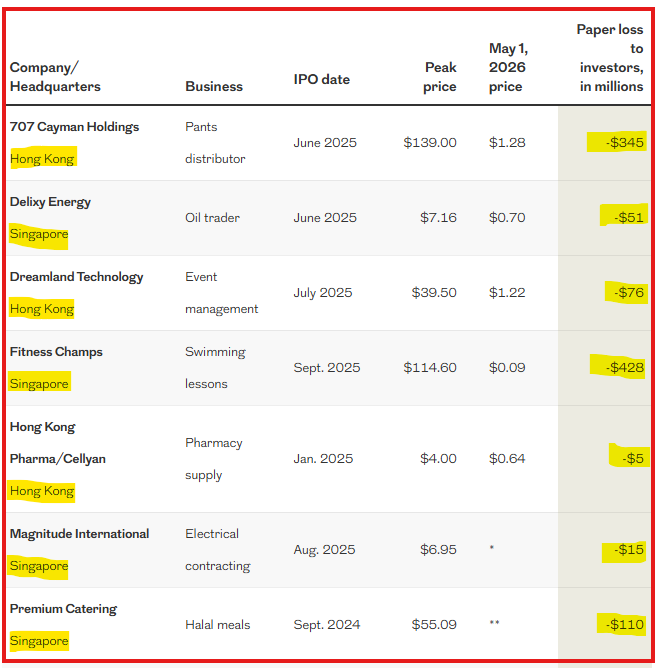
Source: Philadelphia Inquirer, “Social media ‘pump and dump’ fraudsters targeted tiny Nasdaq stocks, including this Philly firm’s IPOs, says lawsuit,” May 12, 2026.
Bloomberg’s own data settles whether Bancroft’s pattern is coincidence or business model. In an analysis of the microcap underwriting market, Bloomberg mapped every investment bank that took companies public on Nasdaq’s smallest listing tier against the share of those deals that later became apparent targets of pump-and-dump schemes, hyped in chatrooms, spiked, and dumped. Bancroft sits in a cluster of firms, alongside names like Revere, D. Boral, Dominari, and Cathay, whose half of the deals they underwrote were later identified as apparent pump-and-dump targets, and unlike the smaller, more erratic bubbles further out on Bloomberg’s chart representing one or two questionable deals apiece, Bancroft’s bubble reflects a real volume of business. Bloomberg’s analysis found that just eight underwriters accounted for nearly three-quarters of every Nasdaq microcap company later targeted by these schemes, including Bancroft.
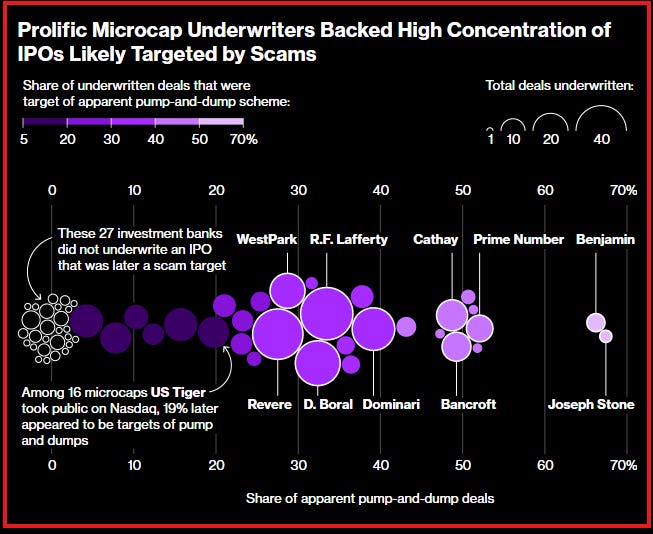
Source: Bloomberg, “How Apparent Pump-and-Dump Scams Thrive on Wall Street,” Jan. 29, 2026.
The Bancroft Capital Connection
Bancroft Capital LLC served as lead underwriter for TEN Holdings’ February 2025 IPO. XHLD sold approximately 1.67 million shares at $6.00 per share, raising roughly $10 million gross.
On its first trading day, the stock exploded above $100. The move briefly valued TEN Holdings near $200 million despite annual revenue of only a few million dollars. The stock then collapsed and eventually traded below $1.
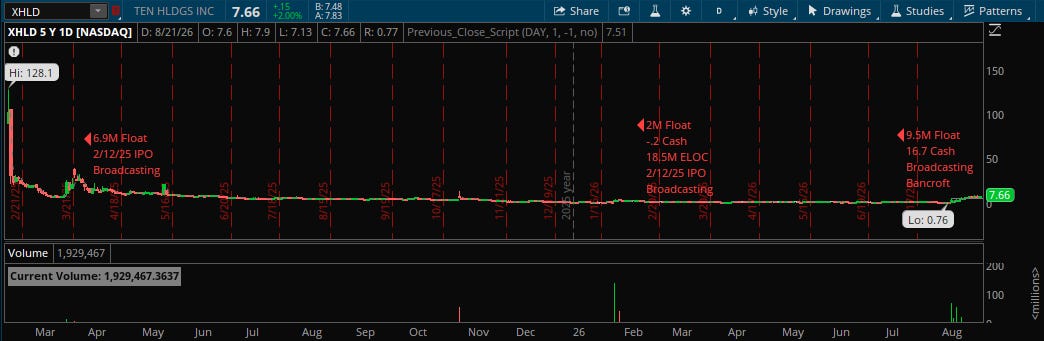
Source: XHLD- TOS 2-year daily chart showing a decline of +90% decline from its peak
Bancroft collected its standard 7% fee on TEN Holdings’ $10 million IPO regardless of what happened to the stock afterward, and it collapsed from over $100 to roughly $18 within four trading days, then traded below $1 within the year. In August 2026, the same stock that closed at $0.80 on August 5 traded as high as $5.42 the very next session on nearly 69 million shares (several multiples of the company’s entire float) and kept climbing to $8.30 by August 19.
The Looming T12 Risk
Two companies from Bancroft’s 11 completed microcap IPOs have followed a far more serious path than an ordinary volatility halt. Nasdaq maintains discretionary authority to halt a stock outright when its price action itself becomes evidence of a problem, a mechanism distinct from routine volatility circuit-breakers, triggered when the exchange requests additional information from the company and refuses to let trading resume until it gets answers.
Premium Catering (PC) went public in September 2024 with Bancroft as underwriter. On October 16, 2025, the SEC ordered trading suspended after citing potential manipulation involving recommendations made by unknown persons through social media that appeared designed to artificially inflate the stock’s price and trading volume. Nasdaq then asked Premium Catering for additional information and documents. When the SEC suspension expired on October 30, trading did not resume. Nasdaq kept the stock halted while it waited for the requested information.
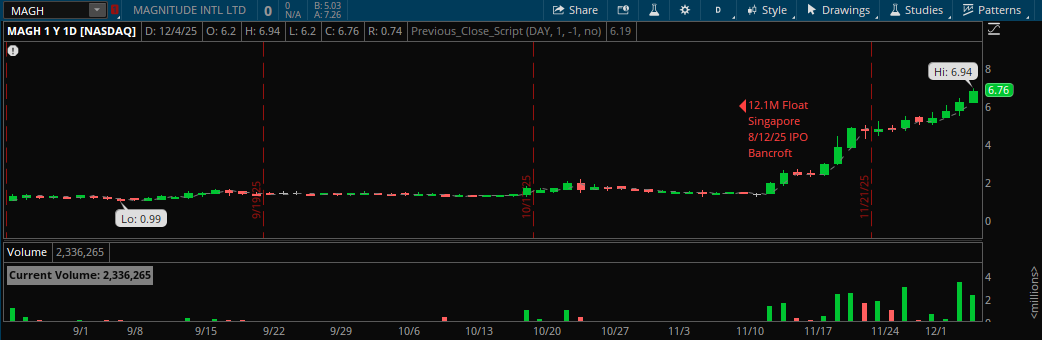
Magnitude International (MAGH) followed a similar sequence two months later. Magnitude completed its Bancroft-led IPO at $4.00 in August 2025. On December 4, the SEC suspended trading after citing potential manipulation involving social-media recommendations telling investors to buy, hold, or sell MAGH and, in some instances, send screenshots of their transactions. When the SEC suspension expired on December 18, Nasdaq did not reopen the stock. On December 19, Nasdaq announced that MAGH would remain halted while it sought additional information from the company.
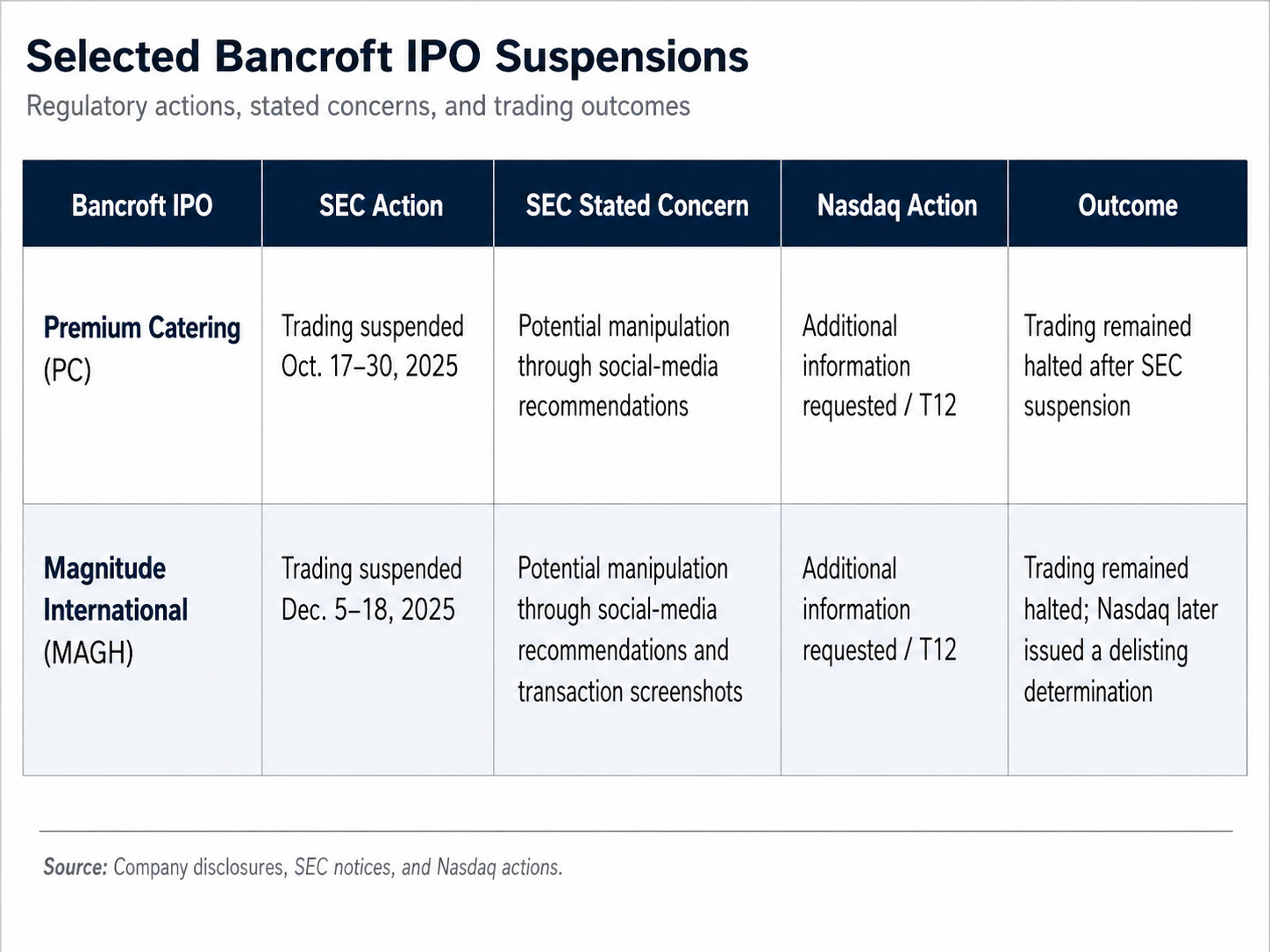
Above: Bancroft underwritten IPOs which remain halted and/or delisted
A trading halt is not hypothetical for this underwriter’s cohort, as XHLD’s stock price action follows the same pattern that preceded both the Premium Catering and Magnitude International halts: a thin float, a sudden multiple-hundred-percent swing, and no disclosed business development to explain it. For a shareholder, a T12 halt is not a pause, as once Nasdaq freezes a stock “pending additional information,” there is no exit, no way to sell, cut a loss, no resolution date, no interim market, and no guarantee the stock ever reopens at anything close to the price it closed at. If a stock is halted and later delisted outright, the practical outcome for most retail holders is a forced move to the OTC market, meaning thinner liquidity, wider spreads, and often a fraction of the pre-halt price, assuming a market exists to sell into at all.
Source: Premium Catering (Holdings) Ltd. Form 6-K, “Suspension of Trading,” filed Oct. 24, 2025.
Source: Nasdaq, “Nasdaq Halts Magnitude International Ltd,” Dec. 19, 2025.
Source: Magnitude International Ltd. Form 6-K, “Announces Receipt of Nasdaq Delisting Determination Notice,” Aug. 5, 2026.
The $5.4 Million IPO Money Trail
On the same day TEN Holdings’ IPO closed (February 18, 2025), the company signed four advisory and services agreements and paid the counterparties $5.4 million upfront, roughly 61% of its $8.9 million in net IPO proceeds, in a single day.
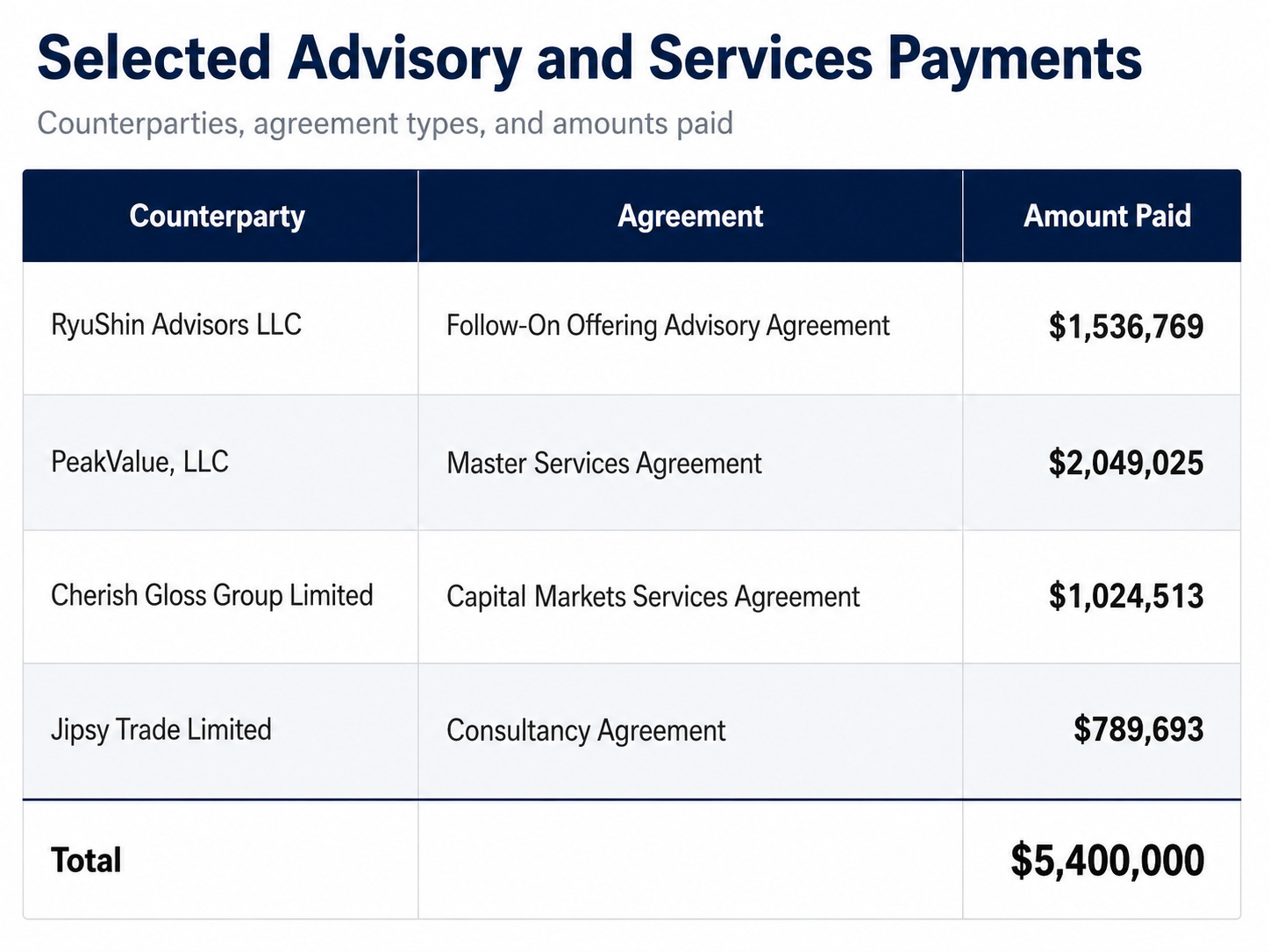
On October 27, 2025, TEN Holdings received a grand jury subpoena from the U.S. Attorney’s Office for the Southern District of New York, seeking documents relating to the company’s IPO. The SEC opened a parallel investigation the next day. Five months later, on March 10, 2026, the SEC issued its own subpoena, this one naming TEN’s former CEO personally. Every officer and director who ran the company at the time of the IPO is now gone.

Source: TEN Holdings, Inc. Form 10-K, fiscal year ended Dec. 31, 2025, filed March 18, 2026.
Following an internal investigation, TEN’s own Board concluded that those agreements, executed at the direction of former management, “lacked economic substance and any direct benefit to the Company,” and may have “solely benefited the counterparties to those agreements rather than the Company.” The company has informed the DOJ and SEC of these findings directly. In July 2026, TEN terminated all four agreements without response.
V-Cube, Inc. (TEN’s controlling shareholder and former parent) disclosed that it could not confirm clear evidence that the contracted services had actually been provided, and identified discrepancies between the parties named in the contracts and the parties who actually received the payments. V-Cube further disclosed that its then-representative director, Naoaki Mashita, had issued a document in V-Cube’s name promising financial support for the payments without prior approval from V-Cube’s own board. V-Cube’s independent auditor, Grant Thornton Taiyo, subsequently issued a disclaimer of opinion on V-Cube’s financial statements for fiscal year 2025, refusing to certify the accounts, having failed to obtain sufficient audit evidence regarding the fee payments. Nobody involved, not the company or its former parent, has yet been able to say what TEN actually got for it.
Source: TipRanks, “V-cube Launches Special Probe Into TEN Advisory Fee Irregularities,” Apr. 24, 2026.
Source: TipRanks, “V-cube hit with auditor disclaimer over Nasdaq-linked fee probe,” May 8, 2026.
The Share Count Was the Business Plan
TEN Holdings completed a 15-to-1 reverse stock split in December, 2025. The split reduced the number of shares outstanding and mechanically increased the quoted share price. Just three weeks later, the company entered a private placement for 991,000 shares at $2.27 per share, raising approximately $2.25 million and granting the investors registration rights; the share count had been compressed for exactly 21 days before it started bloating again.
In May 2026, Nasdaq notified TEN Holdings that the company had fallen below the exchange’s $2.5 million minimum stockholders’ equity requirement. The company’s solution was to sell stock. In May, it sold 500,000 shares at $1.00 per share; then, on June 30, TEN Holdings sold 7.5 million shares at $1.00 each, producing $7.5 million gross and roughly $6.6 million net. Before that offering, approximately 4.48 million shares were outstanding; immediately after, the share count had exploded to roughly 11.98 million shares. In a single transaction, the float increased by 168%, for a total increase of about 201% over six months.

Source: TEN Holdings, Inc. Form 8-K, filed July 20, 2026.
At the August 21, 2026 closing price of $7.66 and 11,977,443 shares outstanding, XHLD’s market cap was about $91.7 million, against $3.1 million in FY2025 revenue and $3.17 million in annualized first-half 2026 revenue. That prices the stock at roughly 29x annualized revenue, multiples associated with high-growth technology companies, applied to a company whose revenue is declining, whose losses dwarf that revenue by a factor of approximately six, with negative cash flow, and going-concern language.
Source: TEN Holdings, Inc. Form 8-K, filed Dec. 3, 2025.
Source: TEN Holdings, Inc. Form 8-K, filed July 20, 2026.
$500,000 From a Chinese-Owned Farm
On May 22, 2026, TEN Holdings sold 500,000 shares of common stock to a single investor, Wang Huaqiu, for $500,000 ($1.00 per share), priced under Regulation S, with registration rights attached so the shares could later be resold into the public market. The filing lists Wang Huaqiu’s address as Production Team No. 006, 21st Production Team, 2nd District, Xihua State-owned Farm, Danzhou City, Hainan Province, an agricultural collective in China, not the kind of address ordinarily associated with a half-million-dollar allocation into a Nasdaq-listed company under a foreign private placement exemption. We present this information because it is exactly the kind of detail a reader doing their own diligence would want to see: unregistered stock, sold quietly to an individual buyer in China (outside of the reach of securities authorities), days before the company would need to demonstrate to Nasdaq that it had solved a stockholders equity deficiency, with a resale registration filed shortly after.
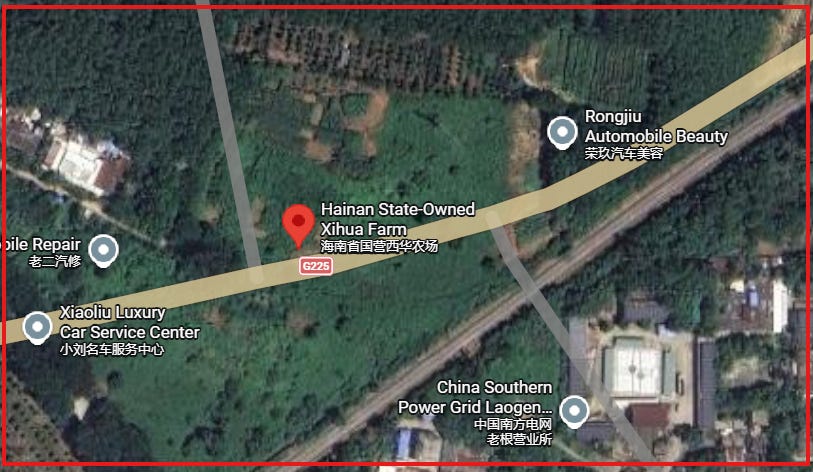
Above: satellite imagery of the “corporate offices” of TEN Holdings’ $500,000 investor, Xihua State-Owned Farm, Danzhou City, Hainan Province. Fugazi Research could not locate a boardroom or corporate office.
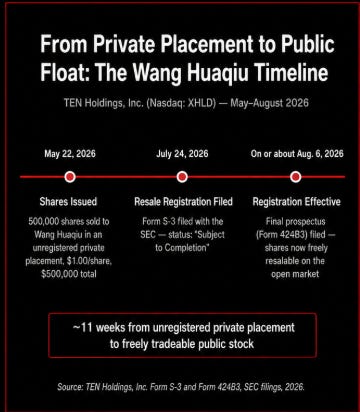
The path from private placement to public liquidity moved quickly, as TEN Holdings filed the resale registration statement on July 24, 2026 (roughly two months after Wang Huaqiu’s shares were issued) converting what had been an unregistered private placement into freely tradeable stock. The filing discloses that Wang Huaqiu holds no other position, office, or material relationship with the company beyond this single 500,000 share stake, and that TEN has no arrangement or understanding with him regarding how or when he sells. Once the registration became effective on August 5, 2026, he was free to sell into the open market at any price, at any time, through ordinary brokerage transactions, without further disclosure of the timing or size of any sale. Apparently, since August 7th the stock has been magically ascending on a daily basis on what appears to possibly be wash-trading on very light volume and liquidity. This is almost a mirror image of how MAGH traded before being T-12 halted for possible manipulation.
Source: MAGH- TOS 4-month daily chart showing the manipulated rise before T-12 halting.
$100,000 a Month for Market Awareness
In July 2025, TEN Holdings entered into a market awareness agreement with MicroCap Advisory LLC. The agreement called for a $15,000 setup fee, $100,000 per month, and 33,333 warrants exercisable at $6.00 per share for two years, with anti-dilution protection built in for any future reverse split. The stated services include “investor communications, positioning, media planning, and campaign execution”.

Source: TEN Holdings, Inc. Form 10-Q, quarter ended June 30, 2026, Note 15 — Consulting and Advisory Agreement.
A September 11, 2025 press release, distributed via GlobeNewswire and syndicated across financial news outlets, carried the headline “TEN Holdings Powers Up with SaaS Pivot,” claimed the company was positioned to “capitalize on the $1 trillion global SaaS market,” cited an unnamed “All-Star Analyst” reaffirming a bullish outlook, and teased “at least one acquisition before year-end” that never materialized in any subsequent filing. The release’s own disclosure footnote states plainly that its publisher “has been paid by Microcap Advisory for providing ongoing XHLD market outreach and other services.”

TEN Holdings was, by its own contractual arrangement, paying to generate bullish media coverage of a stock it now discloses is the subject of a DOJ and SEC investigation into its IPO and post-IPO contracts. Whether that coverage rises to the level regulators associate with coordinated promotion is a matter of reader due diligence and pattern recognition.
The Platform That Still Looks Like Small Events Contractor
TEN Holdings describes itself as an event planning, production, and broadcasting company supporting virtual, hybrid, self-service, and physical events through its Xyvid Pro and TEN Pro platforms. For the six months ended June 30, 2026, platform usage revenue declined from approximately $1.5 million to $1.3 million, while professional and managed services revenue increased modestly, from approximately $268,000 to $324,000, but that improvement was not enough to offset the platform decline. Management attributed lower first-half revenue primarily to reduced expected business from one of its largest customers, with some opportunities shifting into the third quarter.
As of December 31, 2025, TEN Holdings employed 25 full-time people, 15 in management and administration, six in sales and marketing, two in shared services, and exactly two in development. Research and development spending for FY2025 totaled $1.0 million, run by a team the company itself describes as “approximately two research and development specialists.” TEN competes against Zoom, ON24, Cvent, GlobalMeet, Bizzabo, and Meeting Tomorrow, companies with materially larger platforms and materially larger engineering organizations. The company’s own filings show that the service agreement with its largest customer states that “the services outlined in the purchase orders and actually provided by the Company do not include any SaaS offerings.”
The company increasingly emphasizes artificial intelligence, automation, analytics, personalization, and AI-powered content capabilities in its public communications. As of the FY2025 10-K, the company’s entire disclosed AI use case is captioning and transcription, expanded from 8 to over 70 languages in the first quarter of 2026. Everything beyond that is pure wishful thinking: TEN says it “will be incorporating AI-based Business Intelligence capabilities,” that its platform “will analyze your event for the highlights and generate short-form clips,” and that “Generative AI capabilities will be leveraged to provide a summary” of missed events. However, none of these initiatives produce revenue, customer growth, operating leverage, or cash flow. So far, the financial statements do not show an AI business remotely large enough to support the valuation this stock has.
Source: TEN Holdings, Inc. Form 10-Q, quarter ended June 30, 2026.
Source: TEN Holdings, Inc. Form 10-K, fiscal year ended Dec. 31, 2025, filed March 18, 2026.
Before June, There Was Lincoln Park
TEN Holdings had already established a substantial equity financing mechanism with Lincoln Park Capital Fund LLC. In June 2025, the company entered into an agreement allowing it, subject to specified conditions, to direct Lincoln Park to purchase up to $20 million of common stock. The related resale prospectus registered millions of shares connected with the arrangement.
TEN Holdings later disclosed that it issued 4,454,818 shares to Lincoln Park at a weighted-average price of about $0.32 per share, generating about $945,542. The company also issued 2 million shares to Spirit Advisors LLC for advisory services related to financing initiatives; a third-party filing analysis has estimated that roughly $18 million of capacity may remain under the Lincoln Park arrangement. An equity line of credit like this functions as a standing option to dilute; it does not require Nasdaq pressure or a specific catalyst; it only requires management to decide the company needs money and the market will bear the sale.
Source: TEN Holdings, Inc. Form 10-Q, quarter ended June 30, 2026, Note 11 — Stockholders’ Equity.
Conclusion
TEN Holdings, by its numbers alone, is a twenty-five-person events-services company with two developers, declining revenue, a net loss six times that revenue, an accumulated deficit approaching $30 million, and a going-concern qualification from its own auditor. That company would not command a $91.7 million valuation on any exchange, under any circumstances, on its own merits.
An underwriter whose other Bancroft-led IPOs show a coin-flip rate of apparent pump and dump targeting, on a share of the market that regulators and Congress are actively investigating. A federal grand jury and the SEC are examining the company’s own IPO and the four contracts it signed the day that IPO closed, contracts TEN’s own Board now says had no economic substance, contracts that pushed a still unexplained 61% of net proceeds out the door in a single afternoon. A former parent whose auditor refused to certify its books because it could not verify TEN’s own advisory fees were real, a capital structure kept alive not by revenue but by serial dilution, a reverse split, a private placement to an investor registered at a Chinese state farm, a $20 million standing credit line, and a share count that has more than tripled in under a year. A paid media campaign promoting a “SaaS pivot” the company’s own filings admit isn’t SaaS, running at the same time federal investigators were asking questions about the company that funded it, and a stock chart that has now staged the identical pump-and-dump pattern twice, eighteen months apart, on a business that got smaller in between.
Any single one of the previously mentioned facts would be a serious flag on its own. Together they describe a company whose survival depends entirely on its ability to keep finding buyers for newly printed shares faster than the underlying business erodes, a race that dilution always wins, eventually, at the expense of whoever is still holding the stock when it does.
Fugazi Research considers XHLD uninvestable at any price above Zero.
Disclaimer
The research, commentary, reports, and other materials published by Fugazi Research LLC (“Fugazi Research,” “we,” “us,” or “our,”) are provided solely for informational and educational purposes. Fugazi Research is an independent research publisher and is not registered as an investment adviser, broker-dealer, or commodity trading advisor with the U.S. Securities and Exchange Commission or any other regulatory authority. All content published by Fugazi Research represents our opinions as of the date of publication and is based on publicly available information, independent research, interviews, and analytical judgment. Our opinions are inherently subjective, may be incomplete, and are subject to change at any time without notice. We do not undertake any obligation to update or revise our content to reflect subsequent events, market developments, or new information.
Nothing published by Fugazi Research constitutes investment advice, financial advice, legal advice, tax advice, or a recommendation to buy, sell, or hold any security or financial instrument. The information should not be construed as tailored to the investment objectives, financial situation, or particular needs of any individual or entity. Readers should conduct their own independent research and consult their own financial, legal, and tax advisors before making any investment decision.
Fugazi Research, its affiliates, principals, members, employees, consultants, or clients may have positions-long, short, or otherwise-in the securities discussed, and such positions may change at any time for any reason, including risk management, market conditions, or liquidity considerations. We may trade in securities covered by our research before, during, or after publication, and we may reduce, close, or reverse positions at any time without notice. Readers should assume that Fugazi Research has a financial interest in the securities discussed.
Our research may include forward-looking statements, estimates, projections, or opinions that involve known and unknown risks, uncertainties, and assumptions. Actual outcomes may differ materially from those expressed or implied. Past performance is not indicative of future results. All investments involve risk, including the potential loss of principal.
While we believe the information we present is accurate and reliable, it is provided “as is” and “as available,” without any representation or warranty, express or implied, as to accuracy, completeness, timeliness, or fitness for any particular purpose. Fugazi Research disclaims any liability for errors, omissions, or losses arising from the use of our content.
By accessing or using Fugazi Research’s materials, you acknowledge and agree that Fugazi Research shall not be liable for any direct, indirect, incidental, consequential, or other losses arising from reliance on our research or opinions. Use of our content is entirely at your own risk.
All content is the intellectual property of Fugazi Research and may not be reproduced, distributed, or shared without prior written consent.
While the scam is painfully obvious, nice job on digging up the gory details.
When is NASDAQ getting class action sued for allowing all these money laundering / criminal enterprises to proliferate ?