

Executive Summary
SVRN, Inc. is not an AI infrastructure company, and it didn't start as a digital asset treasury. Until this year, it was OceanPal Inc., a small shipping company spun off from Diana Shipping in November 2021. What the market is valuing today is a listing that has been reverse split four times since 2022, for a lifetime factor of 100,000 to 1, wrapped around roughly 55.5 million NEAR tokens, part of which the company has said it pledged to counterparties, and a SovereignAI business whose independently measurable operating economics remain limited in the filings available.
In July 2025, OceanPal raised about $18 million by selling 10,975,600 units of common stock along with some warrants; these warrants had a zero-cash exercise feature and a share adjustment that increased the share count as the price fell. Shares outstanding rose from 18,586,812 on July 22 to 167,402,561 on August 11, a 9x increase in twenty days, with no cash received by the company. A 25-to-1 reverse split took effect two weeks later, and in October the company announced a PIPE tied to a new NEAR token treasury strategy.
The headline was $120 million, but the cash component was about $13.7 million. The NEAR Foundation alone paid roughly $100 million in tokens from its treasury, and a resale registration followed for 102 million plus shares, showing the NEAR Foundation beneficially owning 71.62% of the company on a fully exercised basis. The company’s independent auditor also left on the day the transformation was announced: Ernst & Young resigned as OceanPal’s independent registered public accounting firm effective October 28, 2025, the same day the company unveiled its NEAR treasury strategy and the PIPE that financed it.
By March 2026, the stock had closed below $1.00 for 30 consecutive business days. Because the company had already completed a reverse split within the year, Nasdaq issued a Staff Determination to delist rather than a compliance period, and the company answered with another 20-to-1 split. On July 31, it sold the holding company that held its remaining vessels to Sezali Inc., an affiliate of its former Chairwoman, in exchange for canceling Series C preferred shares and $5.0 million in promissory notes, against an unaudited year-end carrying value of about $40.8 million. All of this happened while the FY2025 audit remained unfinished. As of today, the Form 20-F missed both its deadline and its extension, and as of the latest filing we have verified, an August 27 6-K, the company still listed completing the audit as an outstanding risk; Nasdaq’s outside date to file is October 27, 2026.
Fugazi Research considers SVRN stock uninvestable at any price above zero.
Fugazi Research Analysis
Legacy shareholders have absorbed a cumulative 500-to-1 reverse split factor in roughly seven months; a holder of the roughly 7.6 million shares outstanding before the July 2025 offering now holds the equivalent of about 15,200 shares, approximately 0.8% of today’s basic share count and under 0.3% on a fully diluted basis.
The July 2025 financing was built to dilute, and it did. OceanPal sold 10.98 million units at $1.64 and registered up to 164.63 million shares underlying the Class C warrants, whose reset and zero-cash exercise mechanics the prospectus warned could cause substantial dilution. Within twenty days, the share count rose by roughly 148.8 million shares with no cash.
The company paid $10.5 million in cash and $4.5 million in stock to the parties that facilitated the change of control, including Diana Shipping and Tuscany Shipping, which means roughly three-quarters of the cash the PIPE brought in went to the old controllers for handing control to the new ones.
On July 31, 2026, the company sold OP Vessel Holdco LLC, which held its remaining ships, to Sezali Inc., an affiliate of former Chairwoman Semiramis Paliou. The consideration was the cancellation of 12,185 Series C preferred shares and $5.0 million in promissory notes, totaling about $17.2 million in face value, against an unaudited year-end vessel carrying value of about $40.8 million, with no fairness opinion or independent valuation disclosed.
Ernest & Young resigned as auditor effective October 28, 2025, the day the transformation was announced, and CBIZ CPAs was engaged effective January 26, 2026, so the company booked its first digital-asset, staking, and derivative transactions during a three-month stretch without an auditor. The FY2025 Form 20-F then missed both its original deadline and its Rule 12b-25 extension.
The treasury is not entirely unencumbered. The company’s April 2026 update described its roughly 55 million NEAR as including collateral pledged to counterparties, and in February it appointed G-20 Group to run a derivative overlay on part of the position, which no auditor has yet reviewed.
As of today, the company has not filed a Form 20-F for fiscal 2025, and it has filed no 6-K stating whether Nasdaq accepted the compliance plan due July 20, nor any Panel decision. The most recent S-VRN filing with the SEC remains the August 27, 2026 6-K, which still listed completion of the audit, internal control remediation, and filing of the delayed annual report as outstanding risks. Nasdaq’s maximum exception expires October 27, 2026, so the company has until then to deliver audited financials or face a delisting determination, with no balance sheet furnished to investors since the unaudited December 31, 2025 figures.
Financial Summary
Preliminary, unaudited FY2025 vessel revenue was $13.4 million, down from $25.7 million in FY2024, and staking income of $0.7 million brought total reported revenue and other income to $14.1 million. The operating loss widened to $31.4 million from $18.0 million the year before, and net loss rose to $65.2 million from $17.9 million.
Net loss attributable to common shareholders was $70.0 million in FY2025, up from $19.7 million in FY2024, or about $4.96 of common shareholder loss for every $1 of reported revenue and other income.
At December 31, 2025, the company reported (unaudited) cash of $33.2 million, digital assets of $77.5 million (about 51.3 million NEAR), total assets of $165.5 million and stockholders’ equity of $156.6 million. No balance sheet has been furnished since.
The NEAR position was marked at roughly $133 million on November 13, 2025, and the roughly $55 million decline by year-end is consistent with digital-asset remeasurement driving most of the FY2025 loss.
The July 2025 public offering raised approximately $18.0 million gross through 10,975,600 units priced at $1.64, with Maxim Group as sole book runner.
The October PIPE issued 10,759,994 cash-purchased common shares, 10,136,033 cryptocurrency-purchased common shares, and pre-funded warrants covering 75,210,318 additional shares.
After year-end, the company sold 3,216,819 ATM shares for approximately $2.17 million gross, with about $17.9 million of ATM capacity remaining as of March 26, 2026.
SovereignAI reported 53.9 million NEAR on November 13, 2025, valued at about $133 million and roughly 4.2% of supply, and by August 27, 2026, the company reported holdings above 55.5 million NEAR.
Digital assets were roughly 47% of total assets at year-end on an unaudited basis, and the vessels that made up another quarter have since been sold, leaving the NEAR position as the company’s principal identifiable asset.
The last cash figure disclosed is $33.2 million at year-end, and since then the company has reported the Series D tender, $2.7 million of buybacks, and cash payment of accrued Series C dividends, so we cannot tell how much of that cash truly remains.
Source: OceanPal/SVRN, Forms 6-K dated July 22, August 21, October 28, November 17 and November 26, 2025.
Source: OceanPal, Form 424B4, July 21, 2025; Form F-3, November 26, 2025.
Source: OceanPal/SVRN, Forms 6-K dated March 13, March 26, April 9, May 15, August 3 and August 27, 2026.
500 to 1: Reverse Splits as a Compliance Strategy
A reverse split does not create enterprise value; it changes the number printed beside the stock price, and OceanPal has needed that operation four times in under four years and twice in seven months.
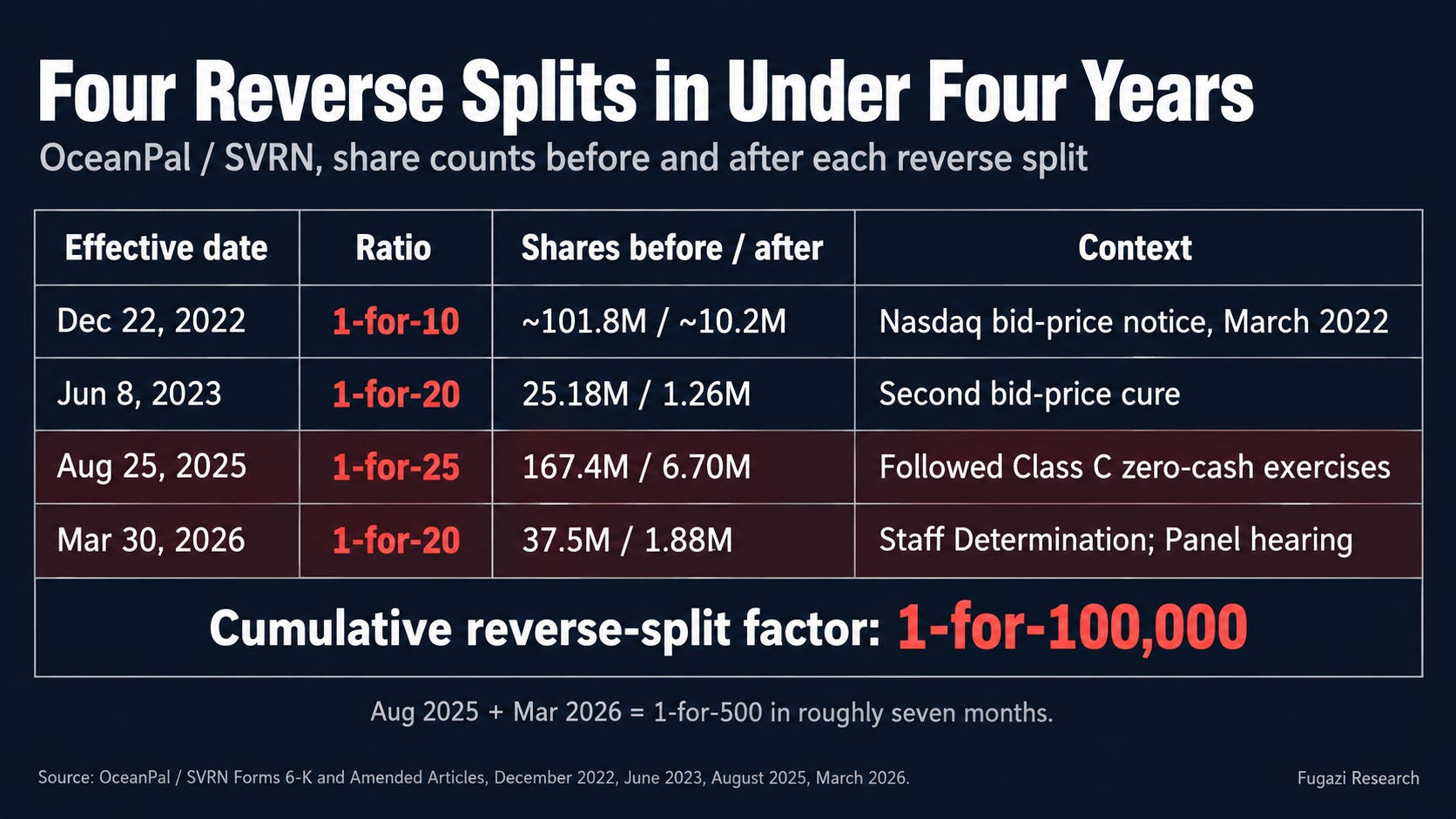
The August 2025 split followed directly from the warrant conversions described below. Seven months later, Nasdaq issued a Staff Determination because the shares had again closed below the $1.00 minimum bid for 30 consecutive business days, from January 29 through March 12, 2026. A company in that position would ordinarily receive additional time to regain compliance, but OceanPal was ineligible because it had completed a 25-to-1 split within the preceding year. The solution was familiar, and effective March 30, approximately 37,517,290 outstanding shares became 1,875,864. The stock printed its split-adjusted 52-week low of $3.12 on March 26, the day the split and the FY2025 results were announced, and Nasdaq confirmed regained compliance on April 16.
The August split came immediately after an $18 million offering whose warrants had already converted into roughly 149 million new shares, and the company pivoted into the NEAR transaction immediately after it, creating another enormous block of common-equivalent securities. By November 25, 2025, the F-3 showed 109,510,789 shares outstanding assuming exercise of the pre-funded warrants, and four months later the company could announce only 1.88 million common shares.
Source: OceanPal, Forms 6-K filed December 2022, August 21, 2025, March 13, 2026 and March 26, 2026; Amended Articles, Ex. 99.1, June 2023; Form F-3 filed November 26, 2025.
Twenty Days in August: Where the Class C Warrants Went
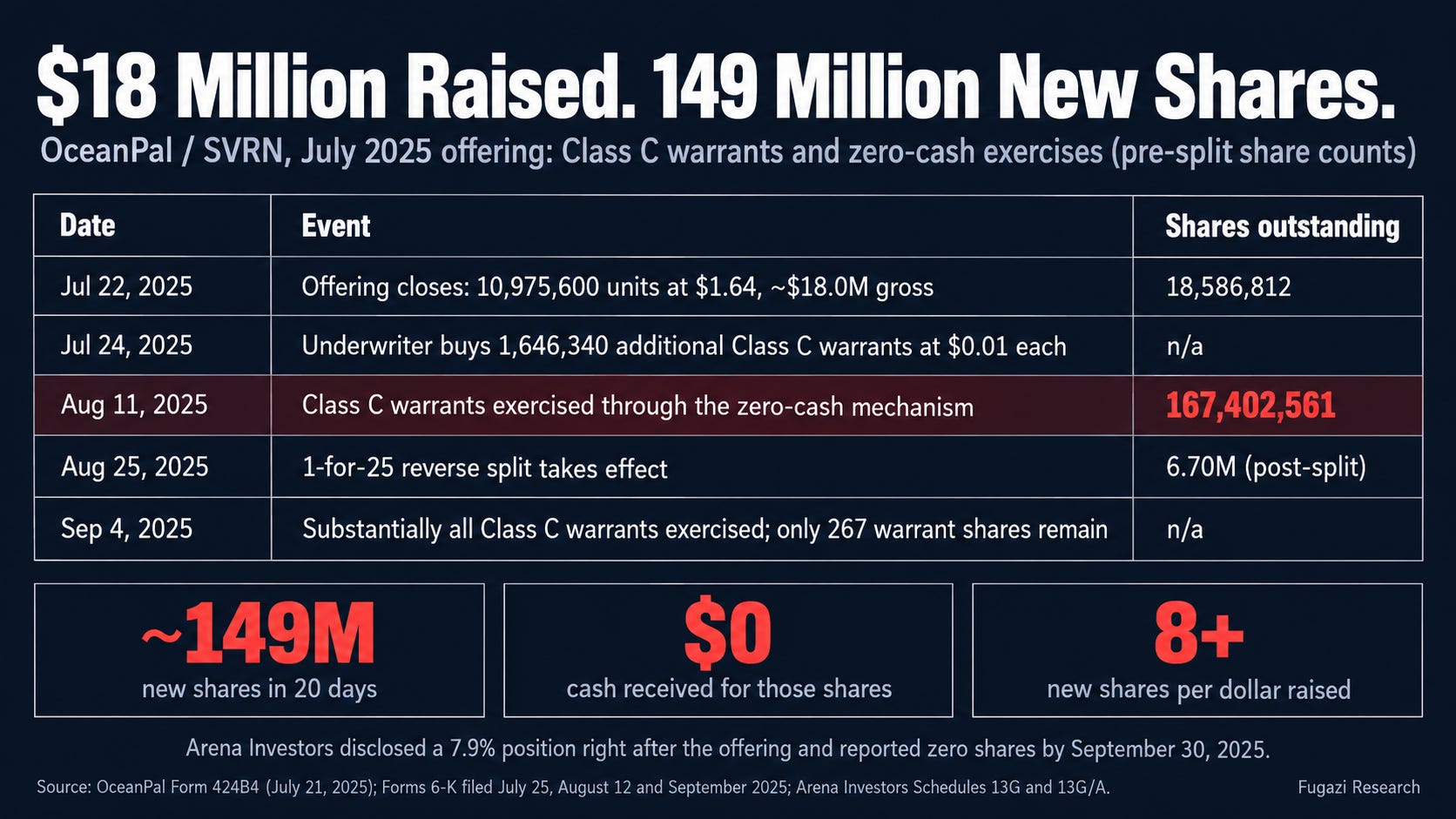
The 424B4 told investors exactly how the Class C warrants could work; each warrant started with an exercise price of 225% of $0.492 and adjusted the share count upward to keep the aggregate exercise price constant. For 90 days, holders could also elect a “zero cash exercise” that doubled the cash-exercise share count, so that at the floor each warrant converted into 15 common shares for nothing, while the prospectus itself described a cash exercise as highly unlikely.

Source: OceanPal, Form 424B4, July 21, 2025; Forms 6-K filed July 25, 2025, August 12, 2025 and September 2025.
Then it happened exactly as described: the underwriter bought 1,646,340 additional Class C warrants for $0.01 each on July 24; shares outstanding reached 167,402,561 by August 11 from 18,586,812 at closing; and by September 4, substantially all Class C warrants, including the over-allotment warrants, had been exercised through the cashless mechanism, with only 267 warrant shares remaining. An $18 million raise therefore produced roughly 149 million new shares in twenty days, more than eight new shares for every dollar raised, and the reverse split that followed was the cleanup. The Arena Investors group disclosed a 7.9% position immediately after the offering and reported zero shares beneficially owned by September 30, 2025.
Source: OceanPal, Form 424B4, July 21, 2025; Forms 6-K filed July 25, 2025, August 12, 2025 and September 2025.
Source: Arena Investors, Schedule 13G (event date July 22, 2025) and Schedule 13G/A Amendment No. 1 (event date September 30, 2025).
The $120 Million Headline, the $13.7 Million Cash Reality
In the October 2025 PIPE, OceanPal sold 10,759,994 common shares to cash purchasers at $1.275 per share, about $13.7 million, or $25.50 per share in today’s split-adjusted terms. Cryptocurrency purchasers acquired another 10,136,033 common shares at the same stated price, along with pre-funded warrants exercisable for 75,210,318 additional shares at $0.01.

The NEAR Foundation contributed tokens “from NEAR Foundation’s treasury reserves” worth about $100 million, and a separate 13D group controlled by NEAR co-founder Illia Polosukhin, through Blackdragon, reported 3,592,156 shares (10.46%), including pre-funded warrants, while SVRN’s website lists Polosukhin as an advisor. Economically, this was a protocol foundation exchanging its own tokens for majority ownership of a publicly traded company without a reliable, consistent auditor.
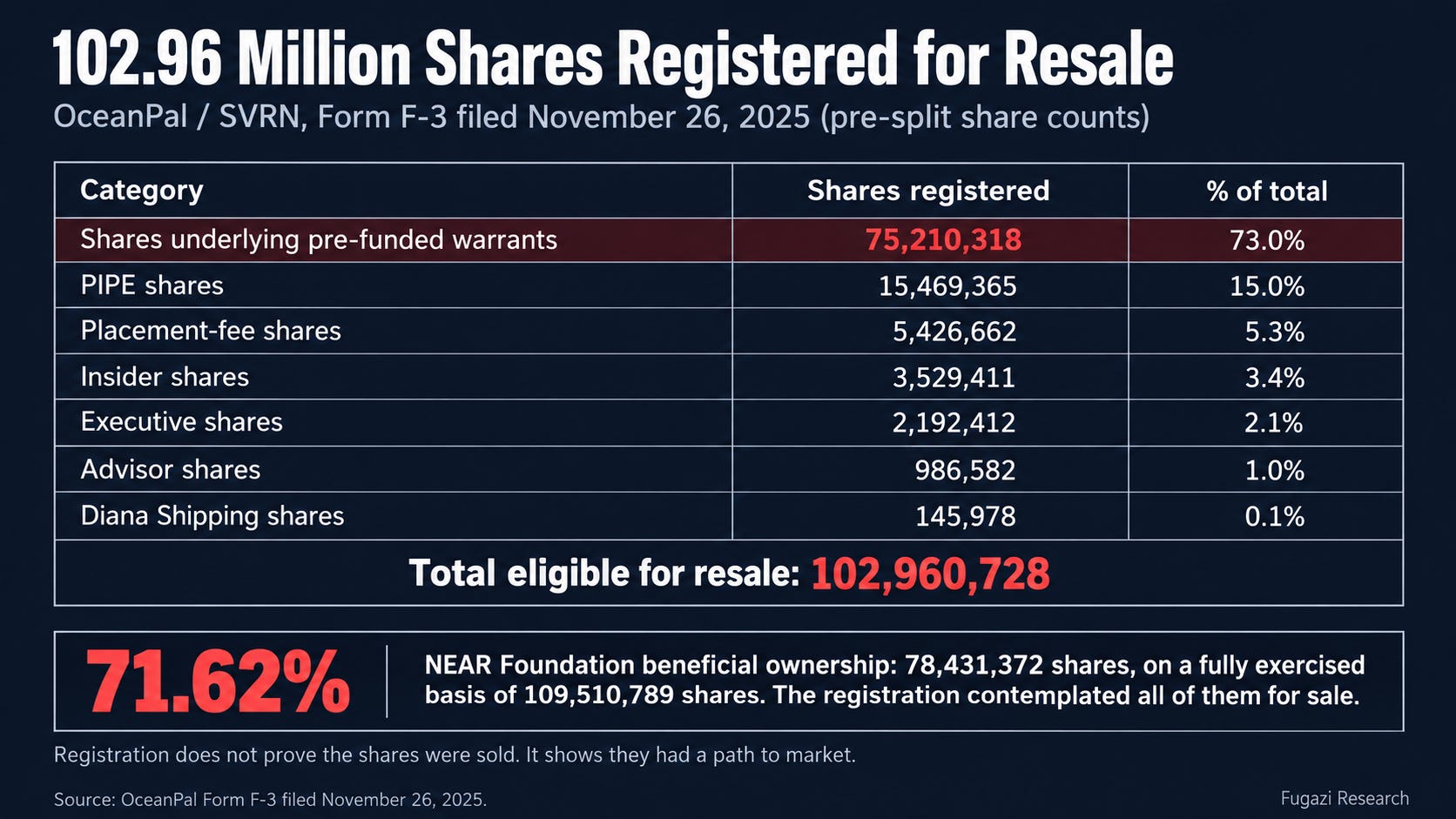
The registration covered 15,469,365 PIPE shares, 75,210,318 shares underlying pre-funded warrants, 5,426,662 placement fee shares, 2,192,412 executive shares, 3,529,411 insider shares, 145,978 Diana Shipping shares, and 986,582 advisor shares, for 102,960,728 shares eligible for resale. It showed the NEAR Foundation beneficially owning 78,431,372 shares, or 71.62% of the 109,510,789-share denominator assumed fully exercised, and contemplated registering all of them for sale.
Meanwhile, the old controllers were paid to leave. Diana Shipping transferred the 500,000 Series B preferred shares to Proximity Labs, Frontier Growth Holdings and the NEAR Foundation, and Tuscany Shipping transferred all 1,200 Series E preferred shares to Ternullo and Schwed, while OceanPal paid an aggregate $10.5 million in cash and $4.5 million in stock to the facilitating parties, including Diana and Tuscany. In other words, the company used cash raised from new investors to pay the previous controllers to transfer control to the new ones. The PIPE subscription agreements contained a covenant that net proceeds would not be used to redeem common stock or common stock equivalents, and within weeks the company launched a $1,400 per share tender for its convertible Series D preferred, about $26.9 million tendered, along with a $10 million common buyback that management says is funded by option premiums.
Source: OceanPal, Form 6-K filed October 28, 2025; Form F-3 filed November 26, 2025.
Source: NEAR Foundation and Polosukhin/Blackdragon, Schedule 13D filings, 2025.
The Fleet Goes Home
On July 31, 2026, OceanPal sold OP Vessel Holdco LLC, which held the 2005-built panamaxes Calipso and Melia, the 2009-built MR tanker Zeze Start, and the RFSea Infrastructure II joint venture interest, to Sezali Inc., an entity affiliated with Semiramis Paliou, OceanPal’s former Chairwoman and the chief executive of Diana Shipping. The consideration was the cancellation of 12,185 Series C preferred shares, each with a $1,000 liquidation preference, and $5.0 million in promissory notes, totaling about $17.2 million in face value, against an unaudited year-end vessel carrying value of about $40.8 million, a gap of roughly $23.6 million. The company also says it paid all accrued Series C dividends in full, in cash, before handing back the shares, and the 6-K discloses no fairness opinion, no independent valuation, and no names of the directors who approved the deal.
The board says independent, disinterested directors approved the transactions, and readers should ask which directors those were, given that three sitting directors held Series C on the other side of the trade. In our opinion, selling the last operating shipping assets to an affiliate of the former chairwoman, in exchange for insider-held securities and with no disclosed valuation, is a related-party transaction that deserved far more explanation than a single 6-K provided.
Source: OceanPal, Form 6-K and Ex. 99.1 filed August 3, 2026; Forms 4 filed August 4, 2026; Schedule 13D/A filed August 4, 2026; 20-F for FY2023 (Series C liquidation preference).
Millions Lost While the Auditor Was Changing
The company pivoted faster than it could audit and document it. Ernst & Young Hellas resigned as an independent registered public accounting firm effective October 28, 2025, the same day the transformation was announced. The filing states that EY’s prior reports contained no adverse opinion or disclaimer and identifies no disagreement, and Fugazi Research makes no allegation about EY’s reasons beyond what the filing says. CBIZ CPAs was engaged effective January 26, 2026, leaving roughly three months without an auditor during the period when the company booked its first digital-asset, staking, and derivative transactions.
In its April 30 Form 12b-25, management attributed the delay to accounting issues arising from the transformation, including recognizing, holding, and measuring digital assets; accounting for staking rewards under two operating models; vessel dispositions; and stock-based compensation, and warned that final audited results would differ from the preliminary figures. It also missed the extension. On May 15, it disclosed that it still could not file, and on May 19, Nasdaq issued a delinquency notification giving it until July 20 to submit a plan and, if accepted, until October 27, 2026, to file.
The audit committee is chaired by Nikolaos Veraros, with Alexios Chrysochoidis as a member, both legacy shipping-era directors, and both held Series C preferred and surrendered it in the July 31 related-party ship sale, after which Form 4s show neither owns any SVRN securities. The committee overseeing the delayed audit therefore included two members who sat on the receiving side of the period's largest transaction.
On August 27, SVRN announced that its corporate transformation was complete, with the ships gone, the preferred stock largely cleaned up, and a new legal name and 55.5 million NEAR tokens, while its own risk disclosure still referred to the audit, internal-control remediation, and the delayed 20-F. Its website states that treasury metrics are calculated from “on-chain data and audited financial reports,” yet the homepage still displays 53.9 million NEAR, a $1.23 share price, and a 1.64x mNAV from before the March reverse split, and two director biographies on the team page carry the note “Draft bio, pending approval.”
Source: OceanPal/SVRN, Forms 6-K filed October 28, 2025, January 29, March 26, May 15, May 22, June 18 and August 27, 2026; Form 12b-25 filed April 30, 2026.
Source: Forms 4 filed August 4, 2026; svrn.net, accessed October 6, 2026.
What Is Actually in the Treasury
NEAR holdings were reported as 53.9 million on November 13, 2025; about 51.3 million on December 31, 2025; about 55 million “including collateral pledged to counterparties” in April 2026; and 55.5 million in August 2026. The reported count fell by roughly 2.6 million tokens between November and December before recovering, and we have not found a reconciliation of that movement. In February 2026, SVRN appointed G-20 Group, which its team page also displays as a backer, to run a “derivative overlay” on part of the treasury, and the company describes an institutional options strategy whose premiums fund buybacks. Premium-generating overlays typically involve selling calls, puts, or both, which caps upside, can amplify downside, and requires posted collateral, and no one has audited the sizing, strikes, or counterparties.
NEAR is also not a strong asset to concentrate a balance sheet in. The token peaked at roughly $20.40 in January 2022 and spent most of the next four years in a prolonged decline, falling to about $0.84 in February 2026, when its market cap shrank from a peak near $11 billion to roughly $1.4 billion. Even after the summer rally that the market has since priced into SVRN’s price, NEAR at $4.88 remains about 76% below its all-time high, and the PIPE, built largely on the token’s valuation, was marked at only about $1.51 per token at year-end. Among the large layer-1 protocols that launched into the 2021 cycle, NEAR has been one of the weaker performers, and a rebound of this size from a depressed base does not prove the drawdown is over. The company’s stated plan is to own 10% of the token's supply, a token that has already shown how far it can fall, financed with equity from a stock priced as though it cannot.
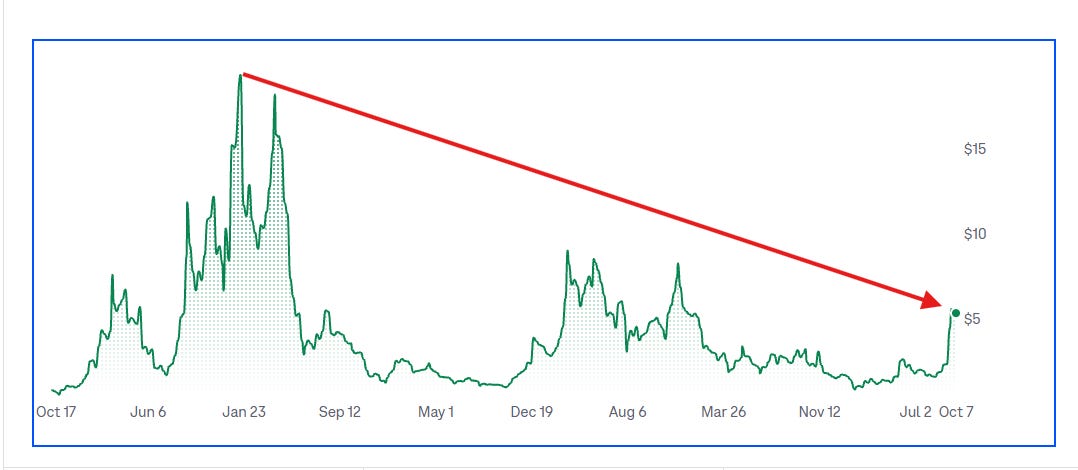
NEAR is still about 75% below its January 2022 all-time high of roughly $20.40, even after a vertical rally in recent weeks.
Source: Coinbase, NEAR/USD price history, October 2020 to October 7, 2026.
The stated goal is 10% of NEAR supply, and at about 4% after eleven months, with no cash disclosed since December, the next leg of accumulation requires new equity. Two external risks threaten the premium: Grayscale and Bitwise's spot NEAR ETF filings were pending as of July 2026, according to SVRN’s own FAQ, and an approved ETF would give U.S. investors direct NEAR exposure without paying for a wrapper. Guidance is also stale, because the March 2026 outlook covered both shipping and treasury segments and said vessel sale proceeds plus digital assets provided roughly three years of operating capital, after which the vessels were transferred for no cash, and no updated outlook has been furnished.
Source: OceanPal/SVRN, Forms 6-K filed November 17, 2025, March 26, April 9, April 16 and August 27, 2026; Company press releases, February 11, 2026 and August 27, 2026; svrn.net/team; svrn.net/faq.
The COO With Two Titles
SVRN COO David Schwed arrived with the experience the company advertised for its new identity. OceanPal appointed him Chief Operating Officer effective October 31, 2025, citing prior experience at Robinhood, BNY, and Galaxy and positioning his cybersecurity and digital-assets background as relevant to the new business. The company then gave him more inducement equity than its CEO: 1,096,205 restricted shares or RSUs versus 822,156 for Ternullo on the pre-March-2026-split basis, or about 54,810 and 41,108 shares, respectively, after dividing by 20. Schwed’s award vests 25% on September 22, 2026, and then in equal monthly installments over the following 36 months; that cliff tranche of about 13,700 shares was worth roughly $660,000 at $47.99.
An OCC charter application for OpenReserve Bank, National Association identifies David Schwed as one of the bank’s organizers. In early September 2026, OpenReserve announced conditional OCC approval and a $25 million a16z-led seed round, listing Schwed as its Chief Technology Officer, and his own website states that role. SVRN’s website still lists him as COO; we found no 6-K reporting a change, and the same site describes him as a strategic advisor to the NEAR Foundation, the company’s largest economic holder.
We observe that SVRN recruited Schwed as a senior operating executive during the transformation, gave him an inducement award larger than the CEO’s plus half of a super voting preferred series, and within months he was formally identified as an organizer of another digital asset financial institution where he now holds a C-suite title.
Source: OceanPal, Forms 6-K filed October 2025 and November 26, 2025; David Schwed, Form 3 filed March 24, 2026; OCC charter application, OpenReserve Bank, N.A., 2026; Banking Dive, September 4, 2026.
The Looming Deadline
SVRN has until October 27, 2026, to deliver the one document that would let investors check what they are buying. That is Nasdaq’s outside date for the company’s fiscal 2025 Form 20-F, and as of the last EDGAR check we ran, the most recent SVRN filing was still the August 27 Form 6-K, with no annual report, no notice that Nasdaq accepted the compliance plan that was due July 20, and no Panel decision. The company filed a Form 12b-25 on April 30 blaming the delay on accounting issues created by its own transformation, missed the extension that form buys, and was told by Nasdaq on May 19 that it had until July 20 to submit a plan and, if accepted, until October 27 to file. In its August 27 filing, which declared the transformation complete, the company still listed completion of the audit, internal-control remediation, and filing of the 20-F as outstanding risks.
If the deadline is missed, Nasdaq issues a delisting determination, and the company would presumably request a Panel hearing as it did in March, which can stay the delisting for a period but does not guarantee the outcome. If the appeal fails, Nasdaq would remove the common stock, and it would fall to the over-the-counter market, where liquidity is thinner, spreads are wider, and institutional holders that cannot own unlisted stock are forced to sell. A reverse split cannot fix this problem the way it did in March, because Nasdaq cannot be satisfied by changing the number printed beside the price. It needs audited financial statements, and those depend on an auditor, CBIZ, that was engaged only on January 26, 2026 and has not yet signed an opinion on a year in which the company booked its first digital-asset, staking, and derivative transactions.
Source: SVRN/OceanPal, Form 12b-25 filed April 30, 2026; Forms 6-K filed March 13, May 15, May 22 and August 27, 2026.
Source: Form of Pre-Funded Warrant, Ex. 4.1 to Form 6-K filed October 28, 2025; market data, October 5, 2026; SEC EDGAR filing index, checked October 6, 2026.
Conclusion
This was a shipping company. It raised $18 million through a common-and-warrant offering whose warrants turned into roughly 149 million new shares in twenty days for no cash, executed a 1-for-25 reverse split, and then entered a crypto recapitalization in which the NEAR Foundation paid mostly in tokens for majority economic ownership while the company paid most of the cash it raised to the parties who facilitated the change of control. It registered 102.96 million shares for resale, changed its ticker to SVRN, fell below Nasdaq’s minimum bid again, executed another 20-to-1 split, transferred its shares to an affiliate of its former chairwoman for no cash, and changed its name. The cumulative reverse-split factor is 500-to-1 in this cycle and 100,000-to-1 since 2022.
The most recent full-year numbers available remain preliminary, showing a $65.2 million net loss and a $70.0 million loss attributable to common shareholders. The auditor changed during the transformation; the annual report missed its deadline and its extension, and Nasdaq’s last extension expires October 27, 2026. Today the company says it holds more than 55.5 million NEAR, part of it pledged as collateral, and with the token near $4.88, the market values that position at roughly 1.0x on a fully diluted basis, up from roughly 0.5x in July. Common holders are paying full value for a wrapper controlled by insiders and the token issuer, whose audit is unfinished, and whose largest holders get a path to sell once that audit is filed.
In our opinion, the company’s history of extreme dilution mechanics, a lifetime of an outrageous 100,000 reverse split factor, the related party disposal of its operating assets, the unfinished FY2025 audit, and the wholesale replacement of its legacy business with a concentrated NEAR treasury leave common shareholders underwriting a capital structure rather than an established operating franchise. Fugazi Research considers SVRN common stock uninvestable at any price above zero.
Disclaimer
The research, commentary, reports, and other materials published by Fugazi Research LLC (“Fugazi Research,” “we,” “us,” or “our,”) are provided solely for informational and educational purposes. Fugazi Research is an independent research publisher and is not registered as an investment adviser, broker-dealer, or commodity trading advisor with the U.S. Securities and Exchange Commission or any other regulatory authority. All content published by Fugazi Research represents our opinions as of the date of publication and is based on publicly available information, independent research, interviews, and analytical judgment. Our opinions are inherently subjective, may be incomplete, and are subject to change at any time without notice. We do not undertake any obligation to update or revise our content to reflect subsequent events, market developments, or new information.
Nothing published by Fugazi Research constitutes investment advice, financial advice, legal advice, tax advice, or a recommendation to buy, sell, or hold any security or financial instrument. The information should not be construed as tailored to the investment objectives, financial situation, or particular needs of any individual or entity. Readers should conduct their own independent research and consult their own financial, legal, and tax advisors before making any investment decision.
Fugazi Research, its affiliates, principals, members, employees, consultants, or clients may have positions-long, short, or otherwise-in the securities discussed, and such positions may change at any time for any reason, including risk management, market conditions, or liquidity considerations. We may trade in securities covered by our research before, during, or after publication, and we may reduce, close, or reverse positions at any time without notice. Readers should assume that Fugazi Research has a financial interest in the securities discussed.
Our research may include forward-looking statements, estimates, projections, or opinions that involve known and unknown risks, uncertainties, and assumptions. Actual outcomes may differ materially from those expressed or implied. Past performance is not indicative of future results. All investments involve risk, including the potential loss of principal. While we believe the information we present is accurate and reliable, it is provided “as is” and “as available,” without any representation or warranty, express or implied, as to accuracy, completeness, timeliness, or fitness for any particular purpose. Fugazi Research disclaims any liability for errors, omissions, or losses arising from the use of our content.
By accessing or using Fugazi Research’s materials, you acknowledge and agree that Fugazi Research shall not be liable for any direct, indirect, incidental, consequential, or other losses arising from reliance on our research or opinions. Use of our content is entirely at your own risk.
All content is the intellectual property of Fugazi Research and may not be reproduced, distributed, or shared without prior written consent.