

Executive Summary
Netcapital Inc. (NASDAQ: NCPL) has managed to turn a crowdfunding platform into the subject of a federal securities enforcement action. On August 10, 2026, the Securities and Exchange Commission filed a civil complaint against Netcapital and five affiliated individuals, alleging that the company improperly recognized approximately $13.9 million in revenue from consulting agreements that the SEC describes as sham transactions, some supported by forged documents. According to the complaint, those transactions inflated reported revenue by approximately 345% between October 2021 and January 2024.
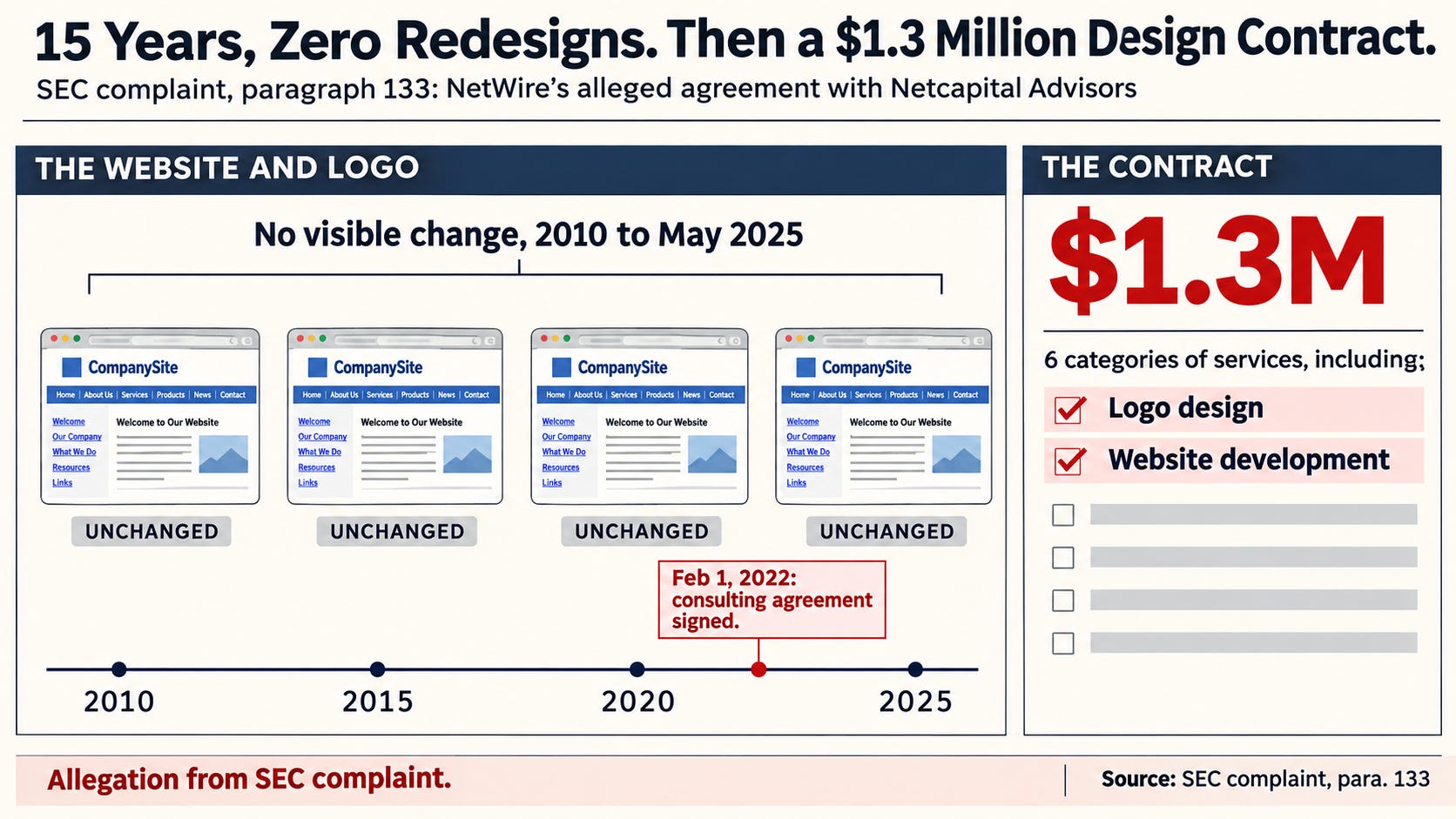
The alleged revenue “fraudulent scheme” was very straightforward. Netcapital purportedly entered into consulting agreements worth between $1 million and $2 million apiece with at least eleven startup companies controlled by John Fanning, a man the SEC alleges functioned as a Netcapital executive without formally holding an officer position. The supposed services included preparing logos, websites, pitch decks and investor introductions. Comparable legitimate customers reportedly paid approximately $50,000 for similar work, while the companies involved in the alleged transactions lacked meaningful assets or revenue and paid in their own equity. One company purportedly agreed to pay $1.3 million for services including logo and website design, despite its website and logo remaining unchanged for approximately fifteen years.
On August 12, 2026, Netcapital’s independent auditor, Fruci & Associates II, resigned, citing the SEC action and its inability to continue serving as auditor. The company subsequently instructed investors not to rely on its audited financial statements for fiscal 2022, 2023, 2024 and 2025. Its fiscal 2026 annual report and Q1 fiscal 2027 report remain delinquent as of the company’s latest November disclosure, with Nasdaq granting an extension until February 9, 2027. A new auditor, Adeptus Partners, has been engaged to re-audit the historical accounts.
Netcapital reported only $335,481 in revenue against $7.90 million in operating expenses during the nine months ended January 31, 2026, spending approximately $23.56 for every dollar earned. The company funded its operations principally through equity issuance, increasing common shares outstanding from 2.19 million to 6.85 million during those nine months. In October 2026, Netcapital then entered into a convertible financing with Hinterland Partners that converts at 85% of the lowest traded price over the preceding seven trading days.
NCPL carries an SEC challenged revenue record, a disappearing financial reporting foundation, continuing dependence on shareholder financing, and a “fraudulent scheme¨ accusation that it’s a permanent stain impossible to erase. Fugazi Research considers NCPL uninvestable at any price above ZERO.
Fugazi Research Analysis
The SEC alleges $13.9 million of improperly recognized revenue, inflating reported revenue by approximately 345%. The complaint identifies at least eleven companies allegedly controlled by John Fanning through intermediary entities. These purported customers generated accounting revenue for Netcapital through consulting arrangements the SEC alleges were fictitious, backdated and, in certain instances, forged. That $13.9 million was about 77% of the $17.95 million of total revenue Netcapital reported, over those ten quarters.
Approximately 81% of reported revenue during the first five fiscal quarters of former CEO Martin Kay’s tenure allegedly came from sham consulting agreements. The SEC identifies $8.12 million of challenged revenue out of approximately $9.98 million reported between the quarters ended January 31, 2023 and January 31, 2024. The alleged overstatement was 436%. For that period, the SEC describes a public company whose principal revenue stream was economically unsupported by the purported customer transactions.
Netcapital has told investors not to rely on four consecutive years of audited financial statements. Following the SEC filing, Fruci & Associates II resigned, and Netcapital directed investors not to rely on audited fiscal 2022 through 2025 statements or specified interim reports. A successor auditor was engaged to re-audit the affected years and fiscal 2026, including the April 30, 2021 opening balance sheet.
The company’s operations consumed $7.66 million in cash to generate just $335,481 in reported nine-month revenue. Operating expenses totaled $7.90 million, or $23.56 for every dollar of revenue. At January 31, 2026, cash was $715,443 against current liabilities of $3.96 million and negative working capital of $2.92 million.
Shareholders financed the losses while their ownership base expanded, and the share count rose by approximately 212% in nine months. Common shares increased from 2,192,226 on April 30, 2025 to 6,847,899 on January 31, 2026. During those nine months, the company reported $8.51 million in proceeds from common-stock sales, compared with $7.66 million of cash consumed in operating activities.
The October 2026 Hinterland note converts at a 15% discount to the lowest traded price in a seven-day lookback. The lender also received 64,387 commitment shares on the first tranche and can elect to convert principal and interest into common stock. The agreement requires a reserve of at least five million shares, subject to its issuance limits, and limits the lender’s beneficial ownership to 4.99%. Hinterland is the latest of at least seven discounted note financings since May 2026, stacked on a $15 million equity line.
The company’s external financial gatekeepers have already reacted to the SEC allegations. Its auditor resigned on August 12, 2026; Cecilia Lenk resigned from the board and Netcapital Advisors following court approval of her SEC settlement; and director Avi Liss resigned from the board and audit committee on August 27, citing the seriousness of the allegations. Lenk’s settlement involved permanent injunctions and a $50,000 civil penalty without an admission of the allegations.
The company’s November 2026 Nasdaq extension grants additional time, not an operating or financial-reporting recovery. Netcapital must file its delinquent fiscal 2026 Form 10-K and July 2026 Form 10-Q by February 9, 2027. Failure to satisfy the conditions may result in a Nasdaq delisting notification, subject to appeal.
Fugazi Research considers NCPL uninvestable at any price above ZERO.
Financial Summary
During the first five fiscal quarters of former CEO Martin Kay’s tenure, approximately $8.12 million of Netcapital’s $9.98 million in reported revenue (81.4%) allegedly originated from sham consulting agreements, representing a 436% revenue overstatement according to the SEC. This implies only approximately $1.86 million in revenue outside the challenged transactions during those quarters.
Netcapital reported $335,481 in revenue for the nine months ended January 31, 2026, compared with $465,437 for the prior-year period. This represented a 27.9% year-over-year decline.
Total operating expenses were $7,903,812 against revenue of $335,481, producing an expense-to-revenue ratio of 23.56 times. Net loss for the period was $7,584,385, equivalent to $22.61 of net loss per dollar of revenue.
Cash used in operating activities totaled $7,661,306 over nine months, compared with $4,614,630 during the comparable prior-year period, an increase of approximately 66.0%. Average monthly operating cash use was approximately $851,256 during the latest reported period.
Cash and cash equivalents totaled $715,443 at January 31, 2026, compared with current liabilities of $3,964,764. The resulting working capital deficit was $2,922,843.
Common shares outstanding increased from 2,192,226 at April 30, 2025 to 6,847,899 at January 31, 2026, an increase of 4,655,673 shares, or approximately 212.4%.
Payroll and payroll related expenses totaled $3,747,881, approximately 11.2 times reported revenue. Reported cash salaries to officers totaled $1,210,130, with additional officer stock-based compensation of $887,543.
Source: Netcapital Inc., Form 10-Q filed March 19, 2026; Forms 8-K filed August 18, August 25, September 3, October 20 and November 9, 2026.
Source: U.S. Securities and Exchange Commission, SEC v. John Fanning et al., Civil Action No. 1:26-cv-13665, Complaint, filed August 10, 2026
Recent Erratic 1,000% Move from $0.21
Since late August, NCPL has surged more than 1,000% without any apparent fundamental justification, exhibiting deeply troubling trading patterns that raise serious concerns about potential market manipulation. The company already faces SEC allegations involving fictitious transactions and materially inflated revenue, further undermining its credibility.
For months, NCPL has experienced violent price swings on extremely thin volume, with wide bid-ask spreads and minimal liquidity. Repeated collapses of 50% or more have been followed by inexplicable recoveries to fresh highs, creating a highly suspicious pattern of price action seemingly detached from economic reality.
This relentless cycle of sharp selloffs and aggressive rebounds resembles a speculative game of hot potato, raising questions about potential wash trading, artificial price support, and coordinated trading activity. While these patterns alone do not prove manipulation, the combination of questionable fundamentals, serious SEC allegations, and extraordinary price behavior presents significant red flags. In our view, NCPL’s valuation appears increasingly unsustainable, with substantial downside risk should speculative demand evaporate.
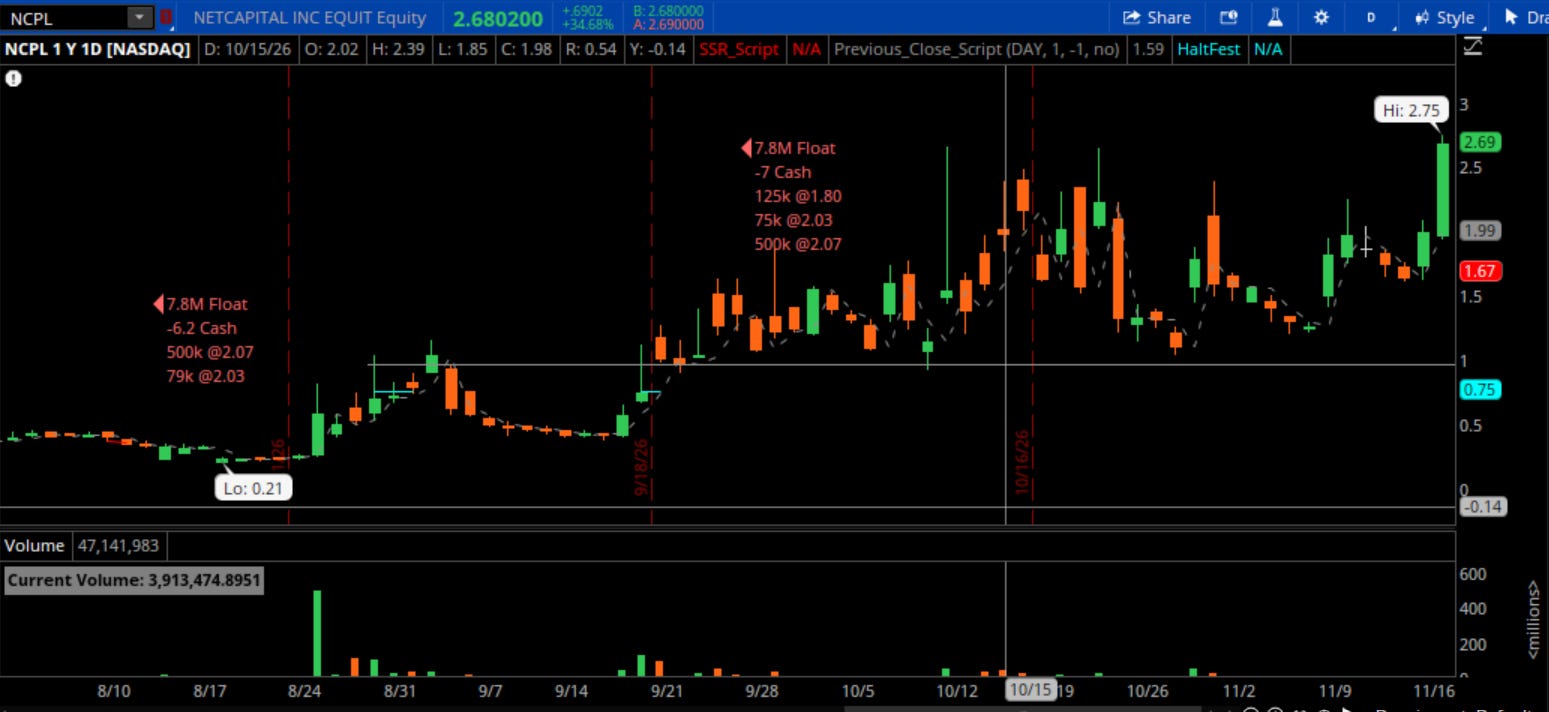
Above: Schwab Thinkorswim chart of NCPL’s 1,000% erratic, manipulated run since August 2026
The $14 Million Revenue Illusion: The SEC Exposes Netcapital’s Alleged Sham Business
According to the SEC’s August 10, 2026 complaint, nearly $14 million in reported revenue was allegedly manufactured through sham consulting agreements, some of which were forged, with supposed customers secretly controlled by an individual operating within the company’s own management structure. Between October 2021 and January 2024, these transactions allegedly inflated Netcapital’s revenue by a staggering 345%, Netcapital was presenting the appearance of a revenue generating enterprise while, according to federal regulators, much of that revenue existed only on paper.
On August 10, 2026, the SEC filed a 56-page federal civil complaint in the District of Massachusetts alleging a multiyear scheme involving Netcapital and five affiliated individuals. The defendants include John Fanning, CFO Coreen Kraysler, former CEO Martin Kay, accountant Paul Riss and former CEO Cecilia Lenk. The SEC alleges that the conduct caused Netcapital to recognize approximately $13.9 million in revenue that should not have been recorded.

The SEC describes a structure centered on Netcapital Advisors, a subsidiary that purported to provide consulting services to companies preparing crowdfunding offerings. The subsidiary allegedly entered arrangements with at least eleven companies controlled by Fanning, who simultaneously exercised substantial influence over Netcapital without formally being designated a company officer. The purported agreements were valued at $1 million to $2 million per customer, principally for services including branding, websites, pitch materials and introductions to potential investors.

The purported agreements were valued at $1 million to $2 million per customer, principally for services including branding, websites, pitch materials and introductions to potential investors. The SEC contrasts those figures with approximately $50,000 paid on average by legitimate, unrelated clients for comparable work; an alleged $1 million contract was therefore priced at twenty times the typical customer engagement; a $2 million agreement represented forty times the comparable amount. The alleged counterparties lacked significant operating assets or revenue and were expected to pay through equity stakes rather than cash.

That arrangement matters because equity compensation from a startup is not the same as collecting cash from a paying customer. Netcapital was purportedly able to recognize substantial revenue from transactions involving companies whose ability to generate future economic returns had not been established. The SEC alleges that the contracts themselves lacked commercial substance and that the supposed consulting services were not meaningfully performed.
According to paragraph 133 of the SEC complaint, NetWire allegedly agreed to pay Netcapital Advisors $1.3 million for six categories of services, including logo design and website development, under an agreement dated February 1, 2022. The same complaint alleges that NetWire’s website and logo remained unchanged from at least 2010 through May 2025. Fifteen years of the same website and logo, followed by a millionaire consulting agreement to design them.
The SEC further alleges that the arrangements were not disclosed as related-party transactions even though Fanning allegedly controlled both sides of the economic relationship through his management influence and intermediary ownership structures. His spouse, Coreen Kraysler, served as Netcapital’s CFO, this is the core governance issue: the transactions were presented as revenue from independent customers, while the SEC alleges that the supposed clients were under the influence of a person operating within Netcapital’s management structure.
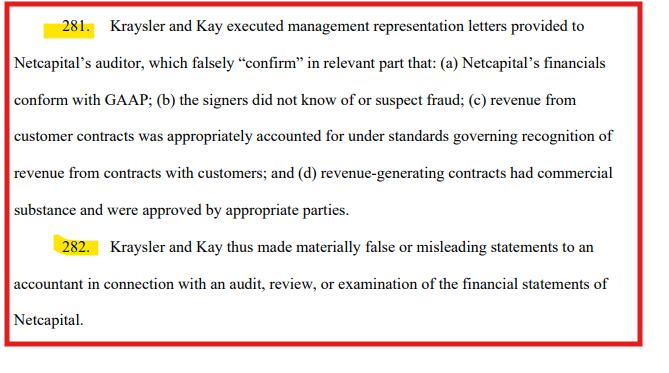
The alleged deception did not stop at manufacturing revenue; according to the SEC, Netcapital’s own executives went as far as providing materially false representations directly to the company’s independent auditors. CFO Coreen Kraysler and former CEO Martin Kay signed management representation letters certifying that Netcapital’s financial statements complied with GAAP, that they had no knowledge or suspicion of fraud, and that the company’s revenue-generating contracts were legitimate, properly accounted for, and supported by genuine commercial substance, but concluding that The SEC alleges these assurances were false.
The extent of the problem becomes clear in the SEC’s analysis of former CEO Martin Kay’s first five fiscal quarters. Approximately $8.12 million of the $9.98 million in reported revenue during that period allegedly came from the challenged arrangements. That is 81% of the company’s reported revenue.

The SEC also alleges that Netcapital incorporated the inflated figures into offering materials used to raise more than $25.6 million from public and private investors between January 2022 and July 2025. This connects the alleged accounting conduct directly to capital formation, the company’s reported revenue was not simply a measure of operations; it was also part of the financial record presented to investors financing the business.
Auditor Resignation and Four Years of Unreliable Financials
Two days after the SEC complaint, Netcapital’s auditor, Fruci & Associates II, resigned effective immediately, citing the SEC’s allegations. Fruci had not completed the fiscal 2026 audit and advised that the company’s audited financial statements for fiscal years 2022 through 2025, along with certain quarterly reports, could no longer be relied upon. Related registration statements and prospectuses were also affected.

Four years of audited financials were effectively discredited, leaving investors without a reliable picture of Netcapital’s historical performance.
The reversal was especially striking given Netcapital’s March 19, 2026 10-Q, which declared its disclosure controls effective and stated that “the previously identified material weakness and significant deficiency have been remediated.” That assurance came just 15 days after the Wells Notices. Former CEO Cecilia Lenk settled with the SEC without admitting wrongdoing, accepting injunctions and a $50,000 civil penalty before resigning from the board and as CEO of Netcapital Advisors on August 19. On August 27, director and Audit Committee member Avi Liss also resigned, explicitly citing the SEC’s allegations. Within weeks, Netcapital had lost its auditor, four years of reliable financial reporting, and two senior figures, all just months after assuring investors its control deficiencies had been resolved.
“Given the nature and seriousness of the allegations, I do not wish to continue to be associated with the Company.” — Avi Liss, resignation letter to Netcapital’s Board of Directors, August 27, 2026.
The company subsequently appointed Adeptus Partners as auditor. Its mandate is not confined to the overdue fiscal 2026 audit: according to the October 13 Form 8-K, Adeptus was engaged to audit fiscal years 2022 through 2026, including the opening balance sheet at April 30, 2021, and to review the unaudited interim periods for fiscal 2026.
Disclosed financings from May to October 2026 total about $1.45 million of gross cash (excluding the unverified Dune note): Vanquish $125,000 and $157,000, Labrys $250,000 and $111,250 net, FirstFire $250,000, a related party note from Netcapital Systems LLC $150,000, and Hinterland $402,743. At the prior burn rate that is under two months of operations. Near term obligations include a $162,400 FirstFire amortization payment due December 9, 2026, Vanquish installments, and the Netcapital Systems note that matured September 30, 2026 with no disclosed repayment.
Nasdaq followed. Netcapital received delinquency notices after failing to file its Form 10-K for the year ended April 30, 2026 and its Form 10-Q for the quarter ended July 31, 2026. Although it regained compliance with Nasdaq’s minimum bid-price requirement in October, the missing reports remained outstanding.
On November 5, 2026, Nasdaq granted an extension until February 9, 2027 for filing both. That extension permits the company to remain listed while attempting to complete its reporting obligations. There is a distinction between regaining Nasdaq’s minimum bid-price compliance and restoring the reliability of a company’s accounts. The former requires a qualifying share price for a prescribed period, the latter requires financial statements investors can actually use. Netcapital has accomplished the former. Its latest filings show it is still attempting the latter.
The Business That Spends $23.56 to Earn $1
Even before the SEC enforcement action, Netcapital’s most recently reported operating figures reflected a business that could not finance itself.
For the nine months ended January 31, 2026, Netcapital reported only $335,481 in revenue. Total operating expenses reached $7,903,812, including $3.75 million in payroll-related costs and $3.65 million in general and administrative expenses. The company therefore spent approximately $23.56 in operating expenses for every dollar brought in from customers.
This was not a temporary gap between revenue and cash collections. Netcapital’s cash-flow statement reported $7.66 million of cash used in operations over the same nine months, compared with $4.61 million a year earlier. At the end of January 2026, the company reported $715,443 of cash. Measured against the historical monthly operating cash-use rate, that represented less than one month of cash coverage at the balance-sheet date, before considering subsequent financing or changes in expenditure. It does not establish the company’s cash runway as of November 2026.
The company’s reported cash position was funded by the capital markets rather than by customers. During the nine-month period, Netcapital reported $8.51 million in proceeds from common-stock sales and $8.19 million in net financing cash inflows. Meanwhile, shares outstanding grew from 2.19 million to 6.85 million.
The implication for existing shareholders is arithmetic rather than interpretive. A holder who did not participate in new issuance retained the same number of shares while the company’s total share count expanded by approximately 212%. The business was still losing money, and every new financing spread ownership across an increasingly large number of claims.
There is an additional problem with the composition of the reported balance sheet. At January 31, 2026, Netcapital carried approximately $19.15 million in purchased technology and $5.81 million in equity securities, against total assets of $26.06 million. Approximately 95.8% of reported assets consisted of technology carrying values and investments in other companies, not cash or customer receivables.
Tangible book value is about $2.45 million, and about negative $3.36 million if the portfolio stakes are excluded. The purchased technology was largely bought with stock (Horizon, Rivetz, Iverson) and is the next impairment candidate in the re-audit.
The company’s investment schedule includes stakes received in consideration for consulting services and holdings valued using observable transactions in private securities. That is material in the context of an SEC lawsuit challenging the substance of certain historical consulting arrangements. It does not establish that every investment is impaired or improperly recognized. It does mean reported book equity should not be confused with readily realizable liquidity.
Related party holdings on the schedule. KingsCrowd: 3,209,685 shares carried at $577,743, exactly $0.18 per share, with Cecilia Lenk on its board. Zelgor: 1,400,000 shares at $1,400,000, controlled by Fanning Jr. Deuce Drone: 2,350,000 units at $0, Lenk on its board. Netcapital also paid $285,000 in nine months to Netcapital Systems LLC, 29% owned by founder Jason Frishman.
The company has been able to issue shares far more effectively than it has been able to generate operating cash. Any restatement or subsequent filing may change these historical amounts. The operating-financing distinction, however, is already evident from the March 2026 cash-flow statement and subsequent financing agreements.
The Restatement Trap: Fix the Books, Trigger the Debt
Netcapital reported just $335,481 in revenue against $7.90 million in operating expenses for the nine months ended January 31, 2026. Payroll-related costs alone reached $3.75 million, more than eleven times revenue.
Shareholders funded the gap. Netcapital raised $8.51 million through common-stock sales while operations consumed $7.66 million in cash. Shares outstanding jumped 212%, from 2.19 million to 6.85 million. After that financing, the company ended January with just $715,443 in cash.
The reported asset base was overwhelmingly tied to accounting valuations. Intangibles and equity investments represented 95.8% of total assets. Excluding intangibles leaves approximately $2.45 million in book equity. Removing the investment portfolio as well produces a $3.36 million deficit.
Those investments included $1.4 million in Zelgor, controlled by the CFO’s son, and $577,743 in KingsCrowd, where Cecilia Lenk served on the board. Deuce Drone, another Lenk board connection, had already been written down to $0. Netcapital also paid related party Netcapital Systems $285,000 during the period.
These historical balances remain subject to the accounting review. The financing dependence is already visible: selling stock brought in more than 25 times the company’s reported revenue, while existing shareholders’ ownership was spread across a share count that more than tripled. Netcapital’s accounting problems are no longer confined to its financial statements. They are now embedded in the terms of its financing.
Conclusion: A Broken Financial Record and a Capital Structure Built on Dilution
Netcapital’s problems extend well beyond disappointing financial results. The SEC has challenged the company’s historical revenue, four years of audited financial statements have been deemed unreliable, and the company has yet to resolve its reporting deficiencies.
Even before these accounting issues came to light, the underlying business was burning through cash. Its most recent available quarterly filing reported just $335,481 in nine-month revenue against $7.90 million in operating expenses and $7.66 million in operating cash outflows. Keeping the lights on required repeated financing, while the common share count more than tripled over the same period.
The financing terms offer shareholders little comfort. Floating-price convertible debt, discounted conversions, commitment shares and pledged assets leave existing investors exposed to further dilution. More troubling, the October 2026 note identifies a qualifying financial-statement restatement as an event of default, precisely as Netcapital attempts to reconstruct years of unreliable financial reporting.
The SEC’s fraud allegations remain subject to adjudication, except for the disclosed settlement involving Cecilia Lenk. But investors do not need to wait for a courtroom verdict to assess the company’s financial condition. The auditor resignation, unreliable financial statements, missed filing deadlines, cash burn and dilutive financing arrangements are documented facts.
The problem is straightforward: Netcapital cannot demonstrate a sustainable operating business, cannot currently provide reliable historical financials, and remains dependent on financing arrangements that threaten to dilute the very shareholders funding its survival.
We see no credible fundamental investment case for NCPL. Any potential recovery must contend with unresolved accounting issues, continued capital requirements and a financing structure that places common shareholders at a significant disadvantage.
Fugazi Research considers NCPL uninvestable at any price above zero.
Disclaimer
The research, commentary, reports, and other materials published by Fugazi Research LLC (“Fugazi Research,” “we,” “us,” or “our,”) are provided solely for informational and educational purposes. Fugazi Research is an independent research publisher and is not registered as an investment adviser, broker-dealer, or commodity trading advisor with the U.S. Securities and Exchange Commission or any other regulatory authority. All content published by Fugazi Research represents our opinions as of the date of publication and is based on publicly available information, independent research, interviews, and analytical judgment. Our opinions are inherently subjective, may be incomplete, and are subject to change at any time without notice. We do not undertake any obligation to update or revise our content to reflect subsequent events, market developments, or new information.
Nothing published by Fugazi Research constitutes investment advice, financial advice, legal advice, tax advice, or a recommendation to buy, sell, or hold any security or financial instrument. The information should not be construed as tailored to the investment objectives, financial situation, or particular needs of any individual or entity. Readers should conduct their own independent research and consult their own financial, legal, and tax advisors before making any investment decision.
Fugazi Research, its affiliates, principals, members, employees, consultants, or clients may have positions-long, short, or otherwise-in the securities discussed, and such positions may change at any time for any reason, including risk management, market conditions, or liquidity considerations. We may trade in securities covered by our research before, during, or after publication, and we may reduce, close, or reverse positions at any time without notice. Readers should assume that Fugazi Research has a financial interest in the securities discussed.
Our research may include forward-looking statements, estimates, projections, or opinions that involve known and unknown risks, uncertainties, and assumptions. Actual outcomes may differ materially from those expressed or implied. Past performance is not indicative of future results. All investments involve risk, including the potential loss of principal. While we believe the information we present is accurate and reliable, it is provided “as is” and “as available,” without any representation or warranty, express or implied, as to accuracy, completeness, timeliness, or fitness for any particular purpose. Fugazi Research disclaims any liability for errors, omissions, or losses arising from the use of our content.
By accessing or using Fugazi Research’s materials, you acknowledge and agree that Fugazi Research shall not be liable for any direct, indirect, incidental, consequential, or other losses arising from reliance on our research or opinions. Use of our content is entirely at your own risk.
All content is the intellectual property of Fugazi Research and may not be reproduced, distributed, or shared without prior written consent.