

Executive Summary
T3 Defense Inc. reported Q1 2026 revenue of $3.6 million and a net loss of $26.3 million, meaning the company lost roughly $7.22 for every $1 of revenue during the quarter. The loss was not a rounding error; it was the mechanical output of a structure that generated $371,000 of gross profit, recorded $4.182 million in operating expenses, and absorbed a $26.6 million market hit from stock purchase warrant liabilities.
T3 Defense began as Brilliant Acquisition Corp., became Nukkleus (NUKK) following its December 2023 business combination, and rebranded as T3 Defense on February 9, 2026, pivoting from financial technology to an aerospace and defense acquisition platform under CEO Menachem “Menny” Shalom.
The capital structure moved faster than the business. Common shares outstanding increased from 19 million at December 31, 2025 to 38 million at March 31, 2026, and to 60 million by May 20, 2026. Then at the beginning of July 2026, a share resale of 30 million shares and after that, the company announced a Project 35 acquisition paid partly with another 21 million of shares issuance and, later disclosing the intent of reverse split sequence first described as 50 to 1 in an 8-K and then described as 125 to 1 in a company press release after “recent stock activity.” Which implies that the shares outstanding before the latest reverse split was north of 139 million shares which would signal a share explosion of 630% increase or a 7x multiple of dilution in less than a year.
This is not a new structure. Under its prior identity as NUKK, the company executed nearly the same sequence eighteen months earlier: a reverse split, followed weeks later by a headline acquisition that triggered a 1,000% plus squeeze, followed by a 4.5x share count explosion diluting straight into the spike. T3 didn’t stumble into this playbook twice by accident, it is run by a CEO simultaneously sitting on top of eight related entities, including a company he sold to himself for $69.4 million and two separate SPACs holding over $425 million in trust, one of which just abandoned its only deal with nothing to show for it. Roughly $172.5 million of that trust money sits consolidated on T3’s own balance sheet, while being completely unavailable to fund a single dollar of T3’s operations or its going concern shortfall.
Strip away the defense narrative and what remains is an acquisition vehicle dependent on maintaining a sufficiently elevated share price to finance itself. Fugazi Research believes the company’s capital structure (not its operating business) has become its primary product, leaving DFNS shares completely uninvestable and of little to no fundamental value.
Fugazi Research Analysis
Operating Losses: T3 Defense generated $3.65 million of Q1 2026 revenue but reported a $26.35 million net loss, losing approximately $7.22 for every $1 of revenue.
Weak Operating Economics: Gross profit totaled just $371,000 against $4.18 million of operating expenses, meaning operating expenses exceeded gross profit by more than 11x before interest expense and warrant remeasurement.
Business Pivot: Formerly a blockchain payments company, T3 sold its Digital RFQ business for £1,000 before rebranding as a defense acquisition platform in February 2026.
Extraordinary Dilution: Shares outstanding increased from approximately 19 million at December 31, 2025 to approximately 139.8 million immediately before the July 2026 reverse split—a roughly 630% increase (7x) in less than seven months.
Equity as Currency: During Q1 alone, the company issued shares for warrant exercises, stock compensation, acquisitions, debt conversions, ELOC financing, and related-party debt settlements, using common equity as its primary source of capital.
Nasdaq Compliance: After receiving a minimum bid-price deficiency notice, the board increased its planned reverse split from 1-for-50 to 1-for-125 under shareholder authority granted at the June 24, 2026 special meeting.
Going Concern: At March 31, 2026, T3 reported approximately $69 million of negative working capital and disclosed that additional financing would be required to support operations over the next twelve months.
Project 35 Acquisition: T3 acquired a 60% interest in Project 35 using more than 21 million shares, a $1.25 million promissory note, and a $2.5 million investment commitment, while financial statements for the acquired business remained unavailable for up to 71 days following closing.
Management Structure: CEO Menachem Shalom simultaneously serves in leadership roles across multiple affiliated entities, including Star 26 Capital, two defense-focused SPACs, and additional public companies.
Consolidated SPAC Assets: Approximately $172.5 million of SC II Acquisition Corp.’s trust assets appear on T3’s consolidated balance sheet under GAAP despite being unavailable to fund T3’s operations or liabilities.
A Repeatable Pattern: Under its former identity as NUKK, the company executed a reverse split, announced a headline acquisition, experienced a 1,000%+ short squeeze, and subsequently expanded its share count 4.5x. T3 followed a strikingly similar sequence again in 2026.
Fugazi Research considers DFNS uninvestable at any price above zero.
Source: T3 Defense Inc. Form 10-K, filed April 9, 2026.
Source: T3 Defense Inc. Form 10-Q, filed May 20, 2026.
Source: T3 Defense Inc. Form 8-K, filed July 9, 2026
Source: T3 Defense Inc. Form 8-K, filed July 16, 2026
Source: T3 Defense Inc. Form 8-K, filed July 15, 2026 — SC II Acquisition Corp. LOI termination.
Financial Summary
Q1 2026 revenue was $3.6 million, cost of revenue was $3.2 million, and gross profit was $371,000. Gross margin was approximately 10.2%, leaving only ten cents of gross profit for every dollar of reported revenue.
Q1 2026 operating expenses were $4.2 million against gross profit of $371,000. Operating expenses were approximately 11.3 times gross profit.
Q1 2026 net loss was $26.3 million against revenue of $3.6 million. Meaning that the company lost approximately $7.22 for every $1 of revenue.
Net cash used in operating activities was $4.9 million in Q1 2026, while cash, cash equivalents, and restricted cash from continuing operations at quarter-end were $7.6 million. That combined balance equaled roughly 4.7 months of Q1 operating cash burn on a simple run-rate basis; actual operating liquidity may be lower because the balance includes restricted cash and excludes additional acquisition-related needs.
Total current assets were $22.8 million and total current liabilities were $91.6 million at March 31, 2026. Resulting in a current deficit of approximately $68.8 million.
The accumulated deficit increased from $122.5 million on December 31, 2025 to $149.6 million on March 31, 2026. The company added $27.147 million to the accumulated deficit in just one quarter.
Shares outstanding continued expanding after the March 31, 2026 quarter end, reaching approximately 139.8 million immediately before the July 2026 reverse split, an increase of roughly 630%, or a 7.3x multiple, from the 19.026 million shares outstanding at December 31, 2025.
Negative working capital grew from approximately $30 million at December 31, 2025 to approximately $68.8 million at March 31, 2026, an increase of roughly $39 million, or approximately 130%, in a single quarter.
Of the $91.625 million in total current liabilities at March 31, 2026, approximately $56 million, or roughly 61%, consisted of stock purchase warrant liabilities, which do not require cash settlement but are marked to fair value each period and flow directly through net income.
Goodwill increased from $7.6 million at December 31, 2025 to $100 million at March 31, 2026, and total assets grew from $202.3 million to $315.4 million over the same period, an increase driven overwhelmingly by non-cash purchases from paper-funded acquisitions rather than organic asset growth or operating cash generation.
Source: T3 Defense Inc. Form 10-K, filed April 9, 2026
Source: T3 Defense Inc. Form 10-Q, filed May 20, 2026.
One CEO, Eight Entities: The Shalom Network
T3 Defense’s chief executive did not arrive as a single operator. Menachem “Menny” Shalom has served as T3’s CEO and a board member since September 2024, drawing total 2025 compensation of $3.97 million, of which roughly 92.2% was paid in stock and options rather than cash (meaning the overwhelming majority of his pay is a direct bet on the same equity he is simultaneously promoting through acquisition announcements).
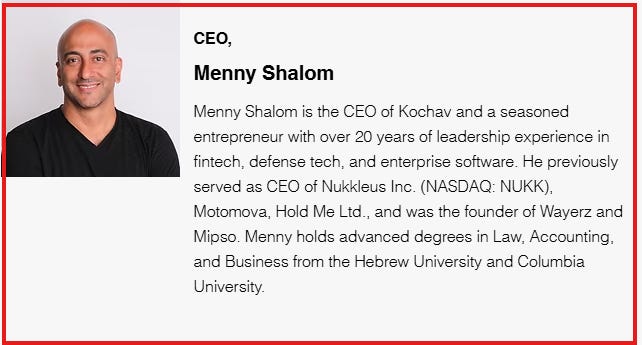
Public filings show Shalom simultaneously holding leadership roles across at least eight related entities, several of which have conducted transactions with one another.
Star 26 Capital — Self-Dealing: Controlled both sides of T3’s $69.4 million acquisition of Star 26, generating $72.3 million of goodwill from a target with negative working capital.
B. Rimon Agencies Ltd. — Circular Fee Arrangement: Management fees flowed between related entities chaired by Shalom.
Zero One Capital LLC — Private Value Extraction: Management fees were paid to a privately controlled entity with limited public disclosure.
SC II Acquisition Corp. — Consolidated Trust Assets: Approximately $172.5 million of SPAC trust cash appears on T3’s balance sheet under GAAP despite being unavailable to fund T3’s operations.
Kochav Defense Acquisition Corp. — Concurrent SPAC Leadership: Simultaneously sponsors and manages a separate $253 million defense-focused SPAC.
Hold Me Ltd. — Concurrent Executive Role: Serves as sole director, CEO, and CFO while simultaneously leading T3 and multiple affiliated entities.
Motomova Inc. — Repeatable Corporate Structure: Previously executed a similar shell-company, reverse-merger, and stock-funded acquisition strategy under Shalom’s leadership.
Only two of these companies (SC II and Kochav) are true blank-check SPACs, sitting on other people’s money while they hunt for something to buy, while the rest appear to be operating businesses, but dig deeper and several of them share the same origin story: take a dormant shell, give it a new name and a defense-adjacent story, then feed it acquisitions paid for mostly in stock instead of cash, and then after a massive dilution reverse split to keep Nasdaq compliance. This isn’t a structure, but a playbook in which Shalom is the only constant across every part of it, the company’s own 10-K states plainly: Menachem Shalom, our Chief Executive Officer, also serves as the Chief Executive Officer of Star 26, Motomova Inc., and Hold Me Ltd. These roles require Shalom to devote significant time and resources to the management and strategic direction of these other companies, which may reduce the time and attention he can dedicate to T3 while implying that his main focus is not improving T3’s business but planning a next acquisition target, while taking advantage of the financial markets.
Source: T3 Defense Inc. Form 10-K, filed April 9, 2026.
Source: Kochav Defense Acquisition Corp. Form S-1/Prospectus, filed with the SEC.
Source: T3 Defense Inc. Form 8-K, filed July 15, 2026 — SC II Acquisition Corp. LOI termination.
The $172.5 Million That Is Not Theirs
When reading T3’s balance sheet at first glance it looks like a company sitting on a real scale, with total assets north of $200 million at year-end 2025. The balance sheet appears substantially larger than the operating business because GAAP requires consolidation of SC II Acquisition Corp.’s trust account.
T3’s wholly owned subsidiary, Nukkleus Defense Technologies Inc., controls the sponsor entity behind SC II Acquisition Corp (the blank check SPAC that raised $172.5 million in its November 2025 IPO). Control of a sponsor is not ownership of the SPAC, and it is certainly not ownership of the SPAC’s trust account, however under consolidation rules, T3’s control of the sponsor is enough to require SC II’s financials (trust account included) to be folded directly into T3’s own consolidated balance sheet.
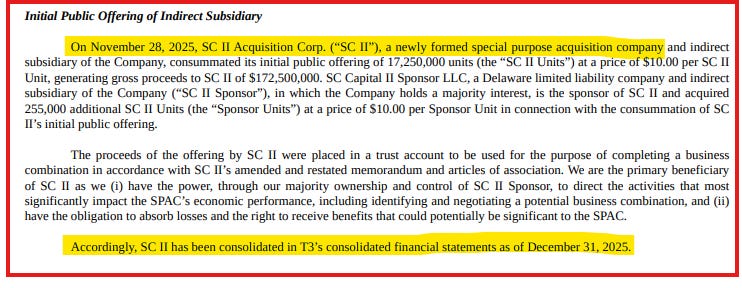
None of the $172.5 million can be used to fund T3’s operations, service T3’s debt, or address the negative working capital and going concern doubt disclosed in the very same filing. And yet it sits there, on T3’s own balance sheet, counted as an asset, because GAAP consolidation asks only whether T3 controls the entity, not whether T3 can spend its money.
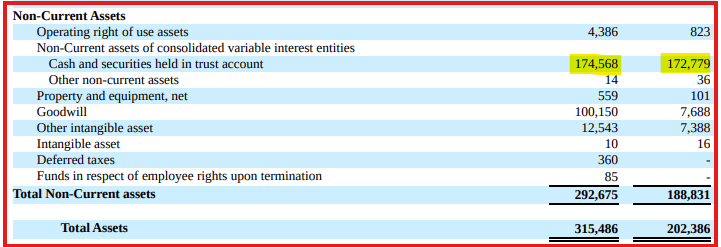
It requires only that a reader trust a summary total without reading three notes deep, which is exactly how most retail investors, and more than a few algorithmic screeners, actually read a balance sheet. Fugazi Research treats this as a standing caution applicable to every consolidated figure T3 reports, any total that touches SC II’s trust account should be assumed inflated relative to what is actually available to T3 common shareholders, until proven otherwise.
Source: T3 Defense Inc. Form 10-K, filed April 9, 2026.
Source: T3 Defense Inc. Form 10-Q, filed May 20, 2026.
The December 2024 NUKK Squeeze
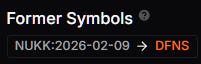
NUKK changed its ticker to DFNS on February 9, 2026, when Nukkleus Inc. formally became T3 Defense Inc. Under its former identity as NUKK, there was a Nukkleus stock story, and it is worth understanding because the playbook never really changed, it was the same repeating pattern on both companies.
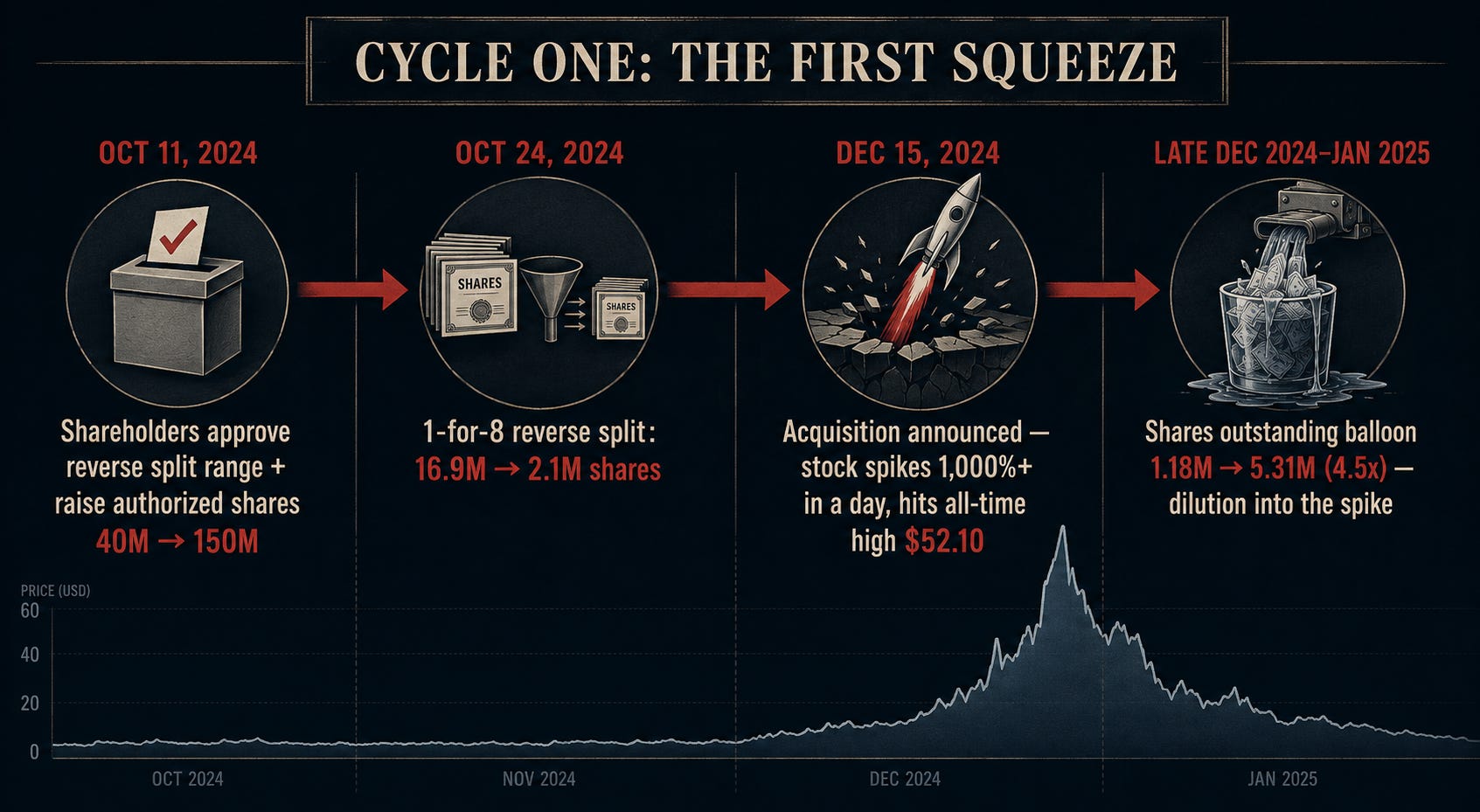
By mid October 2024, short interest in NUKK had reached approximately 70% of the float, turning any type of news into a short squeeze detonator. On December 15, 2024, Nukkleus announced it had acquired a 51% controlling stake in Star 26 Capital, its first announced move into the defense sector. The stock went from $1.39 to over $17 in a single trading day on December 16, marking a move of more than 1,000%, and kept climbing from there, closing above $40 by December 26. In the same window the squeeze was unfolding, shares outstanding expanded from approximately 1.18 million to 5.31 million, marking a 4.5x increase in a matter of weeks.
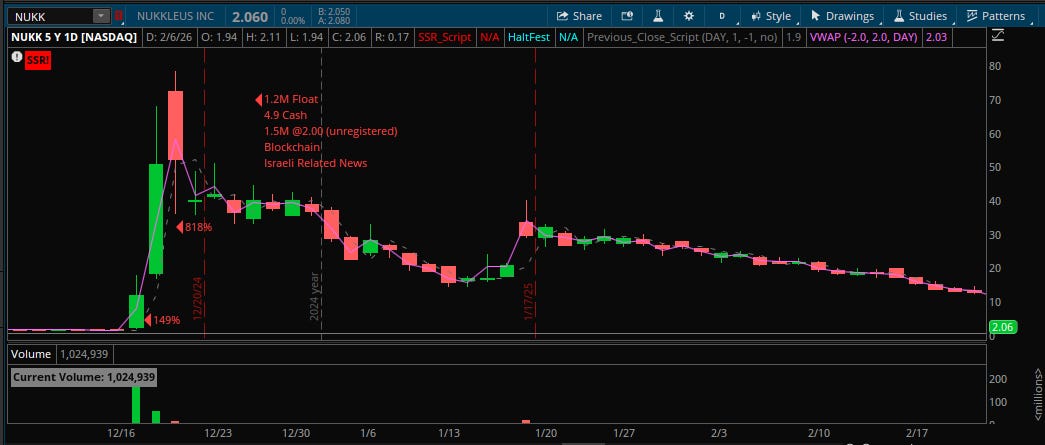
Above: NUKK 3500% short squeeze December 2024 riding crypto hype.
Eighteen months later, the company repeated a remarkably similar sequence following its July 2026 reverse split.
On July 16, 2026, the company announced a 125 to 1 reverse split, effective July 20. The split collapsed shares outstanding from approximately 139.8 million to roughly 1.12 million, in a stock that thin any volume moves the price violently, and buying pressure arrived: DFNS traded from sub $1 levels in the days immediately following the split to a high of $108 within a week. The outcome each time was the same, a stock price disconnected from fundamentals, moving on technical mechanics rather than operating results, in a capital structure that has consistently treated share count as a lever to be pulled rather than a fixed measure of ownership.
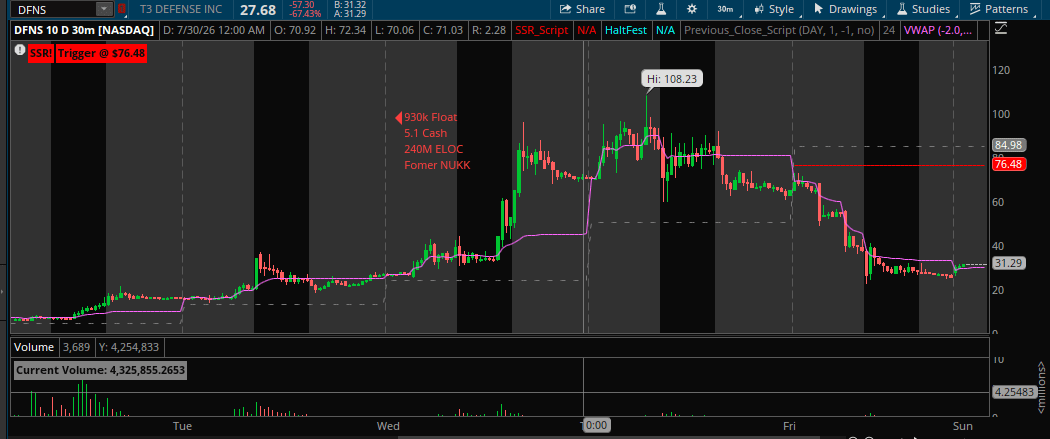
Above: DFNS short squeeze July 2026
The Fintech Corpse Wearing a Defense Helmet
T3 Defense is the latest name on a structure that has already been through Brilliant Acquisition Corp. and Nukkleus Inc. The company completed its business combination on December 22, 2023, began trading as NUKK, then changed its name to T3 Defense on February 9, 2026 and began trading under DFNS.

The company transitioned from a SPAC shell to a blockchain payments business before ultimately repositioning itself as a defense acquisition platform within roughly two years.
Rather than demonstrating an established defense contractor, the filings describe an acquisition vehicle funded primarily through equity issuance and goodwill creation.
The Project 35 Acquisition: Another Defense Asset, Another Paper Print
On July 6, 2026, T3 Defense acquired 60% of Project 35, an Israeli developer of counter-drone interceptors, paying with 21,059,871 shares of common stock, a $1.25 million note at 12% interest, and a commitment to invest another $2.5 million over the next year. The seller is disclosed only as X S.A. Security and Defense Ltd., no beneficial ownership, no stated relationship to the company or its officers, and unlike the Star 26 transaction, no acknowledgment one way or the other of whether this is a related party.
The company issued 21.1 million shares to acquire a 60% interest in Project 35 despite investors having no access to the target’s financial statements for up to 71 days.

The deal closed July 6, the shares were issued, and the interceptor narrative was live in the market for over two months before anyone outside the transaction could check a single audited number against it, a window that happens to open ten days before T3’s 125 to 1 reverse split and lands directly ahead of the low-float squeeze that took DFNS from sub $1 to a +$100 intraday high.
While the timing may ultimately prove coincidental, the sequence mirrors the pattern documented elsewhere in this report.
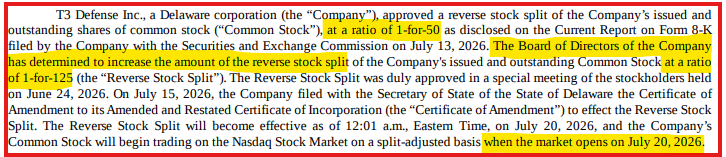
Shareholders approved this reverse split on June 24, 2026. Three days later, on July 16, the board reached back into that same stale authorization and pulled out 125 to 1 reverse split instead, 2.5x times more aggressive, executed with a signature and a press release, no new vote required, no shareholders consulted twice.
The acquisition blatantly added another business, another note, another investment commitment, and another 21 million shares to a company that was already disclosing Nasdaq bid-price issues and relying on equity-linked financing, the public shareholders own a rollup machine disguised as a self-funding defense business or a that converts defense vocabulary into common share supply.
The Playbook: Twice Executed
Cycle One (October to December 2024). On October 11, 2024, Nukkleus shareholders approved a reverse split at a discretionary range and, at the same meeting, approved raising authorized shares from 40 million to 150 million. The board executed a 8 to 1 split on October 24, 2024, cutting shares outstanding from 16.9 million to roughly 2.1 million to cure a Nasdaq bid-price deficiency. Seven weeks later, on December 15, 2024, Nukkleus announced its first move into defense, the Star 26 stake acquisition already documented in this report as the trigger for a squeeze that took the stock from $1.39 to an all-time high close of $52.10. Within weeks of that squeeze, shares outstanding expanded from approximately 1.18 million to 5.31 million, a 4.5x increase, diluting directly into the spike the reverse split had helped set up.
Cycle Two (June to July 2026). On June 24, 2026, shareholders approved a reverse split at a range once again, the same discretionary mechanism, the same blank check for the board to fill in later. On July 6, 2026, the company issued 21.06 million new shares to acquire Project 35, a paper funded deal with financials deferred 71 days, already examined in this report.
One week later, on July 13, the board disclosed a 50 to 1 reverse split; three days after that, on July 16, it upsized the ratio to 125 to 1 without a new shareholder vote. The split took effect July 20, collapsing the float from 139 million to roughly 1.12 million shares, and within days the stock ran from sub $1 to a $108 intraday high.
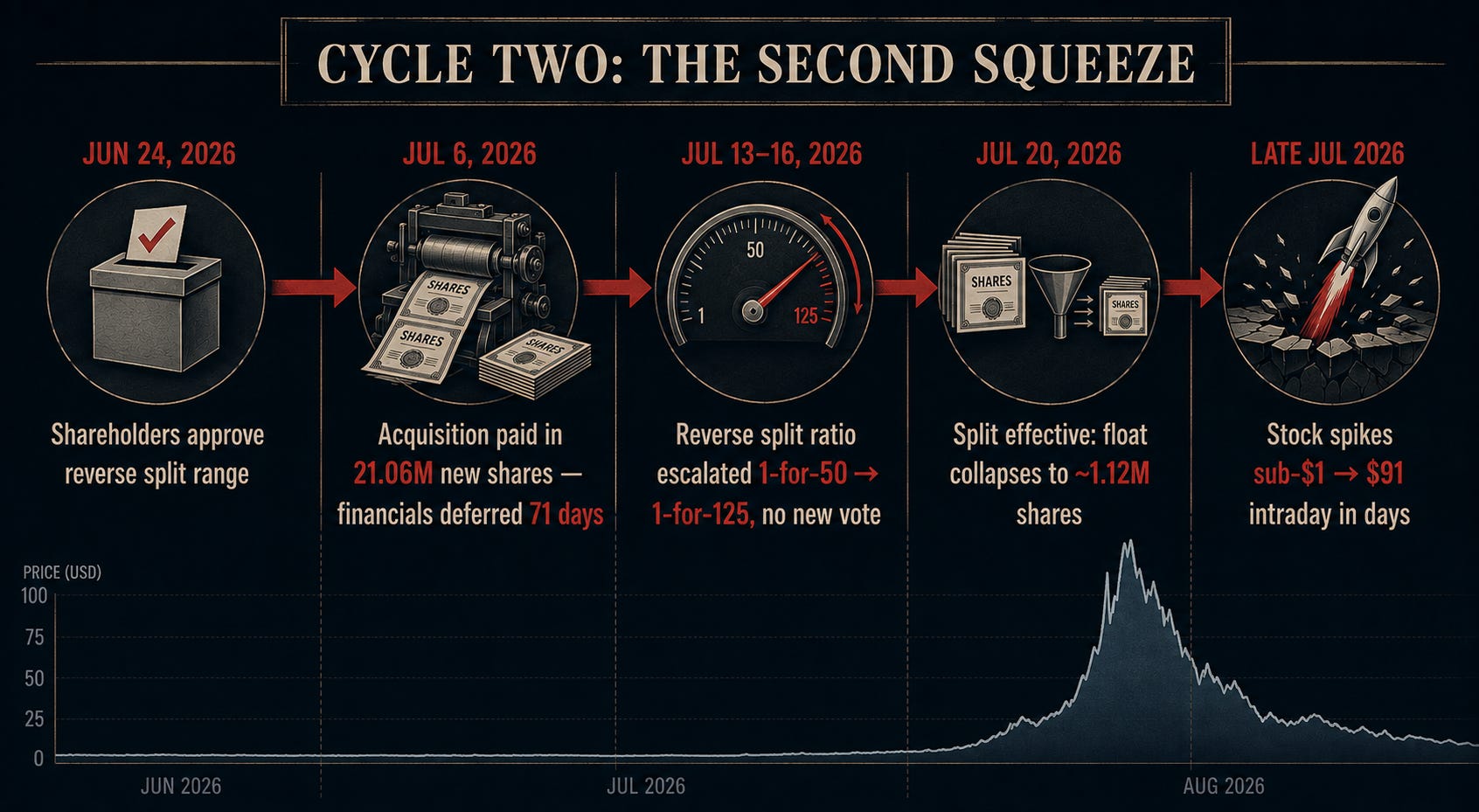
Line the two cycles up and the sequence is nearly identical: a discretionary range shareholder vote, a paper funded acquisition announcement timed close to the split, a float contraction, a squeeze, and dilution absorbed into the resulting volatility. The only real difference is where the dilution sits in the sequence; in 2024 the company diluted after the squeeze, selling into strength it didn’t create; and in 2026 it diluted before the split, paying for an acquisition with stock and then tightening the float around the shares it had just issued, a different tactic run by an operator who has since learned to front load the paper instead of trailing it.
When the Capital Structure Becomes the Business.
Every issue identified in this report—related-party transactions, repeated reverse splits, stock-funded acquisitions, and persistent dilution—ultimately points to the same problem: T3’s operating business does not generate enough cash to sustain itself.
On March 31, 2026, the company reported approximately $69 million of negative working capital and acknowledged substantial doubt about its ability to continue as a going concern. Management’s primary solution is continued access to equity-linked financing through its Equity Line of Credit (ELOC) with Esousa Holdings, while acquisitions continue to be funded largely with newly issued shares rather than internally generated cash.
The result is a self-reinforcing capital structure. Acquisitions support the narrative, the narrative supports the share price, and the share price enables additional equity financing and stock-funded acquisitions. Durable operating cash flow plays only a limited role in that cycle. Should investor appetite for the story weaken, the company’s ability to finance future operations and acquisitions could weaken alongside it.
Conclusion
DFNS presents itself as an emerging defense platform. Its SEC filings describe something materially different: persistent operating losses, substantial dilution, repeated reliance on equity financing, related-party transactions, negative working capital, and a management team simultaneously overseeing numerous affiliated entities.
Under both the NUKK and DFNS names, the company followed a strikingly similar sequence of reverse splits, acquisition announcements, speculative price appreciation, and dramatic growth in shares outstanding. Whether viewed individually or collectively, those events raise serious questions about whether shareholder value is being created through operating performance or through repeated capital markets activity, for this reason, Fugazi Research believes DFNS stock has little to no fundamental value and is uninvestable at any price above zero.
Disclaimer
The research, commentary, reports, and other materials published by Fugazi Research LLC (“Fugazi Research,” “we,” “us,” or “our,”) are provided solely for informational and educational purposes. Fugazi Research is an independent research publisher and is not registered as an investment adviser, broker-dealer, or commodity trading advisor with the U.S. Securities and Exchange Commission or any other regulatory authority.All content published by Fugazi Research represents our opinions as of the date of publication and is based on publicly available information, independent research, interviews, and analytical judgment. Our opinions are inherently subjective, may be incomplete, and are subject to change at any time without notice. We do not undertake any obligation to update or revise our content to reflect subsequent events, market developments, or new information.
Nothing published by Fugazi Research constitutes investment advice, financial advice, legal advice, tax advice, or a recommendation to buy, sell, or hold any security or financial instrument. The information should not be construed as tailored to the investment objectives, financial situation, or particular needs of any individual or entity. Readers should conduct their own independent research and consult their own financial, legal, and tax advisors before making any investment decision.
Fugazi Research, its affiliates, principals, members, employees, consultants, or clients may have positions-long, short, or otherwise-in the securities discussed, and such positions may change at any time for any reason, including risk management, market conditions, or liquidity considerations. We may trade in securities covered by our research before, during, or after publication, and we may reduce, close, or reverse positions at any time without notice. Readers should assume that Fugazi Research has a financial interest in the securities discussed.
Our research may include forward-looking statements, estimates, projections, or opinions that involve known and unknown risks, uncertainties, and assumptions. Actual outcomes may differ materially from those expressed or implied. Past performance is not indicative of future results. All investments involve risk, including the potential loss of principal.
While we believe the information we present is accurate and reliable, it is provided “as is” and “as available,” without any representation or warranty, express or implied, as to accuracy, completeness, timeliness, or fitness for any particular purpose. Fugazi Research disclaims any liability for errors, omissions, or losses arising from the use of our content.
By accessing or using Fugazi Research’s materials, you acknowledge and agree that Fugazi Research shall not be liable for any direct, indirect, incidental, consequential, or other losses arising from reliance on our research or opinions. Use of our content is entirely at your own risk.
All content is the intellectual property of Fugazi Research and may not be reproduced, distributed, or shared without prior written consent.