

Executive Summary
Interestingly, this report was prompted by an initial tip from a Fugazi Research reader writing under the name “Value Checker,” who flagged Aeva’s decade-long pattern of partnership and customer announcements. Fugazi Research treated this as a starting lead, as every claim in this report was independently verified against primary SEC filings, and the financial analysis, valuation work, and structural findings presented here are the product of Fugazi’s own review of Aeva’s 10-K, 10-Q, and 8-K filings.
Aeva Technologies is valued as though it has already crossed the bridge from technology demo to scaled commercial platform; this is not the case. As of August 19, 2026, Aeva’s market capitalization is approximately $1.3 billion against fiscal 2025 revenue of $18.1 million (a price to sales ratio of approximately 72x). By comparison, Oracle trades roughly 6x sales and Coreweave at 7-10x, despite both companies generating actual, contracted hyperscaler and AI-infrastructure revenue at scale. An insane pricing considering Aeva’s $21 million of trailing revenue and a joint development agreement whose first deployment isn’t targeted until the second half of 2027. The filings describe an early stage company that has “primarily sold or otherwise provided prototypes and non-recurring engineering services” and has made only “immaterial commercial deliveries.”
Aeva Technologies entered the market via despac at a price around $18-$19 during the 2021 SPAC frenzy. The average 3-year buy-and-hold return of despacs during this period was -73%. Aeva Technologies in particular bled shareholders out through constant dilution where by March 2024 the stock was down to just .80 (split adjusted) and in need of a reverse split to probably meet Nasdaq minimum exchange requirements. Historically, it is a revelation of toxic dilution and bad management when a stock goes on a downward spiral for 4 straight years and resorting to a reverse split to get back to life.
The company’s reported history is a monument to capital consumption. Aeva disclosed net losses of $145.4 million in 2025, $152.3 million in 2024, and $149.3 million in 2023, and states that broad-based commercial deliveries are not expected to occur in 2026 and may not occur at all. Investors are being asked to pay an extraordinary sales multiple for a company still waiting for the commercial inflection it was originally supposed to reach years ago.
In December 2024, Aeva Technologies, Inc., co-founders Soroush Salehian Dardashti and Mina Rezk, and SPAC sponsor Ahmed Fattouh, among other defendants, reached a $14 million settlement in the Delaware Court of Chancery to resolve stockholder litigation arising from the 2021 SPAC merger. The suit alleged that InterPrivate Acquisition Corp. provided false or misleading proxy materials in connection with the merger and impaired stockholders’ redemption and voting rights. The settlement, which does not constitute an admission of liability by any defendant, provided class members nominal damages of $0.10 per share plus additional recovery tied to shares sold below $10.07 between March 2021 and March 2024
Aeva has attached its technology to autonomous vehicles, industrial automation, defense, NVIDIA, Daimler/Torc, SICK, Railergy, Audi, NASA, and now AI data center optical connectivity. The pattern is that the announcements keep arriving, the markets keep expanding, and the financial statements keep showing a company that has not commercialized products at meaningful scale. The latest pivot is optical connectivity for AI data centers. On August 5, 2026, Aeva announced the launch of this business alongside a joint development agreement targeting initial hyperscaler deployment in the second half of 2027 and production ramp in 2028, that´s more than a year and a half away, with no committed volume.
Alarmingly, Aeva does not fund itself through operations, it keeps refinancing through continuous dilution. A $125 million standby facility with Sylebra, open through November 8, 2026 and a follow-on offering closed on June 5, 2026 (5,168,539 shares and underwriters’ options exercised in full), raised a total of $115.0 million in capital (Approximately 6x Aeva’s FY 2025 revenue). Two financing instruments with one purpose: extend the lifeline on a business that has never covered its own losses with its own revenue.
The mechanism is simple: premium valuation, demo stage economics, serial partnership announcements, and dilution funded survival. Fugazi Research considers Aeva’s shares speculative, and uninvestable at any price above zero.
Fugazi Research Analysis
Aeva trades at approximately 72x sales, or 47x its own forward guidance at best. The stock is priced like a scaled software compounder while the company files like a pre-commercial or demo-stage lidar developer.
Aeva describes itself, in its own risk factors, as an early-stage company that has primarily sold prototypes and non-recurring engineering services, with immaterial commercial deliveries to date and no assurance that broad-based commercial deliveries occur in 2026, or ever.
Aeva has built its entire commercial thesis on FMCW lidar (a more expensive, higher-power approach) while the two most consequential players in the industry have moved the opposite direction. Tesla has built its autonomy program entirely on camera-based computer vision, rejecting lidar altogether. Mobileye, a leading physical-AI and ADAS developer, ended its own internal lidar development program in 2024, citing advances in computer vision and the falling cost of competing lidar approaches. Aeva is not simply competing for design wins; it is betting the company on a technical architecture that two of the industry’s most influential players have each independently declined to build around.
Aeva, co-founders Salehian and Rezk, and SPAC sponsor Fattouh settled Delaware stockholder litigation for $14 million, resolving claims of misleading merger proxy materials, no admission of liability, but the same disclosures that first revealed Aeva’s internal control weaknesses.
Projected Aeva metrics are defined by a forward-looking cumulative billings estimate, built on projected pricing and estimated rates, not contracted revenue. No customer is contractually committed until testing, validation, integration, and market-readiness determinations are all complete.
Three customers accounted for 64% of 2025 revenue, two customers accounted for 72% of 2024 revenue. For the first half of 2026, two customers alone accounted for 59% of revenue. The company simply cannot afford to lose any of its revenue streams.
Aeva has spent nearly a decade attaching its name to NVIDIA, Daimler/Torc, SICK, Railergy, NASA, Audi. Each name generates a stock reaction, while none has yet generated the scaled, recurring revenue the current valuation requires.
Aeva closed an offering on June 5, 2026 for 5,168,539 shares at $22.25 (underwriters exercising their option in full) raising $115 Million. It separately maintains a $125 million standby facility with Sylebra through November 8, 2026, and carries $100 Million of 4.375% convertible senior notes due 2032. This is set against an accumulated deficit of $871.9 million and a first half 2026 net loss of $114.6 million.
Source: Aeva Technologies, Inc., Form 8-K, filed June 4, 2026.
Source: Aeva Technologies, Inc., Form 10-K for the year ended December 31, 2025, filed March 20, 2026.
Source: Notice of Proposed Settlement, In re InterPrivate Acquisition Corp. Stockholder Litigation, Consol. C.A. No. 2024-0221-LWW (Del. Ch.).
Financial Summary
Aeva incurred net losses of $145.4 million in 2025, $152.3 million in 2024, and $149.3 million in 2023, approximately $447.0 million in cumulative losses over three fiscal years.
First-half 2026 net loss was $114.6 million against revenue of $12.4 million, meaning Aeva lost approximately $9.24 for every $1 of revenue generated in the first six months of 2026.
First half 2026 revenue was $12.4 million, which annualized, amounts to roughly $25 million, still far short of the $36 million the company itself has guided to for the full year.
Customer revenue concentration was 64% (three customers) in fiscal 2025, 72% (two customers) in fiscal 2024, and 59% (two customers) for the six months ended June 30, 2026.
Total stockholders’ equity was $27.5 million as of June 30, 2026, against a market capitalization of approximately $1.32 billion, investors are paying roughly 48x the company’s entire book value for a business with $871.9 million in accumulated deficit sitting behind that thin equity cushion.
Aeva closed a public offering on June 5, 2026 of 5,168,539 shares at $22.25 per share, an offering price of approximately $115 million.
Aeva maintains a $125 million standby equity purchase agreement with Sylebra, available through November 8, 2026, and carries $100.0 million of 4.375% convertible senior notes due 2032.
Total available liquidity was approximately $302 million as of June 30, 2026, against an accumulated deficit of $871.9 million and a first-half 2026 net loss of $114.6 million.
Shares outstanding were 69,705,758 as of July 30, 2026, up from 62,947,689 as of March 10, 2026, an increase of roughly 10.7% in under five months.
At $18.87/share (August 20, 2026), market capitalization is approximately $1.32 billion, implying 72x trailing FY2025 revenue, 53x annualized H1 2026 run-rate, or 39x the company’s own FY2026 guidance midpoint.
Source: Aeva Technologies, Inc., Form 10-K for the year ended December 31, 2025, filed March 20, 2026.
Source: Aeva Technologies, Inc., Form 8-K, filed June 4, 2026.
Valuation by Adjacency: Autonomous Cars, Defense, NVIDIA, Data Centers, Still No Scale
Aeva’s valuation problem is not subtle, the stock is not being valued on what the company currently sells, instead it is being valued on what the company might eventually become if every major market it invokes becomes real, adopts Aeva’s technology, moves through validation, enters volume production, avoids delays, avoids customer cancellation, and produces margin. Currently that is not a business model, but a chain of good wishes which guarantee that everything will go according to plan, without any contingencies.
The research captures the pattern clearly. Aeva has spent years attaching its technology to market investors wanting to believe in: self-driving vehicles, industrial automation, robotics, defense, NVIDIA’s automotive ecosystem, and now AI data-center optical connectivity. The research does not claim these references are fabricated, instead it argues that the commercial result has been consistently disappointing relative to the stock-market reaction and the scale implied by the company’s valuation.
The company’s filings validate that skepticism, Aeva discloses that it has not commercialized its products or services in a material amount. Customers do not commit to volume until extensive testing and validation are complete, and that definitive volume production orders arrive only after customers finish integration and make their own market-demand and product-readiness determinations.
Aeva spent $85.4 million on research and development in fiscal 2025 (nearly five times the company’s entire $18.1 million in revenue for the year). This is a company whose core technology still costs more to develop than the business generates in total sales, R&D spending did fall from $102.7 million in 2024, and Aeva frames this as evidence of a maturing product line moving past its most capital-intensive phase. Even so, at $85 million against $18 million of revenue, Aeva’s R&D bill alone exceeds total revenue by more than four and a half times.
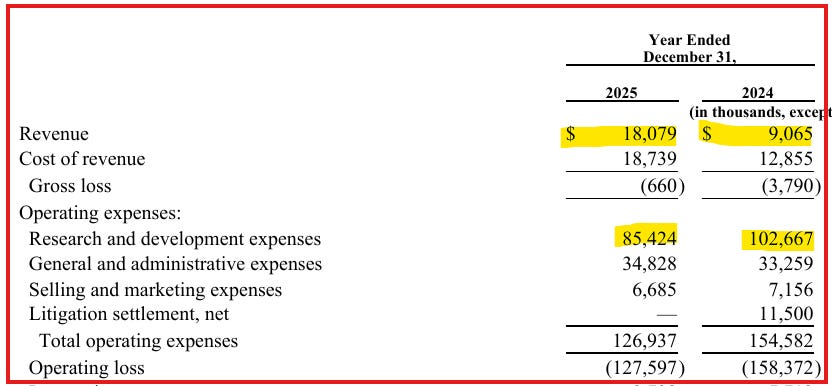
Source: Aeva Technologies, Inc., Form 10-K for the year ended December 31, 2025, filed March 20, 2026.
A company trading at 47x–86x sales, depending on the revenue base used, should have visible recurring revenue, expanding margins, and a commercial engine that scales with volume. Aeva however has only development programs, prototypes, non-recurring engineering services, customer concentration, and financing facilities. The multiple is not attached to current revenue, but to a chain of narrative and continuous PR’s that the company uses to keep its value up to finance itself by selling equity.
The phrase for this mechanism is valuation by adjacency, Aeva does not need to show scaled automotive lidar sales if the market is willing to value a defense adjacency. It does not need to show scaled defense revenue if the market is willing to value an NVIDIA adjacency. It does not need to show NVIDIA-derived revenue if the market is willing to value a hyperscaler data-center adjacency. The stock market pays for the noun; the filing discloses the conditions.
Source: Aeva Technologies, Inc., Form 10-K for the year ended December 31, 2025, filed March 20, 2026.
Selling Into Strength
Aeva’s stock rallied sharply following the August 5, 2026 optical-connectivity announcement, climbing from roughly $19.61 to a peak above $25 within the following week. Insiders did not wait to see whether the rally would hold, but took full advantage of price strength to sell different tranches of shares amounting to approximately $12 million, roughly the same amount of revenue for the first half of 2026.
On August 10 and 11, 2026, five and six trading days after the announcement, at the top of the post-earnings spike, CEO Soroush Salehian Dardashti and CTO Mina Rezk together sold 405,099 shares at prices ranging from $23.81 to $25.69 for combined proceeds of approximately $9.79 million. One week later, on August 18, 2026, departing CFO Saurabh Sinha, who had disclosed his resignation effective September 5, 2026, less than three weeks earlier sold 70,000 shares for approximately $1.48 million, at a lower price of $21.21, as the rally had already started to fade. After his recent selling, he still has 585,000 shares to sell after he resigns.
The entire executive team, in sequence, began selling into the same announcement-driven spike this report identifies as the mechanism behind Aeva’s valuation. In aggregate, Aeva insiders sold approximately $11.9 million in stock over the trailing three months, entirely through prearranged trading plans, with no open-market insider purchases in the same window.
Rule 10b5-1 plans are structured to remove the appearance of opportunistic timing, trades are scheduled in advance, without knowledge of the specific date a plan will execute. But a plan’s schedule does not choose the news; management chooses when to file the 8-K. The August 5 hyperscaler announcement, and the price spike that followed it, arrived directly ahead of the largest cluster of insider selling in recent history. Whether by design or coincidence, the executives closest to Aeva’s operations converted paper gains into cash as the market pushed higher leaving the insiders feeling fomo as this was a great opportunity to sell. Just 2 years ago the stock was depressed all the way to .80 with no hope in sight. Then, all of the sudden, after a reverse split the stock grabbed onto the hype and has offered the insiders to get rich.
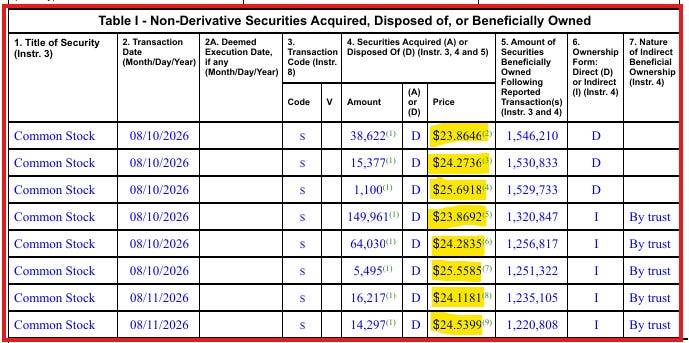
Above: CEO’s disposal of shares at the top.
The Announcement Treadmill
Aeva has announced relationships or market associations involving Audi, ZF, Denso, Plus, NVIDIA, Daimler/Torc, SICK, Railergy, Forterra, NASA, and others across nearly a decade. The argument is straightforward: a long sequence of announcements has not yet produced the large-scale revenue, profit, or operating cash generation required to justify the current valuation.
This is the most important part, because Aeva’s equity story relies almost completely on hype driven announcements. A big customer name can move the stock before the revenue exists, a sector label can re-rate the stock before the product is validated, and a development milestone can be framed like a commercial contract even when the filing language remains without any value or substance.
The company’s own risk-factor disclosure fits the same pattern and describes it clearly, as Aeva says its development cycles can be long, including up to seven or more years in automotive, and that customers may cancel or postpone implementation. It also says there is no assurance that customers included in Order Book estimates will complete testing, enter definitive production agreements, or produce forecasted billings.

Source: Aeva Technologies, Inc., Form 10-K for the year ended December 31, 2025, filed March 20, 2026.
The Hyperscaler Costume
The August 2026 optical-connectivity announcement is the latest example of the announcement related to pumps. On August 5, 2026, Aeva launched an Optical Connectivity business and signed a joint development agreement for a hyperscaler Near-Packaged Optics deployment (initial deployment targeted for the second half of 2027, production ramp targeted for 2028). Not a customer. Not a contract. A development agreement with a production ramp eighteen months away and no disclosed committed volume.
The stock rallied on the news, and it jumped from around $19 to over $24 on the announcement alone. Oppenheimer (one of three joint book-running managers) then floated the possibility of billions of dollars in future orders. A bank that helped price Aeva’s stock weeks earlier was now pricing its total addressable market in the billions, off a joint development agreement with a 2028 production target.
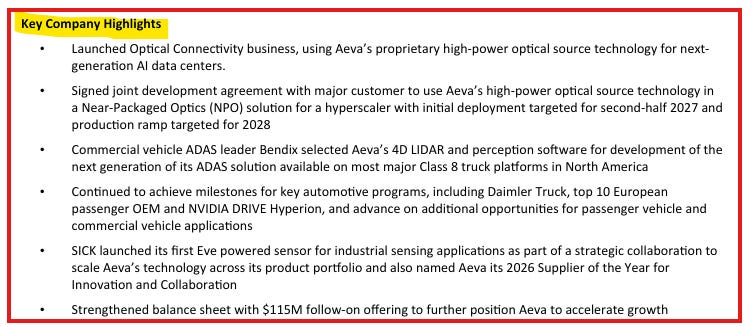
Above: Key company highlights with no disclosed numbers, revenue, or volume. Just forward looking statements, and good wishes.
Source: Aeva Technologies, Inc., Form 8-K, filed August 5, 2026.
Source: Aeva Technologies, Inc., Form 8-K, filed June 4, 2026.
The Advantage That Isn’t
Aeva’s entire commercial pitch rests on a single technical bet: that Frequency Modulated Continuous Wave (FMCW) lidar is a meaningfully better architecture than the Time-of-Flight (ToF) approach used by most of the industry. The company has spent nearly a decade and hundreds of millions of dollars building around that bet. However the two companies with the most influence over how autonomous vehicles have gone a very different way. As Tesla does not use lidar at all, the company has built its entire autonomy program on camera-based computer vision, explicitly rejecting lidar as a necessary sensing modality for full self driving.
Also Mobileye, a leading developer of the physical AI systems that power ADAS and autonomous driving stacks across the industry, announced in September 2024 that it was ending its internal development of next-generation FMCW lidar specifically, the same architecture Aeva has built its business around, and winding down the R&D unit responsible for it, affecting approximately 100 employees.
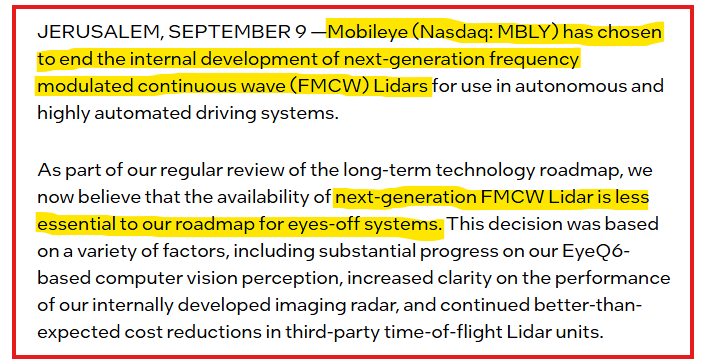
Aeva is not simply late to commercialize a technology the market wants, on top of it, has committed a decade of capital to a specific architecture that two of the industry’s most consequential players have independently declined to build around, one by altogether skipping lidar entirely, the other by walking away from developing it at all.
The Order Book Is Not an Order
Aeva’s filings define “Order Book” as a forward-looking cumulative billing estimate over the expected lifetime of production programs, based on projected pricing terms and good-faith estimates of take rates. It is not a binding backlog in the sense of the public-market investors interpretation of what they want to see in the word “Order.”
The company’s own disclosure takes the air out of the metric, as customers do not make contractual commitments to use Aeva’s lidar sensors and software until testing and validation are complete, integration plans are finalized, market demand exists, and their products are ready for market. Aeva then states there is no assurance that any customer included in Order Book estimates will complete validation, enter a definitive volume agreement, or generate the billings forecasted.

That is the sort of filing language that should sit directly underneath any investor presentation slide mentioning future production opportunities. There is a gap between “Order Book” as a “marketing” phrase and “Order Book” as a disclosed risk factor and that is exactly where the valuation disconnect lives.
Source: Aeva Technologies, Inc., Form 10-K for the year ended December 31, 2025, filed March 20, 2026.
Equity-Funded Survival, Not Operating Leverage
Aeva’s financing structure tells the story more plainly than the product deck. On June 5, 2026, the company completed an underwritten public offering of 5,168,539 shares at $22.25 per share, including the full exercise of the underwriters’ 674,157-share option, for an aggregate offering price of approximately $115.0 million, yielding net proceeds of $108.8 million after $5.8 million in underwriting discounts and $0.4 million in offering costs.
That financing followed years of losses and sits alongside the Sylebra facility, which permits Aeva to sell up to $125 million of convertible redeemable non-voting preferred stock, subject to conditions, through November 8, 2026, and $100.0 million of 4.375% convertible senior notes due 2032 held by Apollo Global Securities. Total available liquidity stood at $302.9 million as of June 30, 2026 against an accumulated deficit of $871.9 million and a first-half 2026 net loss of $114.6 million.
It’s not an accusation, but straight forward math. Aeva consumes cash before scaled commercialization. It raises equity and equity-linked capital to extend the runway. It announces large future markets to support the equity price at which that capital can be raised. The common shareholder is not merely participating in upside; the common shareholder is being used as the funding mechanism and good, old-fashioned exit liquidity.
The research flags additional dilution from convertibles, warrants, preferred stock, and stock-based compensation. The specific share-count bridge in that research (54.1M → 61.5M → 68.6M) is superseded by confirmed primary-source figures: 62,947,689 shares outstanding as of March 10, 2026, rising to 69,705,758 as of July 30, 2026 — a roughly 10.7% increase in under five months. Warrant liabilities stood at $73.961 million as of June 30, 2026.
The key point is fully supported: the company is not funding itself through operating cash flow. It is funding itself through the capital markets.
Source: Aeva Technologies, Inc., Form 8-K, filed June 4, 2026.
Source: Aeva Technologies, Inc., Form 10-K for the year ended December 31, 2025, filed March 20, 2026.
Source: Aeva Technologies, Inc., Form 10-Q for the quarterly period ended June 30, 2026, filed August 6, 2026.
The LG Innotek Circularity Lead
When looking into AEVA, the research raises a potentially important related commercial-structure issue around LG Innotek (LGIT). It describes an investment, joint-development agreement, and manufacturing relationship in which LGIT invested in Aeva, received equity at a discount, entered a development relationship, and became a manufacturing partner. The research frames this as a conflicted cycle: LGIT may benefit from manufacturing or development economics while Aeva remains the loss-making party trying to commercialize the product.
Aeva’s Form 10-K confirms the existence of a strategic collaboration with LG Innotek, entered in May 2025, and warns that such initiatives may prove more expensive than anticipated and may not generate revenue sufficient to offset higher expenses or achieve profitability. Separately, Aeva’s own Q4/FY2025 earnings materials describe the LG Innotek collaboration as including a commitment of up to $50 million for joint product development, which corroborates the general scale of the relationship cited in the reader submission.
This angle should not be overstated until the investment agreement, private placement terms, and joint development agreement are fully reviewed. The safe Fugazi formulation is: the LG relationship should be treated as a financing, development, and supply-chain structure, not merely as validation from a strategic partner. If LGIT’s economics include equity upside, development payments, and manufacturing revenue while Aeva continues to absorb losses, the structure becomes a shareholder question, not just a partnership headline.
Source: Aeva Technologies, Inc., Form 10-K for the year ended December 31, 2025, filed March 20, 2026.
Conclusion
The short thesis is not about Aeva being flagged because lidar is useless, the FMCW technology cannot work, or the fact that management is alleged to be dishonest. The thesis is much simpler: the valuation is disconnected from the business the company actually reports.
Aeva files as an early-stage company with a history of losses, immaterial commercial deliveries, prototypes, non-recurring engineering services, long customer validation cycles, no assured volume commitments, and material customers. The stock trades as though those risks have already been solved when they simply have not.
The research gives the proper narrative context: Aeva has spent years producing announcements around attractive markets and recognizable counterparties. Those announcements may be real, but real announcements are not the same as scaled revenue, profits, or cash generation. The business model does not justify a valuation between 47x and 86x sales, depending on which revenue base is used.
The August 2026 optical-connectivity announcement reveals the hyped up nature of the stock when it ran from $15 to almost $28 a share on unwarranted speculation. Aeva has moved from autonomous vehicles into industrial, defense, NVIDIA-related autonomy, and now AI data-center optics- a market where the company’s own timeline places initial deployment eighteen months out and production ramp-up in 2028. The company keeps finding markets that investors are willing to capitalize before it has proven it can commercially dominate the last one. It has managed to do all of this after their stock price ran into the ground in its first 3 years on the market. All of the sudden, as it gained momentum after a reverse split and for no real reason, the stock price has trended higher and higher benefiting insiders with the opportunity to get super rich.
This is equity-funded commercialization drift masquerading as valuation by adjacency. In reality this is just another 2021 toxic, overhyped despac that belongs with the other 73% of despacs in the despac gutter trading under $5 with constant incoming dilution to depress the stock price even further. The market reacts for Aeva’s constant, ever-flowing pump-style press releases, but the filings show something different. These filings show the same current business: small revenue, large losses, conditional customer commitments, and dependence on capital-market access. Common shareholders are not buying operating leverage; they are funding the next chapter of a story that has already consumed $447 million in losses over three years without producing scaled commercialization.
Fugazi Research considers Aeva’s shares speculative and uninvestable at any price above zero.
Disclaimer
The research, commentary, reports, and other materials published by Fugazi Research LLC (“Fugazi Research,” “we,” “us,” or “our,”) are provided solely for informational and educational purposes. Fugazi Research is an independent research publisher and is not registered as an investment adviser, broker-dealer, or commodity trading advisor with the U.S. Securities and Exchange Commission or any other regulatory authority.All content published by Fugazi Research represents our opinions as of the date of publication and is based on publicly available information, independent research, interviews, and analytical judgment. Our opinions are inherently subjective, may be incomplete, and are subject to change at any time without notice. We do not undertake any obligation to update or revise our content to reflect subsequent events, market developments, or new information.
Nothing published by Fugazi Research constitutes investment advice, financial advice, legal advice, tax advice, or a recommendation to buy, sell, or hold any security or financial instrument. The information should not be construed as tailored to the investment objectives, financial situation, or particular needs of any individual or entity. Readers should conduct their own independent research and consult their own financial, legal, and tax advisors before making any investment decision.
Fugazi Research, its affiliates, principals, members, employees, consultants, or clients may have positions-long, short, or otherwise-in the securities discussed, and such positions may change at any time for any reason, including risk management, market conditions, or liquidity considerations. We may trade in securities covered by our research before, during, or after publication, and we may reduce, close, or reverse positions at any time without notice. Readers should assume that Fugazi Research has a financial interest in the securities discussed.
Our research may include forward-looking statements, estimates, projections, or opinions that involve known and unknown risks, uncertainties, and assumptions. Actual outcomes may differ materially from those expressed or implied. Past performance is not indicative of future results. All investments involve risk, including the potential loss of principal.
While we believe the information we present is accurate and reliable, it is provided “as is” and “as available,” without any representation or warranty, express or implied, as to accuracy, completeness, timeliness, or fitness for any particular purpose. Fugazi Research disclaims any liability for errors, omissions, or losses arising from the use of our content.
By accessing or using Fugazi Research’s materials, you acknowledge and agree that Fugazi Research shall not be liable for any direct, indirect, incidental, consequential, or other losses arising from reliance on our research or opinions. Use of our content is entirely at your own risk.
All content is the intellectual property of Fugazi Research and may not be reproduced, distributed, or shared without prior written consent.